
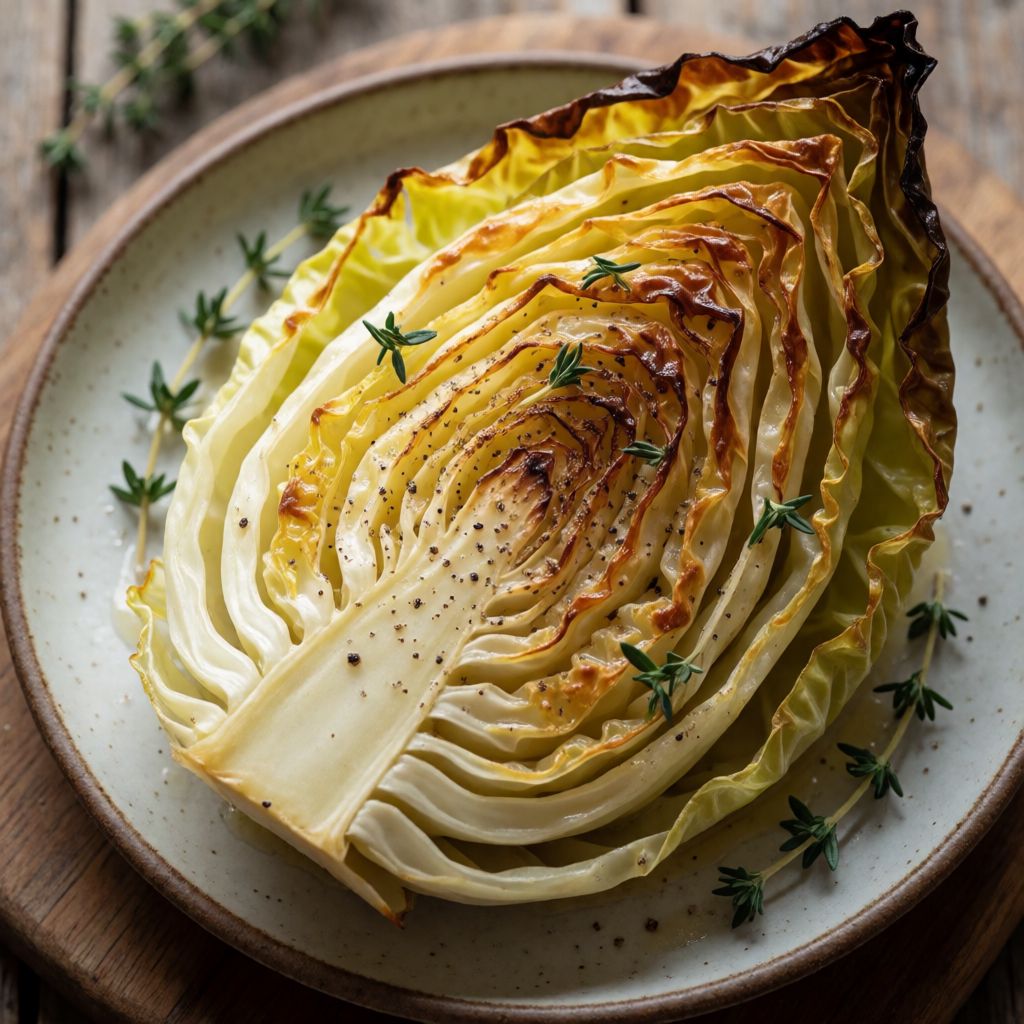
 AI photo
Roasted Pointed Cabbage
A simple roasted pointed cabbage, finished with Parmesan, thyme and butter.
Labels are worked out automatically from the ingredients and can be wrong. Check the packaging if it matters to you.
Ingredients
- 1 pcs Pointed cabbage cut into quarters
- 25 g Parmesan freshly grated
- 2 tbsp Thyme fresh, finely chopped
- 40 g Butter melted
- Salt flaky
- Black pepper freshly ground
- 1 tsp Butter for the dish


Steps
Place the cabbage quarters in a heatproof dish. Brush with the melted butter and sprinkle over the Parmesan, thyme, salt and pepper.
Roast the cabbage in a fan oven preheated to 175°C for about 15-20 minutes.
18 min
Pointed cabbage — the sweetheart cabbage, the one with the point, not the round ball you boil to death for coleslaw — behaves nothing like its cousin once it meets heat. It's looser, the leaves sit less tightly, so butter and heat get between them instead of just glazing the outside. Cut it into quarters through the core and that core becomes the thing holding each wedge together while it roasts, which matters more than people think.
What decides whether this works isn't the Parmesan or the thyme, nice as they are. It's whether the cabbage goes from raw-green to something with a bit of char and collapse at the edges while the core still has a bite of resistance in the middle. Too little time and you've got warm raw cabbage with cheese on it. Too much and the outer leaves turn to ash-dry crisps before the middle's cooked at all, because a wedge this size doesn't heat evenly — outside first, core last, always.
Some say cabbage needs to be blanched before roasting, soft-cooked first so the oven only has to finish it off. No — because the whole point of pointed cabbage done this way is the contrast: leaves going brown and slightly bitter-sweet at the tips, the heart still green and a bit squeaky. Blanch it and you lose that, you get uniform mush with a cheese crust. The dry heat is doing a job the water would undo.
Butter before the oven, not after, is not fussiness. It's carrying the Parmesan and thyme onto the leaves and giving them something to brown in, rather than them just sitting raw on top going stale in the heat.
The oven here is doing something a kazan or an open flame can't: even, enclosed, dry heat that cooks the wedge through while browning the surface, without you touching it. That's the whole case for roasting over frying cabbage in a pan — in a pan you'd need to turn it, baste it, watch it, and a wedge this shape doesn't sit flat, so half of it never touches the metal. In a dish in the oven, heat comes from all sides at once. Your domestic oven won't get the ferocious top heat of a professional one, so don't expect deep char in the time given — expect browning at the edges and tips, softening everywhere else. If your oven runs hot or cold against its own dial, that matters more here than in most dishes, because 15 minutes and 20 minutes make a real difference to a vegetable this size.
Pointed cabbage, specifically — because the leaves are more loosely packed than a ball-head cabbage, the heat and butter actually get in between layers instead of just sitting on the surface. If you can't find it, use the smallest, lightest round cabbage you can and cut it into thinner wedges, six instead of four, so the heat has less to travel through. You're compensating for density, not following a rule for its own sake.
Butter, melted, isn't just fat for crisping. It's the carrier — without it the grated Parmesan and chopped thyme would just sit loose on the leaf and either fall off or burn dry and bitter before they've done anything. The butter wets them onto the surface and lets them brown instead of scorch. Any fat that browns without smelling of itself works here — a light olive oil at a push — but butter's dairy sugars are what help the Parmesan and the leaf edges go properly golden rather than just dried out. 1 tsp more butter for greasing the dish stops the cut side of the cabbage sticking and tearing when you lift it out, which is a small thing until you've torn one in half trying to serve it whole.
Parmesan, freshly grated, not the pre-grated kind from a tub — pre-grated has anti-caking starch on it that stops it melting properly, it just goes gritty and sits there instead of turning into a crust. Freshly grated melts, browns, and binds slightly to the thyme and the leaf surface. If you've no Parmesan, any hard, salty, aged cheese that melts to a crust rather than a stretch does the same job — a mature Pecorino, an aged Cheddar even, though it'll taste rounder and less sharp.
Thyme, fresh and finely chopped, because the leaves are small enough to catch in the butter and cling rather than falling straight to the bottom of the dish. Dried thyme works in a pinch, use about a third of the amount, since drying concentrates it — but you lose the slight grassiness fresh thyme brings against the richness of butter and cheese.
This isn't a dish you can rush by turning the oven up. Twenty minutes is roughly how long it takes heat to travel through a quarter of a cabbage and soften the core without cremating the tips, and no amount of impatience changes the physics of that. Check it with a knife through the thickest part of the stalk — it should go in with a little resistance, not slide through like butter and not fight you either. That resistance is the cabbage still being a vegetable and not soup.