
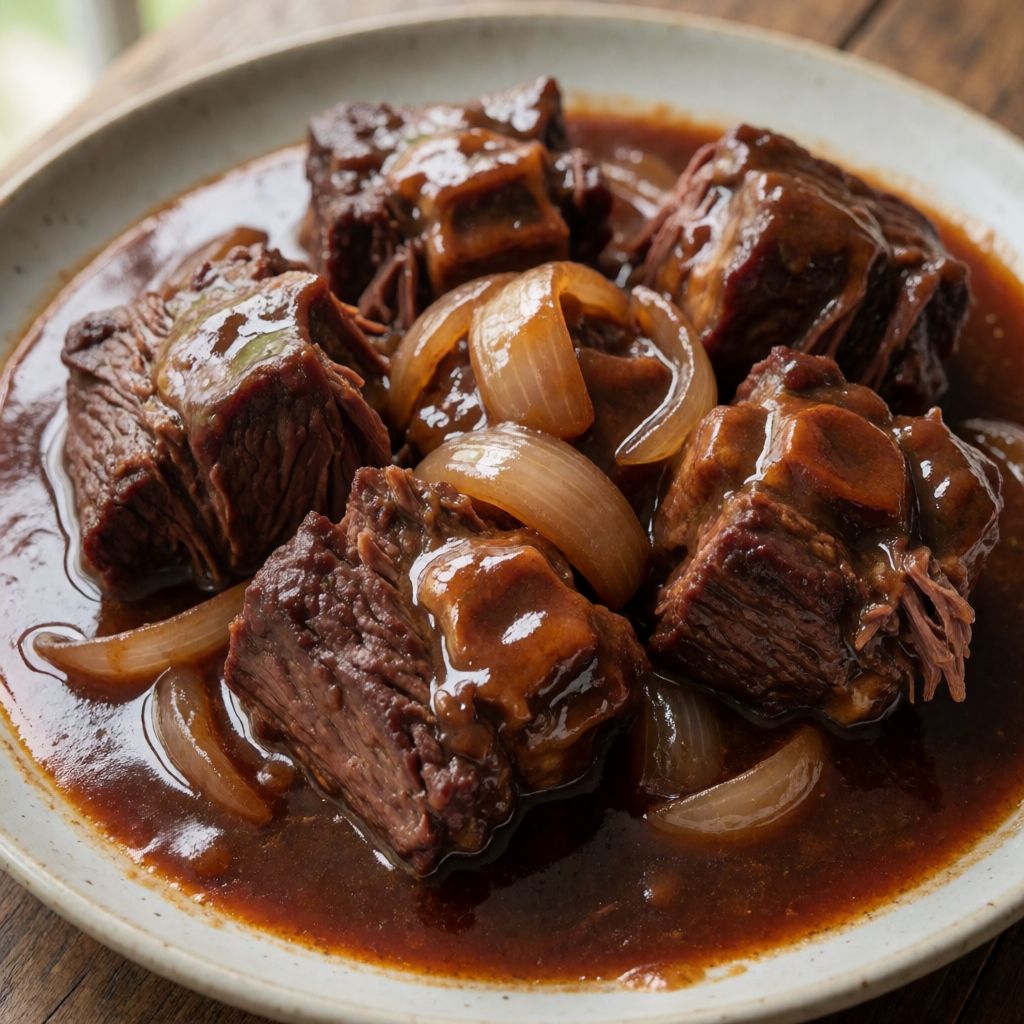
 AI photo
Braised Beef in Barolo Wine Sauce
A hearty braised beef dish simmered slowly in rich Barolo red wine sauce.
Labels are worked out automatically from the ingredients and can be wrong. Check the packaging if it matters to you.
Ingredients






Steps
Dice the onion finely and put it in a pot with the olive oil and butter
3 minBrown the meat on both sides, 2 minutes per side, then pour in the first half of the Barolo wine
Cover the pot and braise the meat over medium heat
60 minAdd the salt and the second half of the Barolo wine, continue cooking. Doneness: 63°C in the centre (medium).
Let the meat rest off the heat
10 minSlice the beef, transfer to a board, pour over the sauce and serve
Beef shin braised slowly in Barolo isn't a quick pan-fry with wine splashed in for effect — it's a long negotiation between a tough, hard-working muscle and time. Shin is the shank: a leg muscle that did real work on the animal, dense with collagen. That collagen is the whole point. Cooked hot and fast it stays rubbery; cooked low and slow it melts into gelatine and makes the sauce silky without a spoonful of flour. This is why people reach for shin, oxtail, cheek — not because cheap cuts are "more flavourful" in some mystical sense, but because they're the only ones with enough connective tissue to pull off this trick.
What decides whether it works is restraint at the start and patience in the middle. You brown the meat properly — real contact with a hot surface, not a nervous turn every thirty seconds — because that crust is where the savoury depth comes from; skip it and the dish tastes thin no matter how good the wine. Then you stop rushing. The braise needs a steady, gentle simmer under a lid, not a fierce boil. Too hot and the outside of the meat tightens and dries while the inside still can't break down fast enough; a bare, lazy bubble is what actually dissolves collagen into gelatine over an hour.
On the ingredients themselves: beef shin is non-negotiable in character even if the exact cut name isn't. You want a cut from a muscle that moved a lot — shin, shank, cheek, oxtail — identifiable by visible white seams of connective tissue running through the meat. If your butcher doesn't stock shin, ask for braising beef or ask what they'd use for a stew; a boneless beef shin steak at a UK supermarket is exactly this. Don't substitute a prime steak cut like sirloin or fillet here — they have almost no collagen to melt, so a 60-minute braise will just toughen them, not soften them.
The onion isn't a vegetable course, it's a base — diced finely so it breaks down and more or less disappears into the sauce, sweetening it and thickening it a little as it collapses. Any onion works; a white or yellow one is standard because it has enough sugar to soften properly without turning bitter.
Butter plus olive oil together is a small, sensible compromise, not fussiness: butter alone burns fast and leaves milk solids catching at the pan bottom; oil alone browns the meat but doesn't give that round, slightly sweet dairy note under the wine. Any neutral oil with no smell of its own stands in for the olive oil if that's what's in the cupboard — sunflower, a mild rapeseed oil, whatever you'd fry with for a Sunday roast. Butter has no real substitute if you want the flavour it gives; margarine will melt but won't taste of anything.
Barolo is the named wine, but the mechanism it's doing — tannin and acid breaking down the meat, alcohol cooking off, body left behind — can be done by any dry, fairly full-bodied red. You don't need to buy an expensive Piedmont bottle for a weeknight braise; a mid-range Italian or French dry red covers the job. Avoid anything sweet or light like a rosé — not enough structure to stand up to an hour of cooking and reducing.
Doneness here is worth being honest about: 63°C in the centre for "medium" is a steak reading, and it sits oddly against a 60-minute braise, because shin at medium is still mostly tough — the whole reason you braise it for an hour is to push well past that, until the fibres pull apart with a fork rather than resist a knife. Treat the time and the texture, not the thermometer number, as your real test: if it still fights you, it needs longer under the lid, not less.
Resting the meat for ten minutes off the heat before slicing isn't a formality either — carve it straight off the heat and the juices run out onto the board instead of staying in the meat, and you lose exactly the moisture the whole hour of braising was trying to protect. In a UK flat without a proper carving board, a plate or the back of a clean chopping board under foil does the same job — the kit is less important than giving it the ten minutes.