
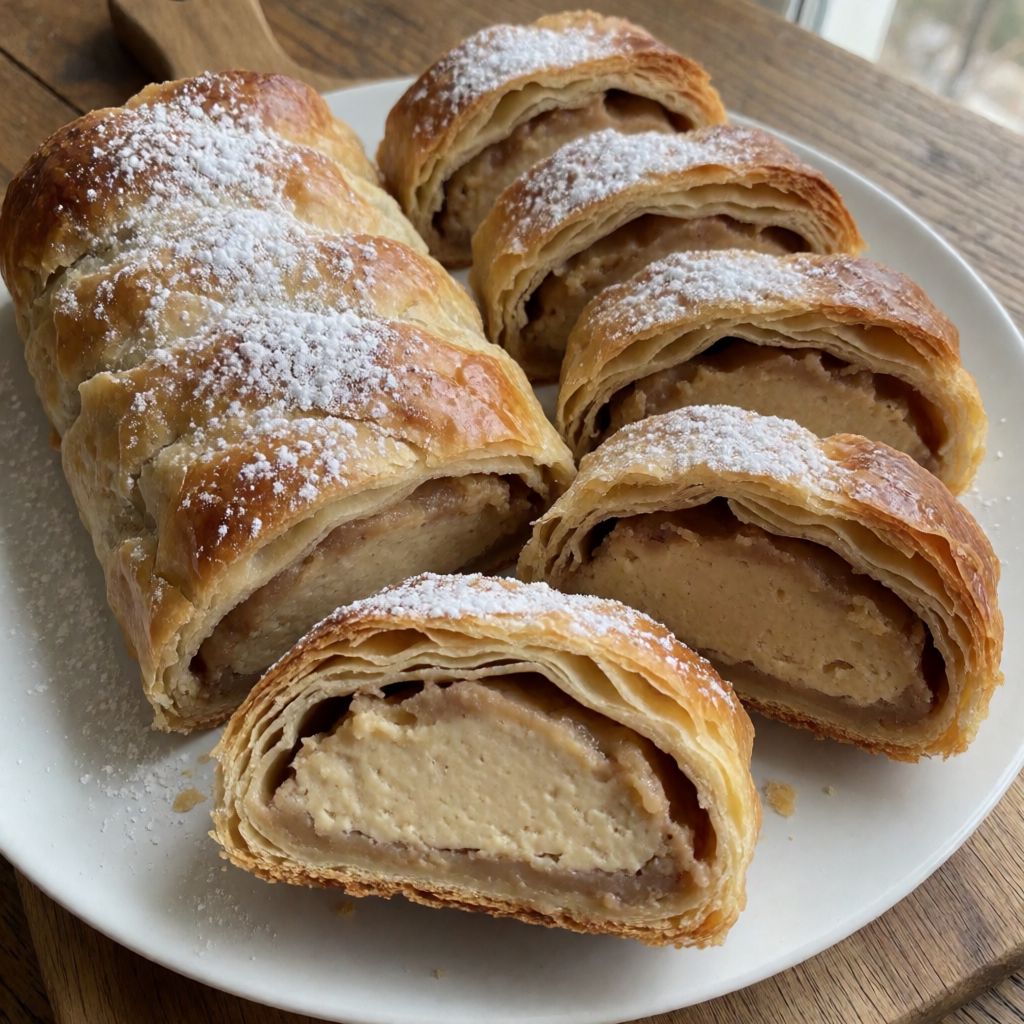
 AI photo
Chestnut Strudel
A sweet shortcrust pastry roll filled with cooked chestnuts, almonds, rum and cocoa.
Labels are worked out automatically from the ingredients and can be wrong. Check the packaging if it matters to you.
Ingredients
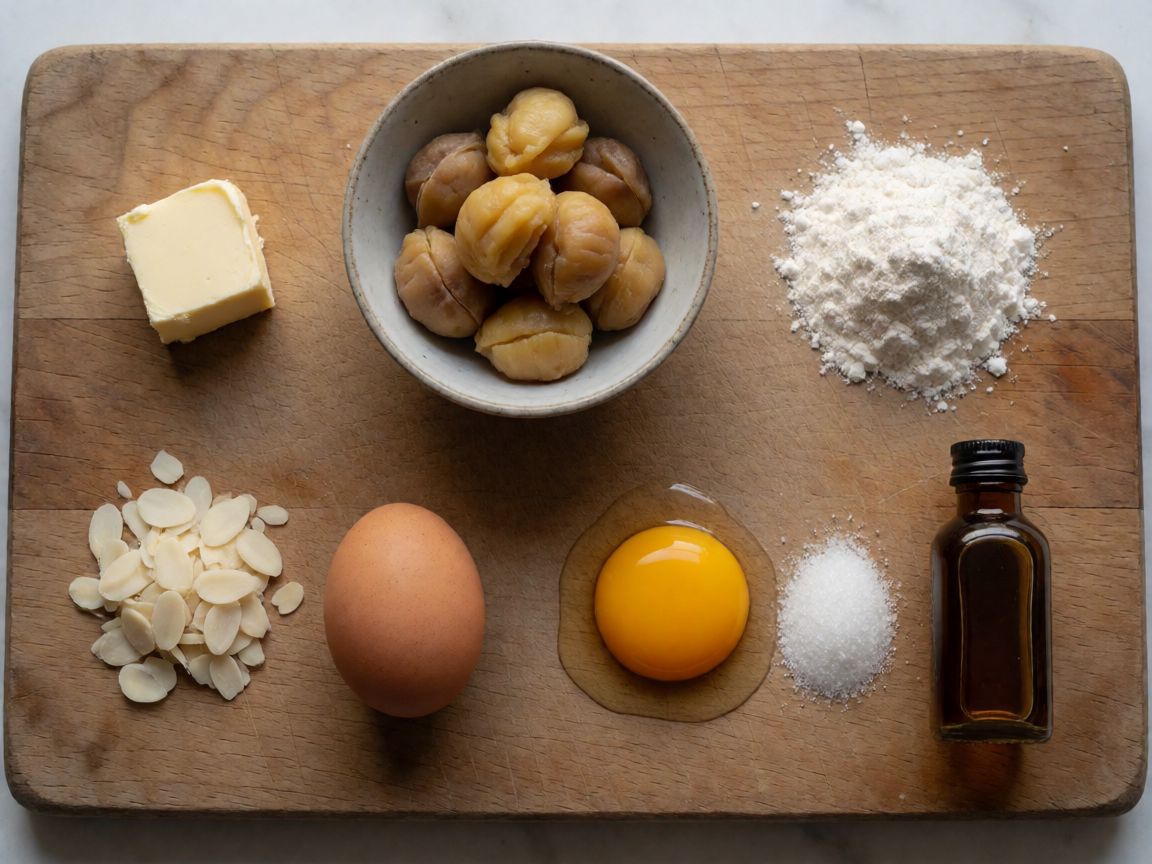
- 120 g Butter cold
- 300 g Cooked chestnuts
- 300 g Plain flour
- 150 g Caster sugar
- 1 pcs Eggs
- 1 pcs Egg yolk
- 50 g Flaked almonds
- 1 pcs Rum shot
- 1 tsp Cocoa powder
- 1 pinch Salt
- 1 tbsp Icing sugar for dusting










Steps
Pile the flour on a work surface with a pinch of salt, making a well in the centre for the sugar, egg, yolk and cold butter.
Quickly knead all the dough ingredients together into a smooth, even ball.
Wrap the dough in cling film and leave it to rest in the fridge.
Peel the cooked chestnuts, removing skin and membrane, and chop into medium-sized pieces.
Add the flaked almonds, rum and cocoa powder to the chestnuts and mix thoroughly.
Roll out the dough on a lightly floured surface to about 5 mm thick.
Shape the dough into a long rectangle and spoon the filling into the centre.
Roll up the strudel, starting from the longer side, until fully enclosed.
Place the strudel on a lined baking tray and brush with beaten egg.
Bake in an oven preheated to 200°C (static) for about 35 minutes, or at 180°C fan.
35 minLet the strudel cool, then dust with icing sugar.
This isn't the Austrian strudel with wafer-thin pastry that tears if you breathe on it. This is a pastry case — a shortcrust, really, a cousin of pasta frolla — rolled thicker and wrapped round a filling that's closer to a chestnut praline than fruit. The name "strudel" here is doing marketing work, not describing technique. What you're actually making is a log of sweet shortcrust with a dense, nutty centre, and that distinction changes how you treat it: you're not fighting for translucency, you're fighting for a dough that holds its shape through the roll and bakes to a biscuit snap, not a soft shortbread crumb.
What decides whether it works is the dough's temperature at every stage you touch it. Cold butter, worked fast, so it stays in small flecks rather than melting into the flour — that's what gives you a crust with a short, sandy bite instead of a tough, elastic one. The moment butter warms past "cold from the fridge, resists your thumb" into "greasy on your fingers", the flour starts absorbing it rather than being coated by it, and you lose the crumb. Rest it after kneading not for flavour but for the gluten you've just upset — a short rest in the cold lets it relax so the dough doesn't spring back and shrink when you roll it.
Flour, butter, egg — the classic shortcrust triangle, and the order in the recipe (well in the centre, wet and fat pooled together, flour drawn in last) exists so you control contact time. The longer flour sits wet, the more gluten develops, and gluten is what you don't want much of here — it's what turns a crumbly case into a chewy one. Work it like you're in a hurry, because you are: the faster the butter goes from solid lumps to "just combined", the less it melts from your hand heat, and the less gluten gets the chance to form long strands. Any plain flour works; nothing exotic required, this isn't bread, you're not chasing protein content.
Butter: cold, always cold, straight from the fridge and cut small before it goes near the flour. Some say margarine works just as well for pastry — no, because butter's water content and the way it melts at a specific point is what creates the layered, short texture in the first place; a fat that behaves differently when it melts gives you a different crumb, flatter, greasier. If you need a substitute for a dietary reason, look for a hard block fat that stays firm at room temperature, not a spreadable tub — the firmness is the property you're actually buying.
The egg and yolk together are binder and richness. One whole egg for structure, the extra yolk for colour and a softer, shorter bite — yolks carry fat and emulsifiers, whites carry protein that, like gluten, toughens things if overdone. If you're short an egg, a splash of cold water will bind the dough but you'll lose some of that golden, tender result; it's a fix, not an equivalent.
Chestnuts, cooked and peeled — buy them vacuum-packed or tinned if you're not boiling and peeling your own, because fresh chestnut peeling is genuinely fiddly, the skin and the bitter inner membrane cling, and most kitchens in Britain won't have a reason to own the knack. This is economics as much as technique: chestnuts used to be a peasant staple across parts of Europe precisely because the tree needs no cultivation and the nut stores through winter, ground into flour when wheat was scarce. The dessert versions, sweetened and dressed up with rum, came later, when chestnuts stopped being survival food and became a seasonal treat instead — which is why this feels festive rather than everyday.
Rum: a shot, for aroma, and because alcohol carries certain flavour compounds that water and oil can't dissolve as well, releasing them as it evaporates in the heat. No rum in the cupboard — use a dark spirit with some sweetness to it, or if you're avoiding alcohol altogether, a spoon of strong black tea with a drop of vanilla gets you some of the same work, moisture plus aromatic lift, though not identical.
Flaked almonds for texture against the soft paste of chestnut — any thin-sliced nut will do the job of "crunch that isn't the crust," walnuts chopped small included, so long as it's dry and not oily enough to seep into the dough.
The bake at 200°C static (180°C fan — fan ovens move hot air faster across the surface, so they cook a touch quicker at the same real temperature, hence the 20-degree drop) is about getting the outside to set and colour before the filling's moisture has a chance to turn the base soggy. Thirty-five minutes is where to start checking, not where to stop the clock — look for the crust going from pale to a deep gold-brown, firm enough that it doesn't dent under a light push. An oven running cool will leave you with a pale case and a filling that's dried out from sitting in the heat too long waiting for colour that isn't coming — that's the real risk here, not burning.
Let it cool before you dust it. Icing sugar on a hot surface just melts into a wet glaze and vanishes — patience here isn't about flavour, it's the only way the dusting actually survives to be seen.
·