
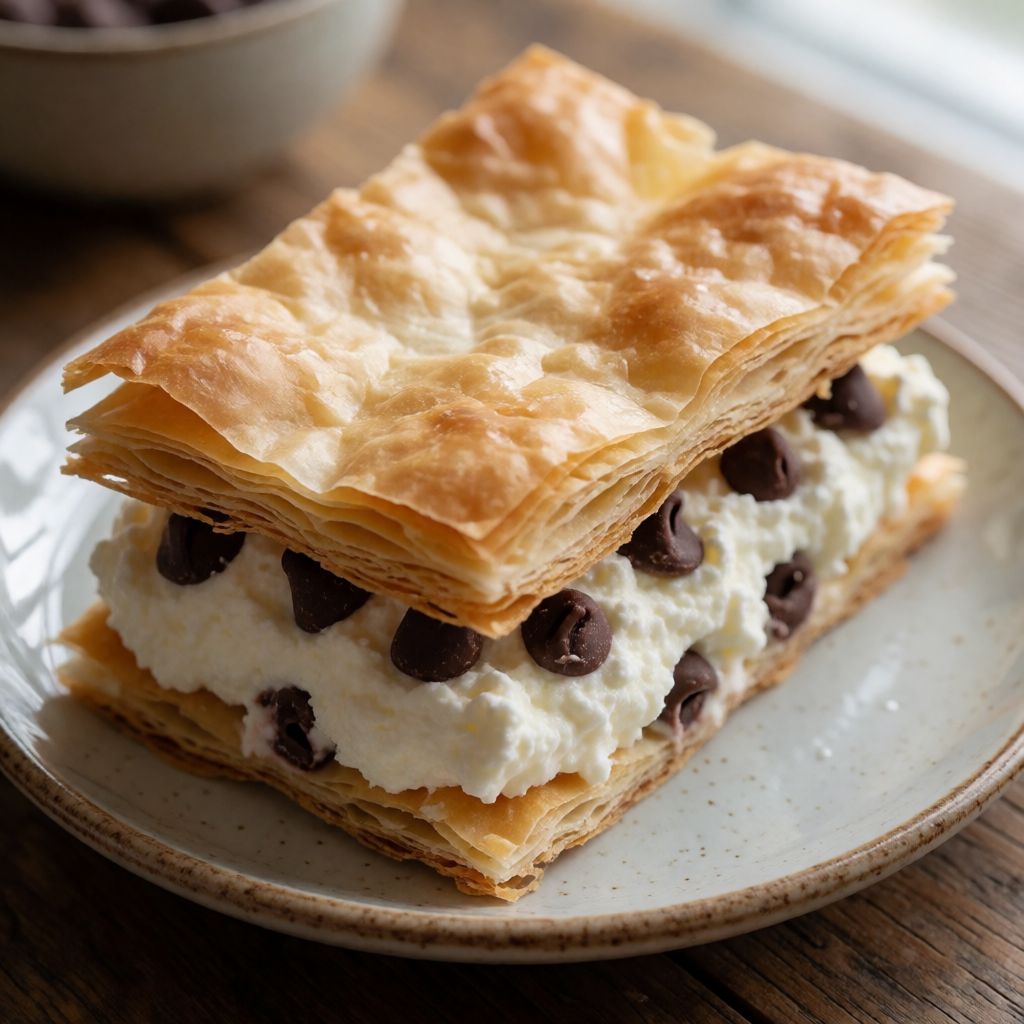
 AI photo
Mille-feuille with Ricotta and Chocolate Chips
A simple no-fuss mille-feuille filled with a ricotta and condensed milk cream, finished with chocolate chips.
Labels are worked out automatically from the ingredients and can be wrong. Check the packaging if it matters to you.
Ingredients
- 1 pcs Ready-rolled puff pastry 250 g
- 250 g Ricotta
- 80 g Condensed milk
- 250 g Double cream
- 30 g Caster sugar
- 20 g Chocolate chips
- Icing sugar to taste






Steps
Unroll the pastry onto the flat base of a baking tin and prick the whole surface with a fork.
Bake in a fan oven preheated to 190°C until golden.
17 minLeave the pastry to cool completely.
Combine the ricotta with the condensed milk and mix until smooth and even.
Add the caster sugar to the double cream and whip until thick and holding firm peaks.
Fold the whipped cream into the ricotta and condensed milk mixture, mixing gently with a spatula.
Add the chocolate chips.
Carefully cut the cooled pastry into three equal strips.
Assemble the mille-feuille, alternating layers of pastry with the prepared cream.
Top with the third layer of pastry and place in the freezer to set.
Decorate the mille-feuille with icing sugar and chocolate chips.
Mille-feuille means "a thousand leaves" and that name is the whole engineering problem. Proper puff pastry gets its lift from dozens of paper-thin layers of dough separated by butter, which melts and steams, pushing the layers apart. You're not making that pastry here — you're buying it ready-rolled, and that's not cheating, that's sense: laminating butter into dough by hand, folding and resting it six or seven times, is a half-day job restaurants justify because they make hundreds of portions. At home, for six people, your afternoon is worth more than that lamination.
What decides whether this works is restraint in two places: the baking, and the filling. The pastry has one job — go in flat, come out crisp, stay crisp. Pricking it all over with a fork isn't decoration, it's venting: those trapped pockets of steam that would otherwise lift the sheet into one big dome instead of flat layers. The oven at 190°C (fan) is hot enough to set the structure fast, gold and dry, before the butter inside has time to just ooze out as a greasy puddle under the sheet. "Golden" is the actual finish line — 17 minutes is roughly how long that takes in most fan ovens, but a darker oven or a thinner roll gets there sooner, and pastry that's merely pale will be chewy and sad under the cream, not crisp.
Ready-rolled puff pastry, all butter if you can get it — look at the ingredients list, not the price. Pastry made with vegetable fat will puff less and taste of very little; butter pastry puffs properly and actually tastes of something once it's gold. 250g is one standard sheet from most UK supermarkets, cut into three equal strips lengthways for your three layers — a sharp knife, one clean pass, not sawing, or the raw edge crumbles and sheds flakes everywhere.
Ricotta is doing a job cream cheese could also do, if that's what's in your fridge: give the cream mixture body so it holds its shape when you cut through it, rather than oozing. Ricotta is lighter and less tangy than cream cheese, so if you substitute, you'll want a touch less sugar — cream cheese fights back more. Condensed milk is sugar and dairy already reduced down to a thick, sweet paste; it's what lets you skip making a syrup or custard from scratch. Don't confuse it with evaporated milk, which has no sugar in it and will leave your filling flat and unset.
Double cream is the UK's answer to this dish's need for fat high enough to whip stiff and stay stiff — at least 36% fat, which is what gives it that firm-peak structure rather than collapsing into soup after twenty minutes. Whipping cream (lower fat) will work but holds its shape for less time, which matters if your kitchen runs warm or you're assembling slowly. The caster sugar in with the cream isn't really there to sweeten — the condensed milk already does plenty of that — it's there to stabilise the whip, giving the proteins something to grab onto so the peaks hold rather than weep.
Chocolate chips: the point is contrast — a cool, soft, sweet cream against small hard bits that don't melt into it. Standard dark or milk chip, chopped chocolate, or even a bar you break into small pieces, all do the same job; just keep the pieces small enough that a slice doesn't crack apart trying to cut through one.
The freezer step at the end isn't about making it an ice cream — it's about setting, fast, in a kitchen that doesn't have a chiller cabinet. A domestic freezer gets the structure firm enough to slice cleanly in maybe half an hour to an hour; check it, don't just set a timer and walk off, because cream this soft can go from "just set" to "frozen solid and hard to cut" faster than you'd think, especially in a small freezer with not much else in it to buffer the temperature.
Icing sugar on top at the very end, not before — it's for the eye, a dusting, and it'll just dissolve into the cream if you put it on too early or too thick. This is a make-ahead pudding for a Sunday that already has a roast in the oven and no spare hands: build it the day before, freeze it, move it to the fridge an hour before pudding, slice with a sharp knife wiped clean between cuts so the layers show instead of smearing. Patience here isn't optional — it's the ingredient that keeps the pastry crisp and the layers distinct instead of one soft heap.
·