
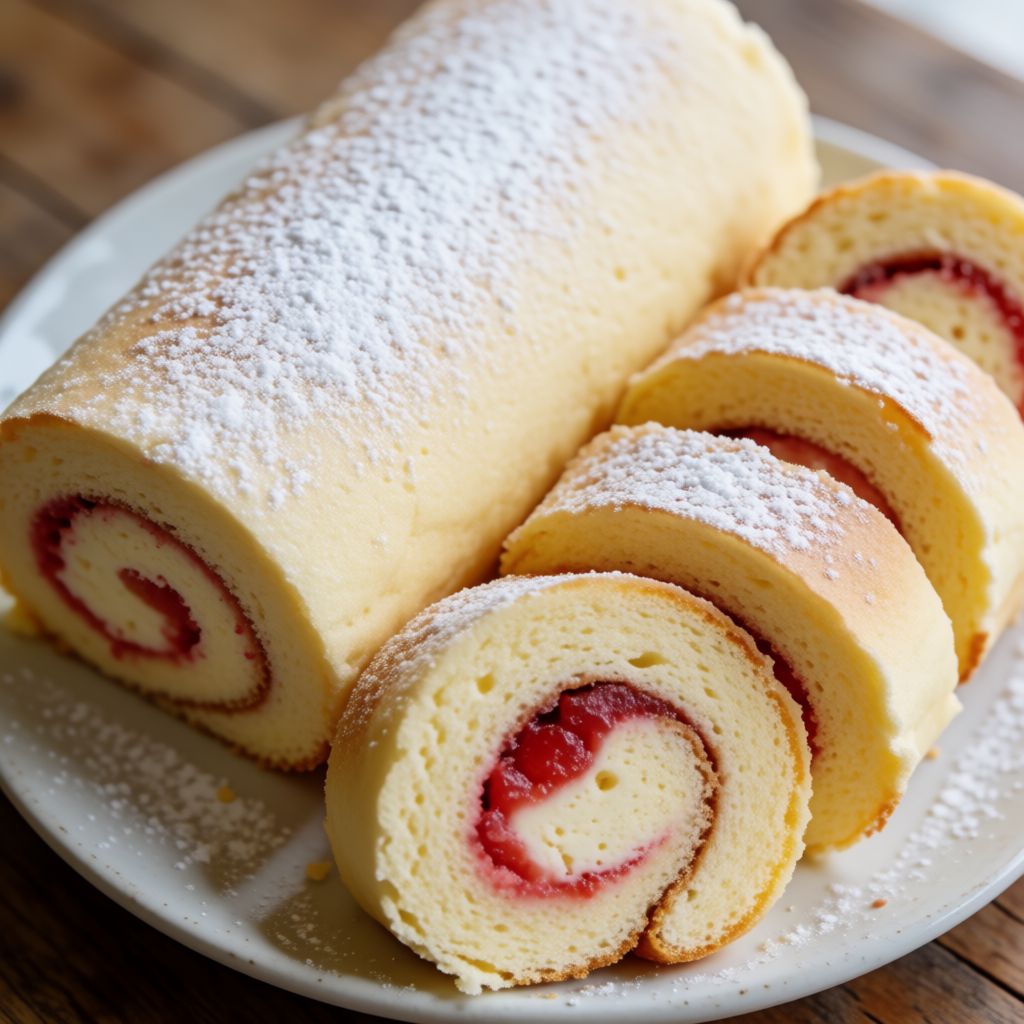
 AI photo
Swiss Roll with Jam
A light sponge roll filled with peach jam, rolled while warm and chilled before slicing into neat pinwheels.
Labels are worked out automatically from the ingredients and can be wrong. Check the packaging if it matters to you.
Ingredients
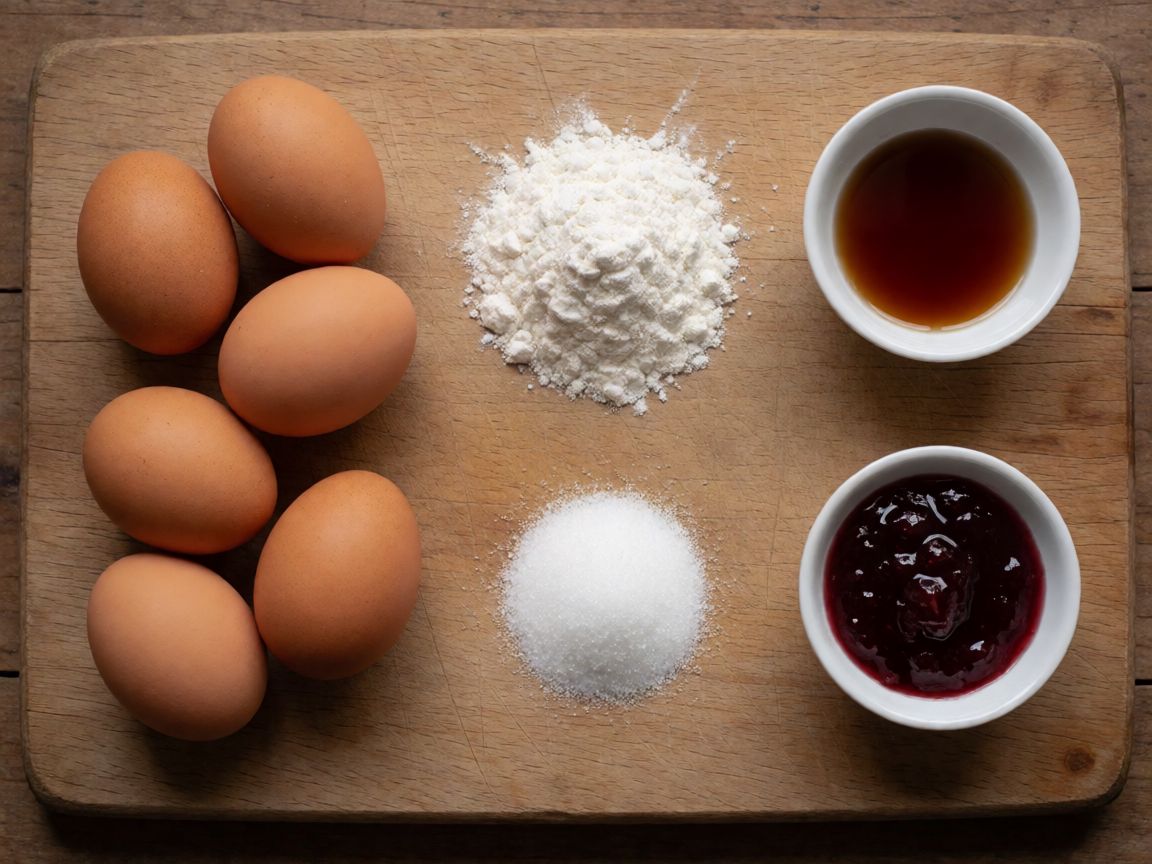
- 5 pcs Eggs
- 90 g Plain flour
- 130 g Caster sugar
- 1 tsp Vanilla extract
- 1 pinch Salt
- 200 g Peach jam





Steps
Separate the egg yolks from the whites.
Beat the yolks with almost all the sugar, keeping back one tablespoon, and add the vanilla extract. The mixture should double in volume and become pale and fluffy.
In a separate bowl, whisk the egg whites with an electric mixer, gradually adding the reserved sugar, until thick and glossy.
Gently fold the whisked egg whites into the yolk mixture using a spatula.
Add the sifted flour and fold gently so the sponge mixture does not lose its air.
Line a baking tray with baking paper, spread the batter and level it evenly.
Bake in an oven preheated to 180°C.
17 minTurn the sponge out onto a sheet of baking paper and peel off the paper it was baked on.
While the sponge is still warm, roll it up, using the baking paper to help.
Wrap the roll in a damp tea towel and let it cool completely.
Unroll the sponge and spread the peach jam over it, leaving a few millimetres free at the edge.
Roll it up again in the same direction, wrap in cling film and chill in the fridge.
60 minSlice the roll with a sharp knife.
A Swiss roll is a sponge that has to behave like a hinge, not a biscuit. The whole trick is in the egg: whipped yolks for richness and colour, whipped whites for lift, folded together so you keep the air you just beat in rather than knocking it back out. No raising agent, no butter — the eggs are doing the entire job of making this thing rise and then, crucially, stay flexible enough to curl round on itself without cracking down the middle.
What decides success isn't the baking — 180°C for seventeen-odd minutes is forgiving, and you'll know it's done when the top springs back and the edges just start to pull from the paper, not by watching a clock. What decides it is the rolling. You roll the sponge while it's still warm and soft, before the structure sets hard in its flat shape. Let it cool flat first and you've trained the crumb to lie flat; ask it to curl after that and it splits, every time. Some say a cracked roll means the oven was too hot. No — nine times out of ten it means you let it cool before rolling, or you rolled against the grain the sponge had already set.
The damp tea towel at the cooling stage isn't fussy ritual, it's doing a real job: it keeps the surface slightly steamy so the sponge doesn't dry out and go leathery at the exact moment it needs to stay supple for the second roll. A dry towel, or no towel, and you're fighting the sponge rather than working with it.
Eggs here are not one ingredient but two, used for opposite reasons. The yolks carry fat and colour and, beaten hard with sugar until pale and thick, they trap air that gives body. The whites, whisked separately to a glossy peak, are pure structure — bubbles held in place by protein with almost nothing weighing them down. Fold them together carelessly and you squeeze the whites flat; the sponge then bakes thin and tough instead of risen and soft. A spatula, cutting down through the middle and folding from the edges in, is slower than a mixer on this step and that's the point — slow is what keeps the bubbles alive. Patience here isn't a virtue, it's an ingredient with its own line in the method.
Sugar is split for a reason too: most of it goes to the yolks for sweetness and that pale, ribbon-thick texture; a tablespoon is held back for the whites, added gradually while whisking. That reserved spoon stabilises the whites — sugar added slowly lets the foam set glossy and strong rather than collapsing back to liquid the moment you stop whisking. Caster sugar dissolves fast because the crystals are fine; granulated will work but needs longer whisking and more faith.
Flour is the smallest-sounding ingredient and the one most likely to ruin everything if you're heavy-handed. Sift it so it falls in light and even, with no lumps to stir hard against, and fold it in rather than beat it — the same logic as folding the whites. Its job is just enough gluten to hold the shape once baked, not to build chew. Plain flour, nothing self-raising: you don't want a second riser arguing with the air you've already beaten in by hand.
Vanilla and salt are both background players — vanilla rounds off the flatness of plain whisked egg, salt (just a pinch, in the whites) tightens the foam slightly and sharpens the sweetness later. Neither changes the chemistry of the rise; leave them out and the roll still works, it just tastes blanker.
Peach jam is the filling because jam, not cream, is a sponge like this can actually hold while still warmish and curled tight — cream would need the roll fully cooled and would squeeze out under the pressure of rolling. Any smooth, not-too-chunky jam does the same job: apricot, raspberry strained of pips, even a good marmalade if you want bitterness against the sweetness. The few millimetres left bare at the edge aren't decorative — that's your margin so the filling doesn't ooze out the ends when you roll and squeeze.
On a UK hob and oven this is straightforward kit-wise: a flat tray lined with baking paper, no tin required, no kazan substitutes to worry about here. The one domestic hazard is oven evenness — a fan oven at 180°C bakes faster at the edges than the middle, so judge doneness by the sponge springing back under a fingertip and the edge just loosening from the paper, not by the timer alone. Chilling the filled roll for the hour in the fridge is what lets the jam set against the crumb and makes slicing clean rather than a slow-motion collapse — skip that and you'll get a presentable roll that falls apart the second the knife goes in.