
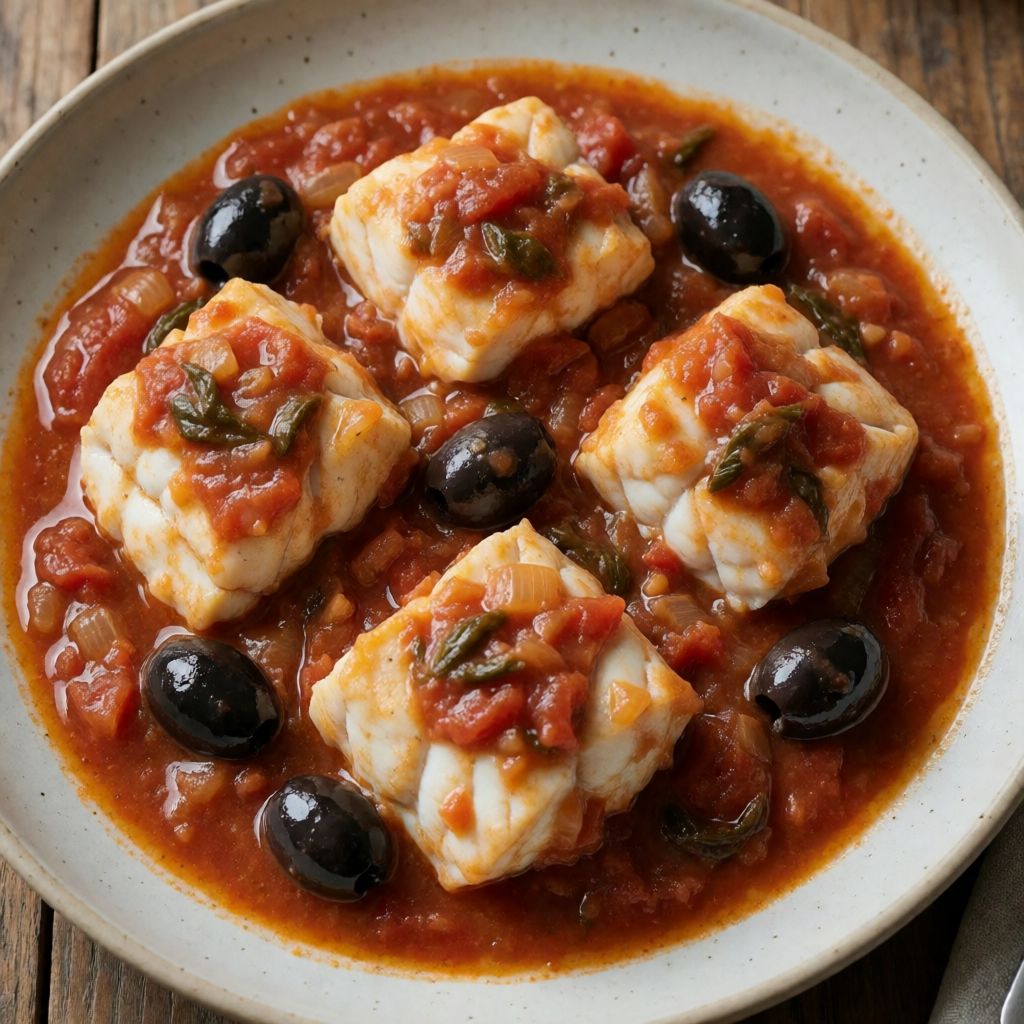
 AI photo
Livornese-Style Cod
A Livorno-style cod simmered in a rich tomato sauce with olives, capers and anchovies.
Labels are worked out automatically from the ingredients and can be wrong. Check the packaging if it matters to you.
Ingredients
- 2 pcs Cod 150 g each
- 4 pcs Toasted Bread Slices
- 300 g Tomato Passata
- 10 pcs Black Olives
- 1 clove Garlic
- 1 pcs Onion
- 5 pcs Capers
- 2 pcs Anchovies
- Olive Oil to taste
- Salt to taste
- Black Pepper to taste









Steps
Heat a little olive oil in a pan. Add the chopped onion and the garlic clove and fry gently.
Add the anchovies and let them soften, then stir in the capers, black olives and tomato passata.
Simmer the sauce, topping up with a little water from time to time.
30 minWarm the toasted bread slices in the oven.
Fry the pieces of cod in a pan with a little olive oil.
Season with salt and black pepper on both sides.
Place the cod pieces into the sauce, cover and simmer over medium heat, turning the fish after 5 minutes.
10 min
What was changed
The bread croutons were replaced with Toasted Bread Slices, since the catalog has no matching item for plain croutons.
Cod alla Livornese is a port cook's dish — Livorno sat on the trade routes, and this sauce is built from what came off boats that weren't fish boats: salt anchovies from barrels, capers and olives preserved for the voyage, tomatoes once they'd arrived from the New World. The fish itself was almost an afterthought, dropped into a sauce that was already doing the work. That's still the logic now: the sauce is the dish, the cod just sits in it at the end.
What decides whether it works is restraint with the anchovies and patience with the sauce. Anchovies aren't there to taste of fish — melted into warm oil they dissolve into savoury depth, the way Worcester sauce or a good stock cube does, and if you can still spot "fish" in the final sauce you've either used too many or let them burn. And the sauce needs its thirty minutes genuinely reducing, not just sitting on a low flame — a thin, watery passata will slide off bread and off cod alike, while a sauce that's been coaxed down to something that clings is the actual point of the dish.
Some say cod falls apart in sauce because it's a delicate fish. No — it falls apart because it's cold going in and then shocked by liquid, or because it's prodded with a spatula like a sausage on a Sunday roast. Fry it properly first so it has a sealed surface, then lower it in gently and leave it alone except for one careful turn.
The onion and garlic go in first and gently — gently meaning you want them translucent and soft, not coloured, because any bitterness here carries straight through thirty minutes of simmering and you can't cook it back out later. On a UK hob, "gently" is lower than you think: a wide frying pan loses heat fast to the air above it, so err toward the low end and give it a minute longer rather than turning the knob up to rescue impatience.
The anchovies are the engine of the flavour, not a garnish. Tinned in oil, salted whole, it doesn't much matter — what matters is they go into warm fat and are left to collapse, stirred until they've essentially disappeared into the onion. That's the difference between "fishy sauce" and "sauce with backbone." If you've got none in the house, a spoon of fish sauce or even a dab of miso does the same job: salt plus savoury depth, no fish flavour you can point to.
Capers and olives are there for sharp, salty interruption — without them the sauce is just stewed tomato, pleasant but flat. Black olives, the ordinary cured kind, not the bright green brined ones, which bring a different, sharper note that fights the tomato instead of sitting in it. If capers aren't to hand, a few chopped gherkins or even a splash of their vinegar gets you close enough; you're after a little acid jolt, not a specific ingredient.
Tomato passata is simply tomatoes with the seeds and skin taken out before you buy it — it's the shortcut version of what Italian kitchens used to do by hand with a sieve. Tinned chopped tomatoes work if you blitz them smooth, though the sauce will need a touch longer to reduce since there's more water locked in the flesh. Either way you're simmering out water, not just warming tomato through, which is why topping up with a splash of water as it reduces, rather than drowning it at the start, keeps you in control of the final texture.
The toasted bread isn't decoration — it's the plate's real job here, the thing that mops the sauce the way the tomato didn't come with rice or potatoes in this tradition. Any sturdy, slightly stale bread toasted hard works; a fresh soft slice goes soggy and collapses under the sauce, which rather defeats the point of toasting it.
Cod is the standard choice because it's firm enough to survive frying and a second cooking in sauce without disintegrating into flakes — but it's not sacred. Any firm white fish that holds together under heat does the job: hake, coley, pollock. What you're protecting by frying it first and seasoning both sides before it ever meets the sauce is the surface — salt drawn out too early or fish dropped in raw turns the whole dish watery and the fish woolly rather than firm. That one flip at the five-minute mark isn't fussiness; it's the only moment the fish needs you at all.