
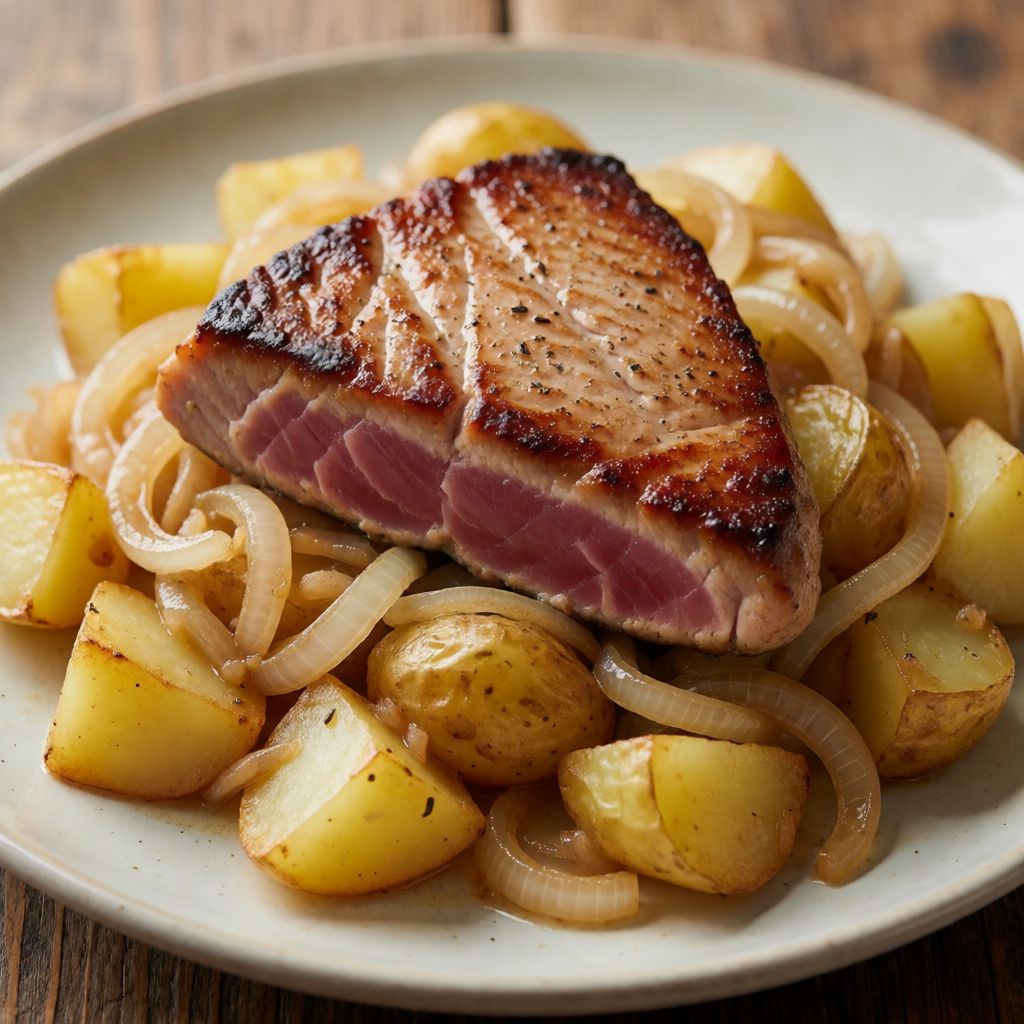
 AI photo
Tuna with Potatoes and Onion
A simple baked tuna dish with potatoes, onion and orange, finished with white wine and olive oil.
Labels are worked out automatically from the ingredients and can be wrong. Check the packaging if it matters to you.
Ingredients
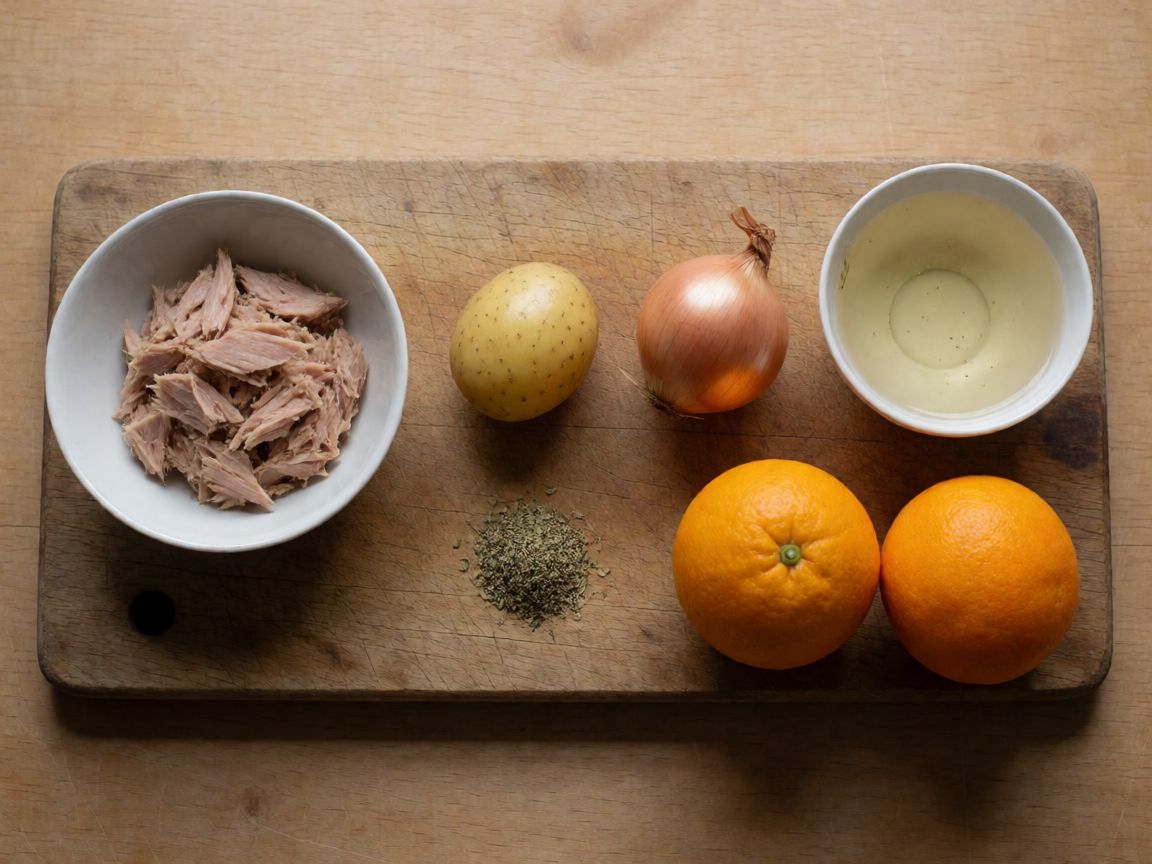
- 500 g Tuna
- 400 g Potatoes
- 1 pcs White onion
- 2 pcs Orange
- 240 ml White wine
- Oregano to taste
- Olive oil to taste
- Salt to taste
- Black pepper to taste







Steps
Peel the potatoes, wash, pat dry and cut into thin slices.
Put the potatoes into a pot of cold water and cook.
5 minCarefully drain the potatoes in a colander, rinse with cold water to remove the starch, and toss with 4 tablespoons of olive oil.
Peel the onion and cut into thin slices.
Stew the onion in a pan with olive oil, water, salt, pepper and oregano.
10 minLet the onion cool.
Marinate the tuna in orange juice.
30 minDrain the liquid from the tuna.
Line a baking tray with parchment paper, place the pieces of tuna on it, and season with salt and pepper.
Cover the tuna with the stewed onion and potatoes, and drizzle with wine and olive oil.
Bake at 200°C.
25 min
This is a fish dish built like a Sunday roast's quieter cousin: protein on the bottom, a soft vegetable blanket on top, everything finishing together in the same dry heat. Tuna is not cod — it's a dense, almost meaty fish, and that's exactly why it survives 25 minutes in an oven without turning to cotton wool the way a delicate white fish would. What decides whether this works isn't the fish, though — it's whether the potato underneath it is cooked through before it ever sees the oven, because the oven's only job here is to finish the tuna and melt everyone else into agreement.
That's why you parboil the potato slices first, for five minutes, then rinse them in cold water. Some cooks skip that rinse, thinking it's just extra washing-up — no, it's the step that stops the dish turning gluey. Potato starch, once the heat's hit it, wants to glue itself to its neighbours; rinse it off and the slices stay as slices, not as paste. Skip this and your "baked potato topping" becomes a sheet of wallpaper paste sitting on good fish.
The onion gets stewed separately, low and slow with a splash of water so it softens rather than browns — you're not making caramelised onion here, you're making a cushion. It needs to go in cool, laid over the raw tuna, because a blanket of hot onion straight from the pan would start cooking the top of the fish before the oven's even preheated, and you'd end up with tuna cooked unevenly — seared on top, raw underneath, which defeats the whole point of baking it as one piece.
Tuna, 500g, is your main cost here and the one ingredient worth buying with care. You want a fresh loin, not steaks that have been sitting under plastic for days — look for deep red flesh, no browning at the edges, no strong fishy smell (fresh tuna smells of very little). Frozen tuna loin, properly defrosted in the fridge rather than rushed under a tap, works fine; the structure holds up to baking either way. If tuna's not available or the price makes you wince, swordfish is the honest substitute — same density, same reason it survives dry heat without falling apart. Don't reach for cod or haddock as a swap: they're delicate white fish, built for gentle poaching, and 25 minutes at 200°C will dry them out before the potato's even warmed through.
The potato, 400g, wants to be a waxy or all-rounder variety — Maris Piper or King Edward, the ones you'd use for a roast — because you're slicing them thin and want them holding their shape as discs, not collapsing into mash under the tuna's weight. New potatoes work too if that's what's in the bag.
Onion: one white onion, sliced thin, stewed rather than fried. If you only have a yellow onion, use it — the difference is marginal sweetness, not technique. Red onion will work but bleeds a bit of colour into the pan juices; not wrong, just a different look on the plate.
Orange, 2 pieces, for juice to marinate the tuna — you want ordinary juicing oranges, not the waxed decorative kind sold for marmalade displays. If oranges are thin on the ground, lemon juice cut with a spoon of sugar gets you the same acid-plus-sweetness balance, though the flavour sits closer to Mediterranean than citrus-bright.
White wine, 240ml — any dry white you'd actually drink a glass of, nothing sweet. It's there to deglaze and steam gently under the lid of potato and onion, keeping the tuna from drying at the edges while the top crisps slightly. No wine in the house? Use the orange juice you marinated the tuna in, thinned with a splash of water — you lose the wine's dryness but keep the moisture doing the same job.
Oil: olive oil, and the reason the recipe insists on it rather than just "oil" is that olive oil's own flavour is meant to come through in a dish this plain — tuna, potato, onion, citrus, nothing shouting. If you only have a neutral oil — sunflower, vegetable — use it for the potato toss, where it's mostly there to stop sticking, but try to find at least a drizzle of olive oil for the top before baking, where its flavour actually matters.
On the oven: 200°C with a domestic fan oven runs a touch hotter than the dial says, so if your tray's browning fast on top while the middle's still cool, that's your oven running hot, not the recipe being wrong — move the tray down a shelf rather than lowering the temperature, so the tuna still gets real heat from below.
And the thing that's easy to rush: the marinating, the stewing, the parboiling — none of it is long, but all of it happens before the oven, and none of it can be skipped to save ten minutes. Patience here isn't about long hours; it's about doing three short, separate things properly instead of one long thing carelessly.