
 AI photo
Wholemeal Bread Rolls
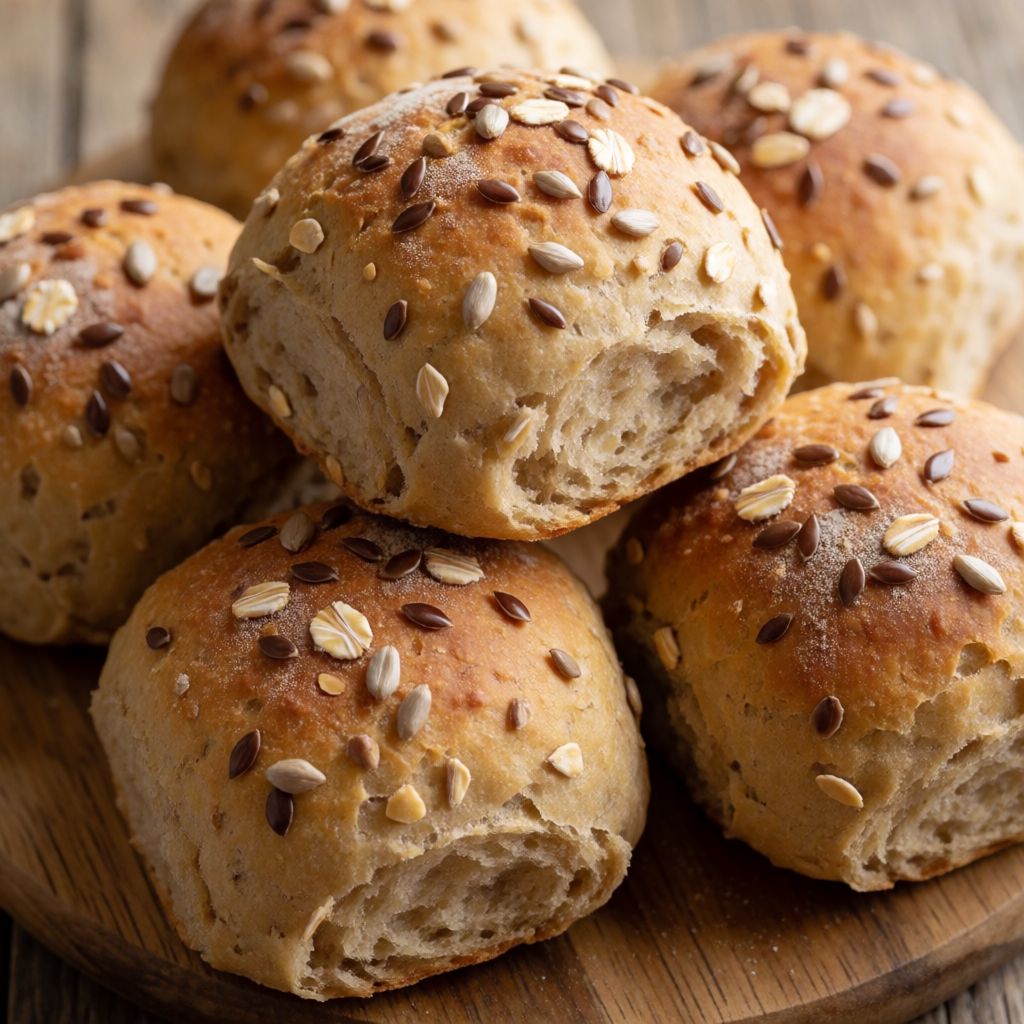
Hearty wholemeal rolls with flax and sunflower seeds, left to prove overnight in the fridge for an easy next-day bake.
Labels are worked out automatically from the ingredients and can be wrong. Check the packaging if it matters to you.
Ingredients
- 10 g Yeast
- 500 ml Water
- 1 tbsp Honey
- 50 g Flax Seeds
- 50 g Sunflower Seeds
- 75 g Porridge Oats
- 1 tsp Salt
- 150 g Wholemeal Flour
- 325 g Plain Flour
- 1 tsp Olive Oil for greasing the bowl
- 1 pcs Eggs beaten
- 25 g Porridge Oats
- 20 g Sunflower Seeds











Steps
Dissolve the yeast in the water in a bowl.
Add the honey, flax seeds, sunflower seeds, porridge oats, salt, wholemeal flour and plain flour.
Knead the dough with a mixer on low-medium speed for 15 minutes, until it is soft, elastic, smooth and even.
15 minTransfer the dough to a clean bowl lightly greased with olive oil.
Leave the dough to rise on the kitchen counter for 30 minutes, then put the bowl in the fridge overnight, or for at least 12 hours.
30 minTip the dough onto a floured surface and cut it into rolls with a dough scraper.
Place the rolls on a baking tray lined with baking paper.
Brush with the beaten egg and sprinkle with porridge oats and sunflower seeds.
Bake the rolls in a preheated fan oven at 200°C for 15 minutes.
15 minThen raise the temperature to 230°C and bake for a further 5-7 minutes, until the crust is golden and crisp.
7 min
These are dense, seedy rolls with a long cold rise instead of a long warm one — the sort of thing you'd be happy to tear open next to a Sunday roast and mop gravy with. What decides whether they work isn't the baking at all. It's the twelve hours in the fridge, and whether you have the patience to let them actually sit there.
Most bread advice tells you to prove dough somewhere warm, because warmth speeds the yeast up. Fine for white rolls you want on the table in two hours. But wholemeal flour and whole seeds are heavier, thirstier, and they fight the gluten strands as they try to form — so a fast, hot rise gives you a loaf that's risen in volume but still tastes raw and grainy, with seeds sitting in the dough like gravel rather than part of it. Slow the yeast down in the cold and you buy time for the bran and the seeds to properly hydrate, for enzymes to break starches into sugars the yeast can actually use, and for flavour compounds to build the way they do in a sourdough starter, just without the starter. That's the whole trick here: not a clever dough, a patient one.
Yeast first, dissolved straight into the water — this isn't fussy ritual, it's just giving the yeast a head start waking up before it has to compete with salt and sugar-heavy honey, both of which slow it down if they hit it cold and undiluted. If your yeast is old or you're not sure it's still alive, this step tells you early: no bubbles, no froth after a few minutes sitting, bin it and start again, because a dead yeast ruins twelve hours of waiting, not just one proving.
The flax and sunflower seeds aren't decoration, they're structure and nutrition both — flax especially swells and goes slightly gummy when wet, which helps the dough hold moisture over that long fridge rise instead of drying out. If you haven't got flax, any small oily seed with no loud flavour of its own works as a stand-in — sesame, poppy, even pumpkin seeds roughly chopped — the job is texture and a bit of fat, not a specific taste.
Porridge oats do double duty: inside the dough they soak up water and soften the crumb, stopping wholemeal flour's bran from making the rolls dry and crumbly; on top, after the egg wash, they're purely for crunch and that rustic look. Use the plain rolled kind, not the quick-cook instant oats, which have been pre-processed to disintegrate fast — exactly what you don't want sitting inside a loaf of bread.
Wholemeal flour against plain flour in roughly a one-to-two ratio is a compromise, not an accident. All wholemeal and you get a dough too heavy and bran-laden to rise properly in a home kitchen without a professional prover; all plain and you lose the point of a wholemeal roll. If you want more fibre, nudge the ratio, but go gently — every gram of wholemeal you add is a gram fighting the gluten network plain flour's protein builds.
The egg wash on top is for colour and shine, nothing more — it's not holding anything together. If you're out of eggs, a brush of milk gives a softer, duller gold; water alone gives you a paler crust with less sheen, but the rolls will still be rolls. The extra oats and seeds scattered on top before baking are stuck there purely by the egg's stickiness, so brush generously or they'll roll off onto the tray.
On that overnight fridge rest: some say you can skip it and just prove twice as long on the counter to save time. No — the fridge isn't just slowing things down uniformly, it's giving you a different kind of dough, with that slow sugar development and flavour the warm rise never produces, because enzyme activity and yeast activity don't scale together as temperature changes. A long warm rise gets you volume faster; it does not get you the same roll.