
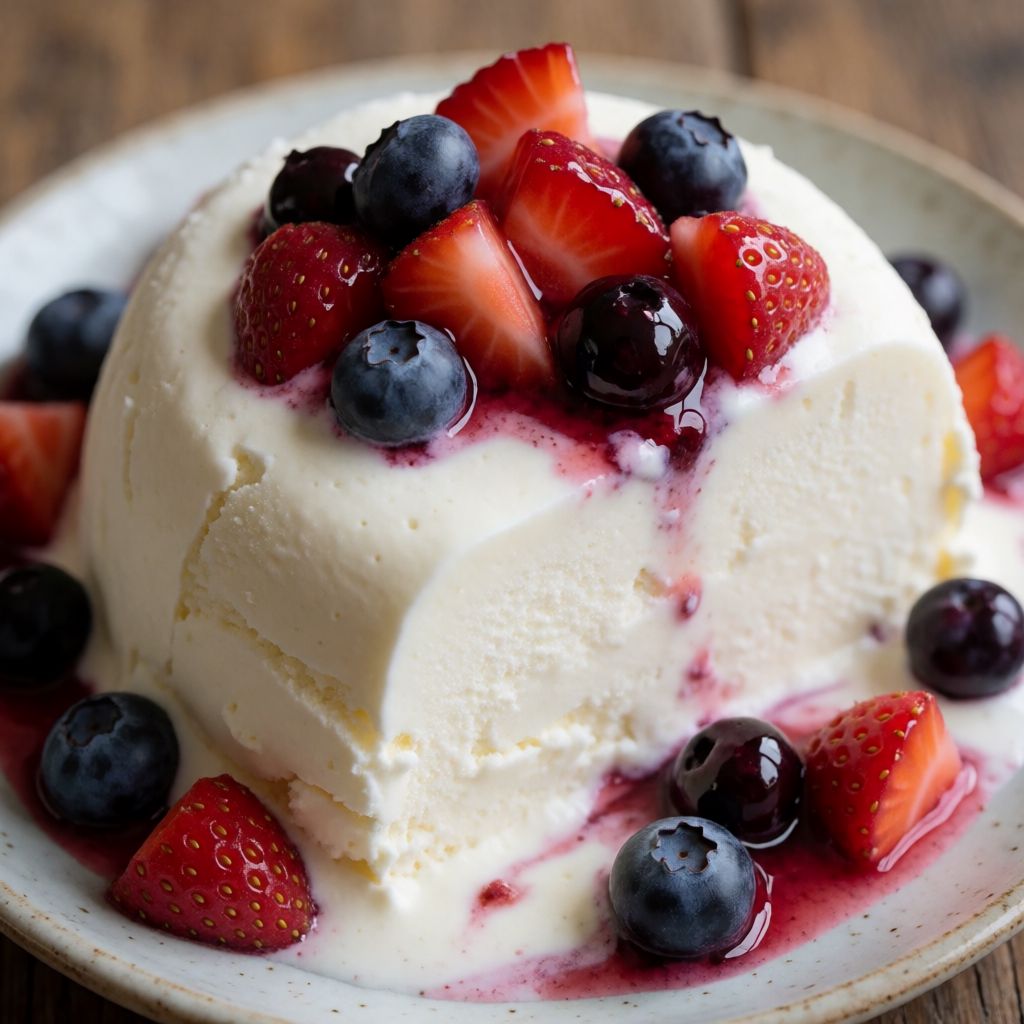
 AI photo
Yoghurt Semifreddo, a Fresh Gelatine-Free Dessert
A fresh, no-gelatine semifreddo made with yoghurt, cream and condensed milk, layered with strawberries, blueberries and kiwi.
Labels are worked out automatically from the ingredients and can be wrong. Check the packaging if it matters to you.
Ingredients
- 500 g Low-fat plain yoghurt
- 200 ml Double cream
- 20 g Icing sugar
- 180 g Condensed milk
- 300 g Strawberries
- 125 g Blueberries
- 1 pcs Kiwi
- 1 bunch Mint a few leaves








Steps
In a bowl, mix the condensed milk with the yoghurt, stirring with a spatula until smooth.
Separately, whip the double cream with the icing sugar until light and fluffy, then gently fold it into the yoghurt mixture.
Pour the mixture into a freezer-proof mould, cover and freeze for 45 minutes.
45 minWash and dry the strawberries and blueberries, and dice the strawberries and kiwi.
Remove the mixture from the freezer and pour half into a loaf tin lined with cling film.
Spread the diced fruit over the surface of the mixture.
Cover the fruit with the remaining mixture, smooth the top and cover with cling film.
Freeze for at least 4 hours.
240 minBefore serving, remove the semifreddo from the tin, let it stand for a few minutes at room temperature, then decorate with mint and fruit.
Semifreddo means "half-cold" — and that half is the whole trick. This isn't ice cream, which needs a machine to beat air into it constantly as it freezes, fighting ice crystals the whole way. Here you beat the air in first, with whipped cream, and freezing just locks that air in place. No churn, no gelatine, no custard base cooked over a bain-marie. The texture that holds it together is fat and air, nothing else.
What decides whether it works is the whipping, not the freezer. Double cream whipped to soft peaks — the point where it holds a shape but still looks glossy, not grainy — carries thousands of tiny bubbles. Fold that into the yoghurt-condensed-milk mix too roughly and you knock the air back out; the result freezes hard as a brick instead of staying sliceable and soft. Fold it too little and you get streaks, dense yoghurt pockets that turn icy. Gentle, from underneath, turning the bowl — that's the whole skill here.
Some say you need gelatine to make a frozen dessert hold its shape when sliced. No — gelatine is for things with a lot of free water (fruit purées, juices) that would otherwise weep and turn to slush. Condensed milk and double cream are both already thick with fat and sugar; sugar lowers the freezing point and fat doesn't form the sharp ice crystals water does. That's why this stays soft under a knife instead of shattering.
On the two freezes: the first 45 minutes isn't about setting the dessert — it's about firming the mixture just enough that it doesn't slump when you pour half of it into the loaf tin and lay fruit on top. Skip it and the fruit sinks straight through to the bottom, uneven and ugly. The second freeze, four hours minimum, is the real one — it has to go rock-solid enough to slice, and a British freezer running at a genuine -18°C will get there in that window; if yours is older or packed full, give it longer rather than trust the clock. Time here is the floor, not the answer — the real test is whether it holds a clean edge when you cut it, not whether four hours have passed.
Low-fat yoghurt is doing something specific: it brings tang and body without piling on more fat than the cream already supplies. Full-fat yoghurt works too, just makes the whole thing richer and slightly less sharp — your call, not a rule. Greek yoghurt, if that's what's in the fridge, is thicker and will need a touch more condensed milk loosening it, since the dessert leans on that mixture pouring and folding easily.
Condensed milk is here for sugar and body at once — it sweetens and thickens in one ingredient, which is exactly why Victorian and later wartime British cooks reached for a tin of it so often: sugar that didn't need weighing out, didn't spoil, and did two jobs. You could rebuild its role with caster sugar plus a splash more cream, but you'd lose the slight caramel note it leaves behind, which is part of the flavour here, not incidental.
Icing sugar in the cream, not caster — caster takes longer to dissolve into cold cream and can leave a slight grit if you're whipping by hand rather than with a machine. Icing sugar's fineness is the whole reason for choosing it; any sugar that dissolves fast and fine will do the same job.
The fruit is flexible by nature, not just by taste. Strawberries and kiwi inside need to be fairly firm and not too wet — overripe strawberries bleed juice into the mixture and you get pink streaks and ice crystals where that juice sits, since juice freezes harder than the fat-based mixture around it. Any firm fruit that holds its shape when diced — mango, firm peach, even well-drained tinned pineapple — can stand in. Blueberries and mint are for the top at serving, so they're about colour and a clean bright note against all that cream — swap for raspberry, blackberry, whatever's at the greengrocer that week.
The loaf tin lined with cling film is your kazan substitute here, basically — a shape with straight sides so the thing turns out in one block instead of collapsing, and the cling film is doing the job a well-seasoned mould would do on its own: letting it release clean. Letting it sit a few minutes at room temperature before serving isn't fussiness — a semifreddo straight from the freezer is hard enough to resist a knife and numb enough to mute all the flavour you built in. A few minutes brings both the texture and the taste back to where you can actually notice them.