
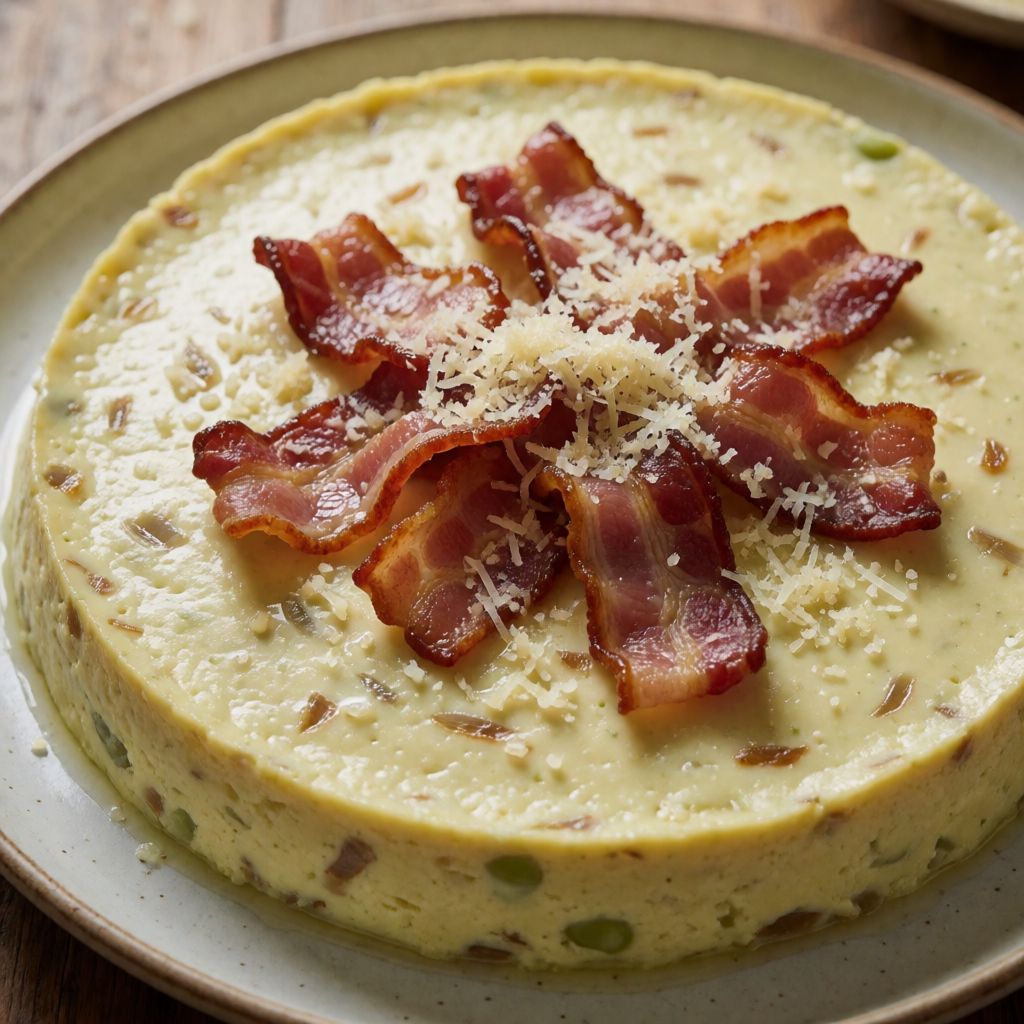
 AI photo
Broad Bean and Pancetta Bake
A creamy baked broad bean pot with pecorino and smoked scamorza, finished with crispy pancetta.
Labels are worked out automatically from the ingredients and can be wrong. Check the packaging if it matters to you.
Ingredients
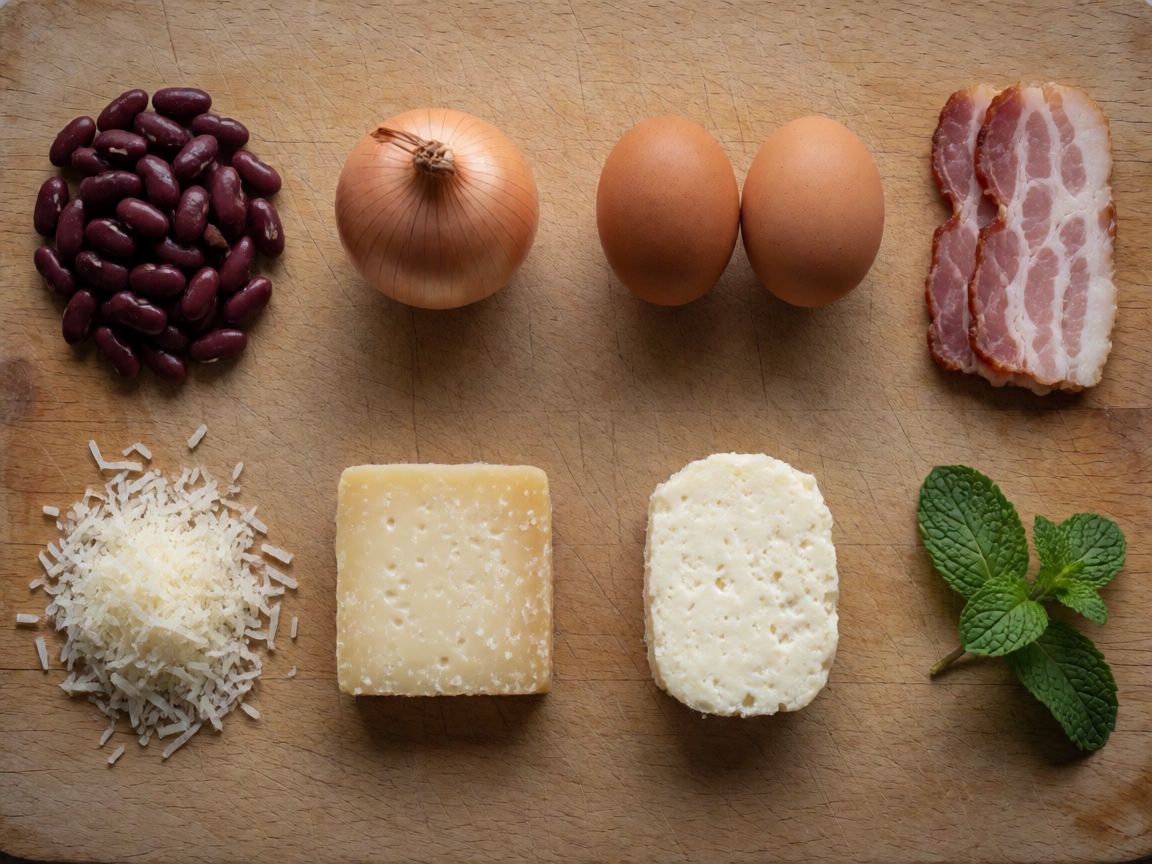
- 350 g fresh broad beans
- 200 g spring onion
- 2 pcs eggs
- 150 g pancetta
- 100 g aged pecorino
- 100 g pecorino
- 100 g smoked scamorza
- 5 pcs mint
- 1 pcs rosemary
- 2 tbsp olive oil
- 30 g butter
- salt to taste
- black pepper to taste











Steps
Blanch the fresh broad beans for 2-3 minutes in salted boiling water, rinse under cold water and remove the skins.
3 minSlice the spring onion into half-moons, place in a non-stick pan with butter and cook over low heat.
6 minAdd the beans, hot water, mint and rosemary; cook and season with salt and pepper.
Let cool for 10 minutes.
10 minTransfer the mixture to a blender with the aged pecorino, smoked scamorza and eggs; blend until smooth.
Grease small moulds with butter, fill them three-quarters full and place in a heatproof dish with water for a water bath.
Bake in the oven at 170°C for 25-30 minutes.
28 minFry the pancetta slices with olive oil in a pan until golden.
5 minLet the moulds cool, turn out onto a plate, and garnish with pancetta and pecorino.
This is a sformato — Italy's answer to "what do I do with the end of the broad bean season". Beans, onion, egg and two cheeses go into a blender, into little moulds, into a water bath, and come out as something between a custard and a flan: soft enough to tremble on the plate, firm enough not to collapse when you turn it out. It's a side dish dressed as something grander, and that's exactly the point — it makes spring vegetables feel like an occasion.
What decides whether it works is the water bath, not the blending. Bake these moulds dry and the egg at the edges sets fast and hard while the centre is still cold mixture — you get a rubbery shell around a wet core. The water around the moulds slows and evens out the heat, so the custard sets gently all the way through, like a crème caramel. Some say a water bath is just chefs being precious. No — it's the only way to stop egg proteins overcooking at the edge before the middle has even warmed up.
The other hinge point is doneness, and here your eyes and a light touch matter more than the clock. The sformato is ready when it's set at the edges and only just firm in the centre — give the mould the gentlest shake and it should wobble like a set jelly, not slosh like batter. 25–30 minutes is where that usually happens in most ovens, but ovens lie, so treat the time as the earliest you're allowed to check, not the answer.
Start with the beans themselves. Fresh broad beans have a tough, slightly bitter skin around a sweet, starchy inside — blanch them briefly and that skin slips off with a pinch, the same reason you blanch almonds before peeling them. Skip this and you're blending grit into your custard; the texture will never be smooth, no matter how long you run the blender. If fresh beans aren't in season, frozen broad beans (already skinned, usually) are the honest substitute — just blanch briefly to soften, not to cook through.
Spring onion goes in sliced into half-moons and cooked low and slow in butter until it goes soft and sweet, not browned. The job here is to drive off the sharp, sulphurous raw-onion bite before it ever meets the egg — do this fast over high heat and you caramelise the outside while the inside stays harsh, and that harshness carries straight through into the finished bake, where you can't fix it anymore. If spring onion isn't to hand, a mild leek does the same job; ordinary onion works but needs longer and gentler cooking to get the same sweetness.
The cheeses aren't interchangeable with each other, even though three different ones feels like excess. Aged pecorino, hard and sharp, goes into the blended mixture for backbone and salt. Smoked scamorza, melting and faintly smoky, goes in with it for body and that savoury depth that plain pecorino alone doesn't give. The second batch of pecorino, the un-aged kind, is saved for grating over the top at the end as garnish — soft, milky, a contrast rather than a reinforcement. If you can't get scamorza, a smoked mozzarella or even a mild smoked cheddar will do the melting job, though you lose a little of that Italian specificity. The rule for any substitute cheese here: something that melts smoothly and doesn't throw oil everywhere when warmed, or your custard goes grainy and slick instead of silky.
Eggs are the only thing actually binding this into a custard rather than a loose vegetable purée — two eggs for this quantity is a light set, which is why the water bath matters so much; there's not much egg to forgive overcooking.
Pancetta is fried separately and kept crisp, which is doing more than decoration — it's the textural contrast against the soft custard, and the saltiness against the sweetness of the beans and onion. Smoked bacon lardons, which you'll find in any UK supermarket, are the nearest stand-in; they're cut and cured differently but bring the same salt-fat-crisp job to the plate.
On equipment: you don't need a proper kazan or specialist moulds for this — small ramekins or even teacups you don't mind putting in the oven will do, sat in a roasting tin with water coming a third to halfway up their sides. That's your water bath, built from what's already in the cupboard. Three people, three to four small moulds, depending on how generous you want the portions — this is a starter or a side alongside something plainer, not a meal on its own.