
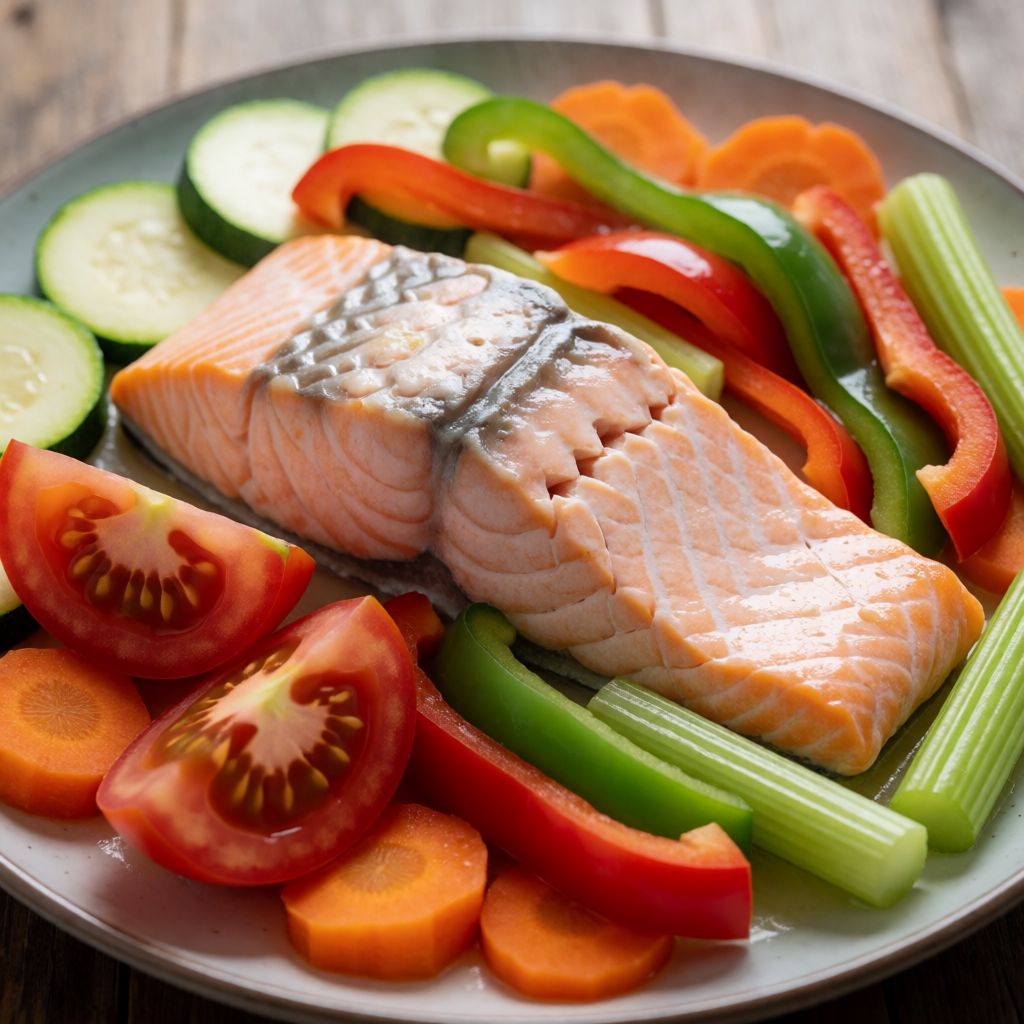
 AI photo
Steamed Salmon
Steamed salmon steaks served with a vegetable medley and a fresh lemon-herb marinade.
Labels are worked out automatically from the ingredients and can be wrong. Check the packaging if it matters to you.
Ingredients
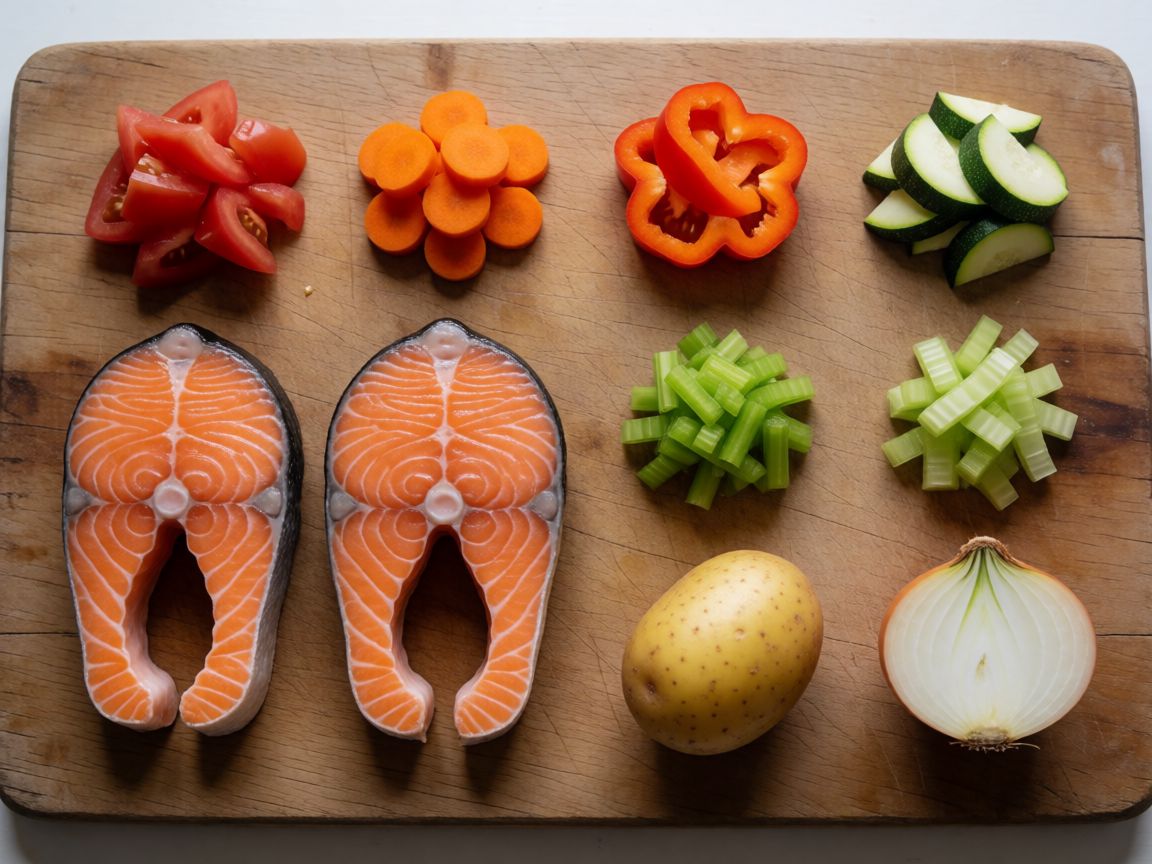
- 2 pcs Salmon steaks, 200 g each
- 100 g Cherry tomatoes
- 100 g Carrot
- 100 g Bell pepper
- 100 g Courgette
- 50 g Celery stalk
- 1 pcs Potato
- 1/2 pcs Onion
- 1 pcs Lemon zested and juiced
- 2 bunch Dill
- 2 bunch Rosemary
- 2 bunch Thyme
- 3 pcs Bay leaf
- 11 tbsp Olive oil
- 475 ml Water
- Salt to taste
- Black pepper to taste















Steps
Clean the salmon: remove the skin and all bones. Finely chop all the herbs.
Marinate the salmon steaks with lemon juice, 8 tbsp of olive oil and half of the chopped herbs.
10 minSeason with salt and pepper to taste, cover the pot with cling film and place in the fridge.
Peel the potato and carrot, and cut into cubes. Dice the celery and courgette the same way. Halve the bell pepper, remove the seeds, and chop. Finely chop the onion.
Cut the cherry tomatoes into pieces and blend the flesh with a hand blender.
Put a pot of water on the heat, add the lemon zest, bay leaf and rosemary, and bring to the boil.
In a frying pan, fry the onion in 3 tbsp of olive oil. Add the diced bell pepper, carrot, potato and celery. Once the potato is golden, add the herbs, courgette, salt and pepper.
10 minStir in the blended tomato flesh and cook for a further 10 minutes.
10 minSet a steaming basket over the pot. Place the salmon steaks in the basket and cook, covered. It is ready when the thickest part reaches 63°C.
Serve the salmon with the vegetables and marinade.
Steamed salmon is a dish built on two separate heats working at once: a gentle, moist one for the fish, a dry, caramelising one for the vegetables. Keep them apart in your head and the whole recipe makes sense. The fish never touches fat or a hard surface — it sits in rising steam, which is forgiving in a way a frying pan isn't. The vegetables do the opposite job: they want contact, colour, a bit of stick and scrape, because that's where flavour actually comes from.
What decides whether it works is not minutes, it's a thermometer and your eyes. 63°C at the thickest part of the steak is the point where salmon's proteins have just set — translucent flesh turned opaque, but still moist, not yet pushing out the white fat that means you've gone too far. Some say you can tell doneness by poking the fish with a fork and seeing if it "flakes" — no, because by the time it flakes easily, you've already overshot; flaking is a sign of overcooking, not readiness. A probe thermometer costs less than a round of fish and saves you every time.
The vegetable base is a mirepoix with ambition — onion, carrot, celery, pepper, courgette, potato — and it's cooked in a strict order for a reason: the potato needs the longest exposure to dry heat to turn golden and starchy-sweet, the courgette needs the least because it's mostly water and collapses fast. Fresh tomato pulp goes in last and turns the whole thing into something closer to a light stew than a side dish, meant to sit under and around the fish, not next to it on a separate plate.
Start with the salmon itself. You want steaks with the skin and pin bones still manageable — ask your fishmonger to do the bones if you're not confident with tweezers, because a stray bone ruins trust in the dish faster than any cooking mistake. Farmed Scottish salmon is the easy, consistent choice here; wild salmon is leaner and will hit 63°C faster, so watch it more closely rather than trusting the clock at all — time in this recipe is only ever a floor, not a target.
The marinade — lemon juice, olive oil, half the chopped herbs — isn't really marinating in the long sense; ten minutes won't tenderise anything, salmon doesn't need tenderising. What it does is season the surface and perfume the steam that cooks it, since the fish sits above the acidified, herb-scented water. Use an olive oil with real character here, not a neutral one — this is a dish where the oil contributes taste, not just carries heat. Any good extra virgin will do; what you don't want is a refined oil with "no smell of its own" sitting where it's meant to be tasted.
For the vegetable base, the vegetables are interchangeable within limits: each needs to bring either sweetness (carrot, pepper, tomato), bulk and body (potato), or moisture that cooks off into steam and flavour (courgette, celery). If you're missing courgette, use more celery or a bit of leek — the point is textural variety, not any one specific vegetable. The potato is the one non-negotiable: it's what turns this from a vegetable garnish into something substantial enough to call a side.
The cherry tomatoes, blended rather than left whole, are doing the job a tin of chopped tomatoes would do in a slower-cooked dish — except here you want fresh acidity and a shorter cooking time, so raw tomato flesh blitzed just enough to break it down works better than anything tinned, which has already been cooked once and softened past the point you need.
Lemon zest, bay and rosemary in the steaming water aren't decoration — they're there because steam carries aromatic oils upward into the fish as it rises, the same principle as poaching in a court-bouillon but gentler, since nothing touches the fish directly. If you don't have a proper steamer basket, a metal sieve or colander set over the pot, with a lid or even an upturned plate over it, does exactly the same job — a kazan isn't needed here, this is a domestic hob dish through and through, just one that asks you to actually watch it rather than walk away.
Salt and pepper go on both the fish and the vegetable base separately, and that matters — the steam doesn't carry salt the way the frying pan does, so the fish needs its own seasoning before it goes in, not after.