
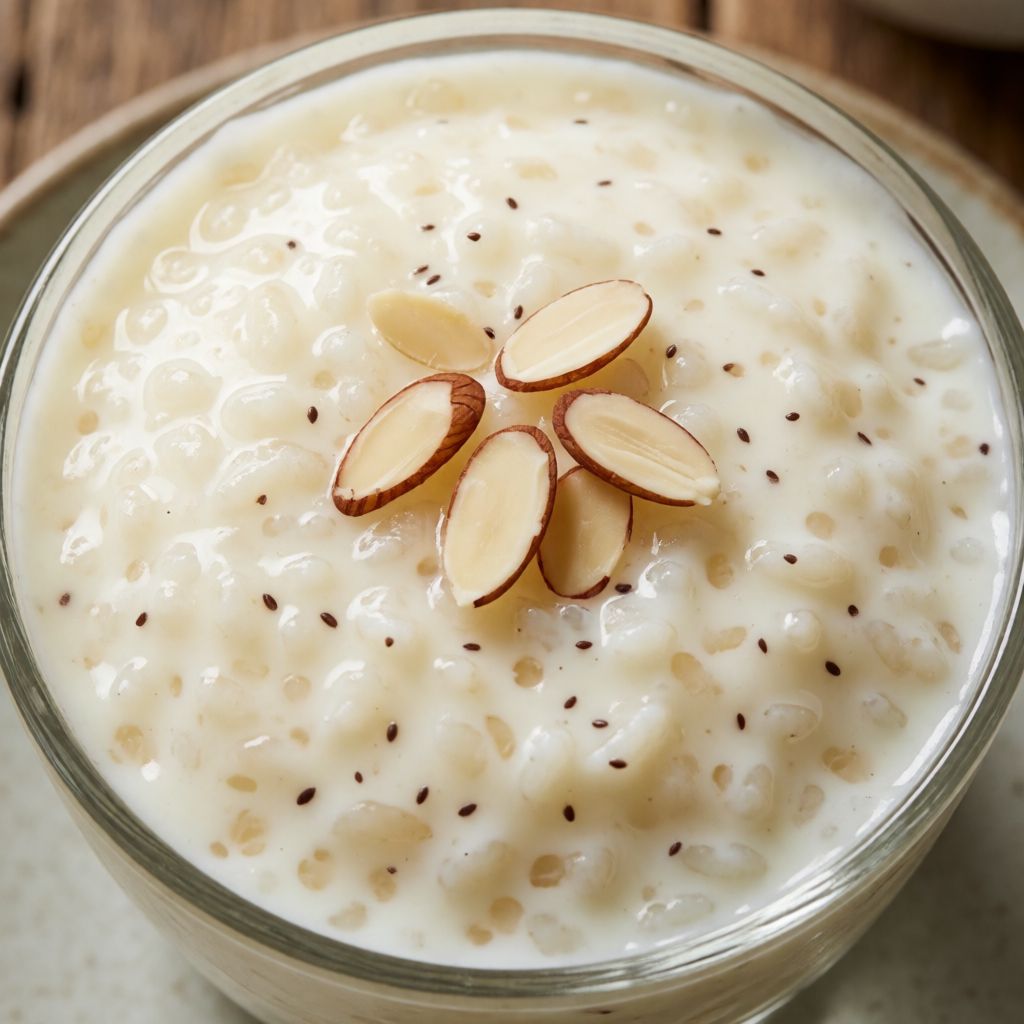
 AI photo
Cold Rice Pudding
A chilled, creamy vanilla rice pudding folded with whipped cream and blanched almonds.
Labels are worked out automatically from the ingredients and can be wrong. Check the packaging if it matters to you.
Ingredients
- 1 l Milk
- 180 g Pudding rice
- 1 pcs Vanilla pod
- 70 g Caster sugar
- 100 g Almonds
- 1 pinch Salt
- 400 ml Double cream







Steps
Put the milk and pudding rice in a saucepan and bring slowly to the boil, stirring constantly.
Reduce the heat to the lowest setting, stir for a few minutes and cover the pan with a lid.
Split the vanilla pod lengthways and scrape out the seeds, then mix the seeds with the sugar.
Add the sugar, vanilla seeds and vanilla pod to the pan, stir and let the rice simmer gently for 45-50 minutes.
48 minRemove the vanilla pod from the pudding.
Cover the almonds with boiling water and leave to stand for 10 minutes.
10 minDrain, cover with boiling water again and leave for 2 minutes.
2 minDrain, peel the almonds and roughly chop them.
Stir the peeled, chopped almonds and the salt into the pudding.
Let the pudding cool completely in the fridge for a few hours or until the next day.
180 minAbout 1 hour before serving, whip the cream to soft peaks and fold it into the rice pudding.
60 min
This is rice pudding that's been told to grow up: cooked slow on the stove like the nursery version, but then chilled solid and loosened with whipped cream so it eats cold, like a mousse with manners. The whole dish stands or falls on one thing — whether you let the rice actually finish cooking in milk at a bare simmer, rather than racing it on a vigorous boil. Rice cooked too hot in milk doesn't swell evenly; the outside of each grain turns to starchy glue before the centre softens, and you get a gluey pudding with hard little hearts. Slow is not fussiness here, it's the only way starch and liquid meet in the middle.
The second thing that decides it is patience with temperature, not with the clock. "45-50 minutes" is a lower bound, not a deadline — the real test is a grain between your fingers: it should give, not squeak. Everyone has a grandmother's pot that took an hour because her hob ran cool, and another that took thirty-five minutes on a fierce gas ring. Go by the grain.
Then there's the chill. Some treat the fridge hours as dead time, something to skip if you're in a hurry. Don't — a warm pudding folded with cream collapses into soup, because warm starch hasn't set up its structure yet and warm cream has nothing to hold on to. The cold is doing real work: firming the rice's released starch into something with body, so the cream can be folded through rather than stirred in and lost.
Finally, the almonds aren't decoration, they're the one textural argument against an otherwise completely soft dish — bite against give.
Milk is doing two jobs at once: it's the cooking liquid and it's most of the flavour, so don't reach for a low-fat version thinking it's lighter — thin milk gives a thin pudding, full stop. Whole milk is the baseline; if you want to push it, you can swap a splash for single cream, but don't go further, because too much fat early on coats the rice and slows how much liquid it can actually absorb — you'll end up with soupy pudding and tired rice.
Pudding rice is short-grain, round, starchy — the opposite criterion to the rice you'd use for a pilaf. The starch on the outside is the whole point: it swells, bursts a little, and thickens the milk around it, which is how you get body without flour or eggs. Risotto rice (arborio, carnaroli) will do at a pinch, it's built the same way — roundish and starchy — but it's a bit firmer-grained and may want a few extra minutes at the gentle-simmer stage. Long-grain rice is the wrong tool entirely: it's bred to stay separate and dry, which is exactly what you don't want in a pudding.
Vanilla pod, scraped and then left in the pan to finish cooking alongside the rice, gives you flavour in two forms — the seeds, rubbed into the sugar so they don't clump and sink, and the spent pod itself, still giving off oils as it simmers. Vanilla extract will get you flavour without the visual flecks and without the slow infusion, so use it if that's what's in the cupboard, but know you're trading a little depth for convenience. Vanilla sugar, if you keep a jar of it going (sensible — bury spent pods in your sugar tin), does both jobs for the price of one.
The almonds get blanched twice in quick succession — once to loosen the skin, once to finish lifting it — because the brown skin itself is bitter and leathery, and left on it would sit in your mouth as grit rather than crunch. Chop them roughly, not fine: a ground almond disappears into the pudding and you've wasted the texture it was there to provide. No almonds, or an allergy in the house — toasted flaked hazelnuts or a few crushed amaretti biscuits will give you the same job: something with a bite, stirred in cold.
Double cream is non-negotiable in its fat content, though not in its ceremony: whip it only to soft peaks, because stiff cream folded into pudding sits in lumps rather than melting through, and you lose the point of adding it, which is lightness, not more richness. Fold it in close to serving — within the hour — because whipped cream left standing starts to weep and separate, and a pudding that's been waiting since this morning with its cream already in will have gone watery at the edges by teatime.
A pinch of salt at the end isn't there to be tasted as salt — it's there so the sugar and vanilla taste like more of themselves, the same reason you'd salt a custard. Leave it out and the pudding isn't wrong, just a shade flatter, like tea without milk — still tea, just missing something it's used to.