
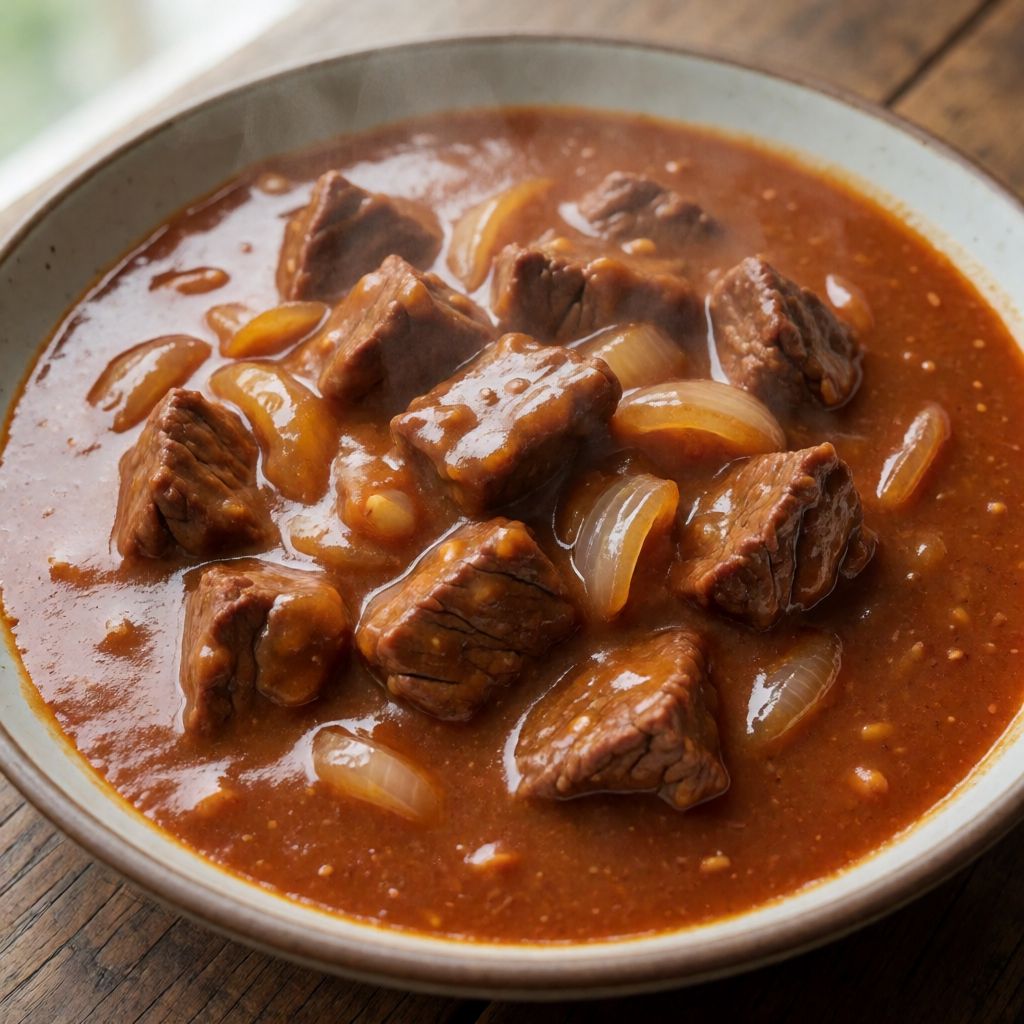
 AI photo
Beef Stew in Peanut Sauce
A rich, slow-cooked beef stew in a smooth peanut sauce.
Labels are worked out automatically from the ingredients and can be wrong. Check the packaging if it matters to you.
Ingredients
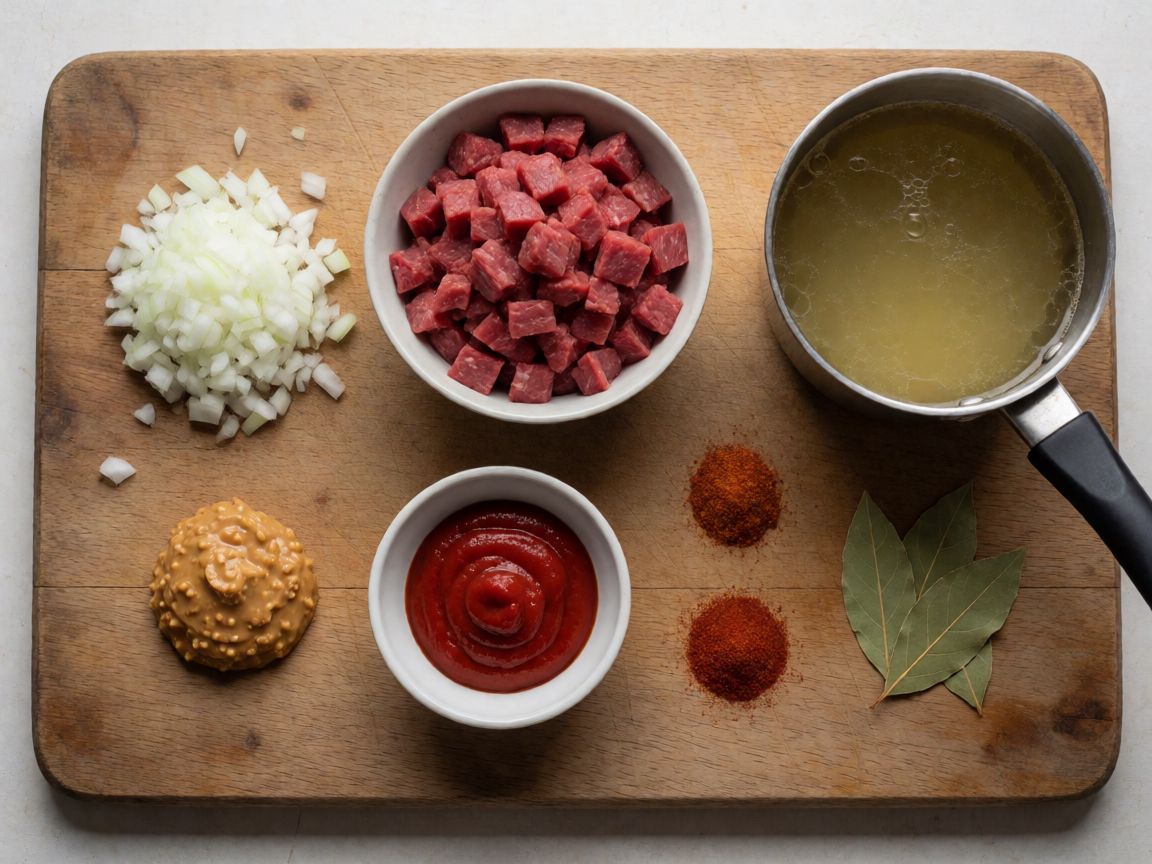
- 1 pcs Onion finely chopped
- 850 g Beef trimmed of fat, cubed
- 120 g Peanut Butter crunchy preferred
- 300 ml Water cold
- 100 ml Tomato Paste concentrated
- 400 ml Stock
- 1 pinch Cayenne Pepper
- 1 tsp Smoked Paprika
- 3 pcs Bay Leaf
- 2 tbsp Olive Oil for frying
- Salt
- Black Pepper freshly ground










Steps
Fry the onion in a pot over medium heat until soft.
Increase the heat, add the meat and sear it on high heat.
Stir the peanut butter into the cold water and pour it over the meat.
Add all the other ingredients.
Mix well and leave the dish to simmer, covered, for 1 1/2 – 2 hours.
105 minStir occasionally.
When the meat is nice and tender, remove and discard the bay leaves.
Serve with rice or mashed potato, a good salad and a pinch of fresh herbs.
This is a West African groundnut stew wearing a Sunday-roast disguise: 850g of cubed beef cooked down with peanut butter, tomato paste and stock until the sauce goes thick, dark, and faintly rust-coloured from the paprika. It looks like nothing special in the pot — a brown stew, the kind you'd walk past at a buffet. The peanut butter is doing the heavy lifting here, and that's the part people underestimate.
What decides whether this works is not the spicing, it's the fat. Peanut butter is roughly half fat by weight, and when you simmer it for two hours that fat separates and rises — you'll see an oily sheen on top near the end, and that's correct, not a mistake. If you panic and skim it off, you lose the body of the sauce along with it. The thickening in this dish is peanut starch and protein breaking down slowly into the liquid, the same way a roux thickens a gravy, except here the "roux" is already in the jar.
The meat choice is the other half of the story. "Beef, cubed" is doing a lot of unstated work: this wants a cut with connective tissue — shin, chuck, blade — not sirloin or anything you'd put under the grill. Some say any stewing beef is interchangeable with any other beef if you just cook it long enough. No — collagen converts to gelatine at a specific range, roughly 160–180°F / 70–82°C held over time, and a lean quick-cook cut will just go dry and stringy no matter how long you leave it, because there's no collagen there to convert.
The onion goes in first and alone, in oil, over a heat gentle enough that it goes soft and translucent rather than brown — you're softening cell walls, not caramelising sugars yet. That comes later, in a different way. Then you crank the heat and sear the beef hard before anything wet touches it. This isn't about "locking in juices" — that's the old myth, and it isn't true, meat is not a sealed bag. What searing actually does is build a crust of browned proteins (the Maillard reaction) that then dissolves back into the sauce and gives it a depth no amount of simmering alone produces. Skip this step and the stew tastes flat no matter how long it cooks.
Peanut butter: crunchy is specified for a reason, not snobbery. The ground peanut pieces survive the two-hour simmer and give the finished sauce a bit of bite against the smoothness — swap to smooth and you lose that texture, which is fine if that's what you want, but know it's a trade, not a downgrade. Any natural peanut butter works; avoid the very sweet, additive-heavy supermarket kind if you can, because sugar behaves differently under heat than fat does and will push the sauce toward caramel-sweet rather than savoury-rich. If you're allergic or just out, a seed butter — tahini, sunflower seed butter — gives you the same fat-and-protein thickening mechanism, though the flavour obviously shifts toward sesame or sunflower rather than peanut.
The cold water the peanut butter gets stirred into first is a small technical fix: peanut butter dropped straight into a hot pot seizes and clumps, same reason you don't dump flour into hot milk for a sauce. Loosening it in cold liquid first means it disperses smoothly into the pot instead of sitting in stubborn lumps you'll be chasing round the pan with a spoon for the next hour.
Tomato paste, concentrated, not passata or chopped tomatoes — it's there for acid and colour, in a small enough volume that it doesn't water down the sauce you're trying to thicken. If you only have the less-concentrated stuff, use more and simmer it a little longer uncovered at the start to drive off extra water before you add the stock.
Smoked paprika and a pinch of cayenne aren't there to make this a "spicy" dish — one pinch of cayenne is heat-as-background, not heat-as-headline. The paprika's smoke note is standing in for the wood-fire cooking these stews traditionally come from; it's a flavour shortcut for a kitchen with a hob and an extractor fan rather than a fire pit. Bay leaves go in whole and come out whole at the end — they're infusing, not eating, so don't chop them and don't forget to fish them out, a stray bay leaf in someone's mouthful is not a pleasant surprise.
Stock over water for the bulk of the liquid: water would work, but stock means the sauce starts seasoned and savoury rather than needing to be built up from nothing, and with a dish simmering this long, every hour is an hour for that base flavour to concentrate further as liquid reduces. Salt late rather than early, by the way, and taste before you add it — the stock and tomato paste both carry salt already, and peanut butter sauces reduce a lot, so what tastes right at the start can turn sharp two hours later.
Patience really is the ingredient doing the most work in this recipe. There's no clever trick that gets tough beef tender in twenty minutes — the collagen conversion is a function of time at temperature, not heat alone, and turning the hob up higher just dries the outside while the inside stays unconverted. Rice or mash on the side is the right instinct: this sauce is rich and a little heavy, and you want something plain underneath to carry it, the same logic as gravy over a roast potato rather than gravy over more gravy.
·