
 AI photo
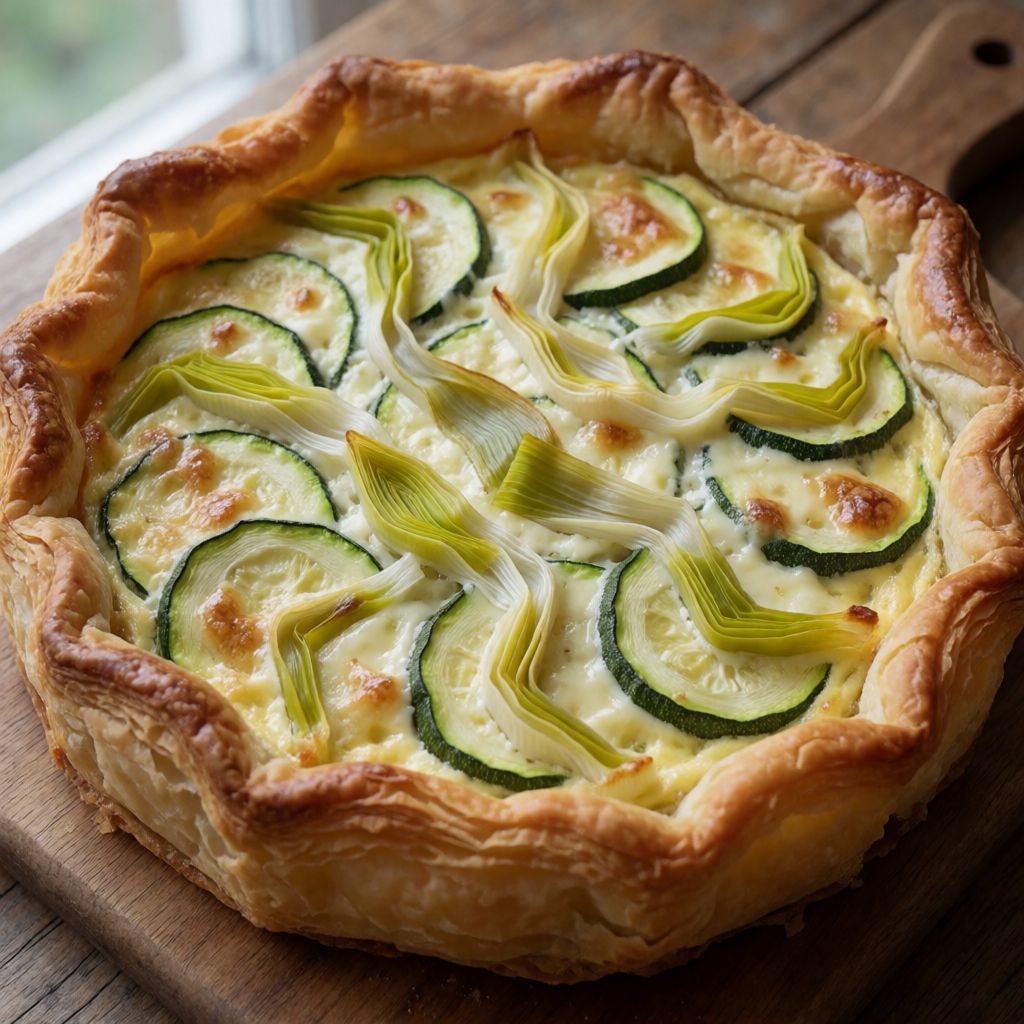
Puff Pastry Tart with Courgette, Leek and Brie
A savoury puff pastry tart with courgette, leek and melting brie.
Labels are worked out automatically from the ingredients and can be wrong. Check the packaging if it matters to you.
Ingredients
- 1 pcs Ready-rolled puff pastry
- 100 g Brie
- Parmesan
- 2 pcs Courgette
- 1 pcs Leek
- 3 pcs Eggs
- 200 ml Double cream




Steps
Lay the puff pastry together with its baking paper into a tart tin.
Prick the base of the pastry with a fork, sprinkle with Parmesan and breadcrumbs, and scatter over pieces of brie.
Arrange rounds of courgette and rings of leek on top.
In a bowl, whisk the cream with the eggs, add Parmesan, salt and pepper, and pour the mixture over the vegetables.
Fold in the edges of the pastry and bake at 200°C.
25 minServe warm.
This is a quiche with its school uniform changed — puff pastry instead of shortcrust, courgette and leek instead of bacon and onion. What decides whether it works is the same thing that decides every open tart: does the custard set without turning rubbery, and does the base stay crisp instead of going soggy underneath a wet filling. Everything else is arrangement.
The Parmesan-and-breadcrumbs layer under the brie isn't decoration, it's a barrier. Courgette in particular weeps water as it bakes — cut it raw and lay it straight on pastry and you get a soft, pale, slightly sad bottom crust, because the custard above and the vegetable water below are both trying to soak into the same sheet of dough at once. A dry, slightly fatty layer (cheese, crumbs) slows that down. Some say brush the base with egg white first — no, because egg white sets into a thin plastic skin, it doesn't absorb anything, it just sits there; a layer with actual texture does the job better.
Puff pastry here is doing a job shortcrust normally does, and it's worth knowing why that swap works at all. Shortcrust is built to carry a wet filling because it's dense and short — low rise, tight crumb, it resists soaking through. Puff pastry rises in layers because of steam pushing sheets of butter and dough apart, and under a pool of cream and egg those layers can go gummy instead of flaky, especially in the centre where the filling sits deepest. Pricking the base with a fork isn't ritual, it's venting — it lets steam escape through small holes instead of ballooning the whole base up away from the tin, which would otherwise tip your custard sideways before it sets. Keep the baking paper under it, as the recipe says, because puff pastry straight on a metal tin at 200°C browns unevenly on the bottom before the top layers have even started to colour.
Courgette: buy it firm, matte-skinned, heavy for its size — a courgette gone soft or shiny-slack has already started losing water and sugar to age, and you're fighting that battle from the start. Slice thin and round rather than in batons, because thin cooks through in the custard's timeframe and round gives you more surface contact with the barrier layer underneath. No courgette, any young, mild, high-water summer squash does the same job — what you're choosing for is low bitterness and fast cook-through, not a specific vegetable.
Leek: the white and pale green part only, the dark green is for stock, not for a tart where texture has to be gentle. Slice it into rings and separate them a little — leek holds grit between its layers from being grown hilled up in soil, so wash it properly or you'll bite down on sand, which is the actual reason leek has a reputation for being "difficult," not because of anything about cooking it. Raw leek in this bake softens but keeps a slight bite; if that's not to your taste, a minute in a dry hot pan first takes the rawness off without fully cooking it, though the original doesn't ask for that step and it's not required.
Brie: you want the rind and the paste both — don't trim it off, the rind holds its shape a little under heat and gives you pockets of melted cheese rather than a uniform cheesy custard throughout. If brie isn't to hand, any mould-ripened, soft cheese with a loose, almost runny interior at room temperature — Camembert, a mild blue if you want more edge — fills the same role. Hard cheese won't; it stays separate from the custard instead of melting into it.
The egg-and-cream mixture: cream here is for richness and for slowing the custard down just enough that it sets smooth rather than scrambling, because fat insulates egg proteins from each other as they coagulate. Three eggs for 200ml is a soft-set ratio — more egg relative to cream and you'd get a firmer, almost sliceable set, closer to what the French call for in a quiche lorraine. Double cream specifically, because single cream doesn't have enough fat to do that insulating job and the custard can split under the direct heat near the pastry.
200°C is the temperature at which the puff pastry's water content flashes to steam fast enough to lift the layers before the fat melts out of them — go lower and you render the butter out before it's built any structure, and you get a flat, greasy base instead of a flaky one. There's no shortcut round that with a domestic oven; a fan oven runs a touch hotter than it reads, so if your edges are colouring fast while the centre's still loose, that's your oven telling you, not the recipe failing.
Done is a look, not a clock: the custard should have a gentle, even wobble in the centre, like a worn mattress — not liquid, not set solid. Solid-set at the centre by the time it comes out means it'll be tough and slightly rubbery once it's rested and finished carry-over cooking out of the oven. Twenty-five minutes is the lower bound your oven and your tin thickness will decide the rest. Let it sit five minutes before cutting — not because tradition says so, but because a fresh-from-the-oven custard is still technically setting, and cutting into it too soon lets the still-loose centre run out rather than hold its slice.