
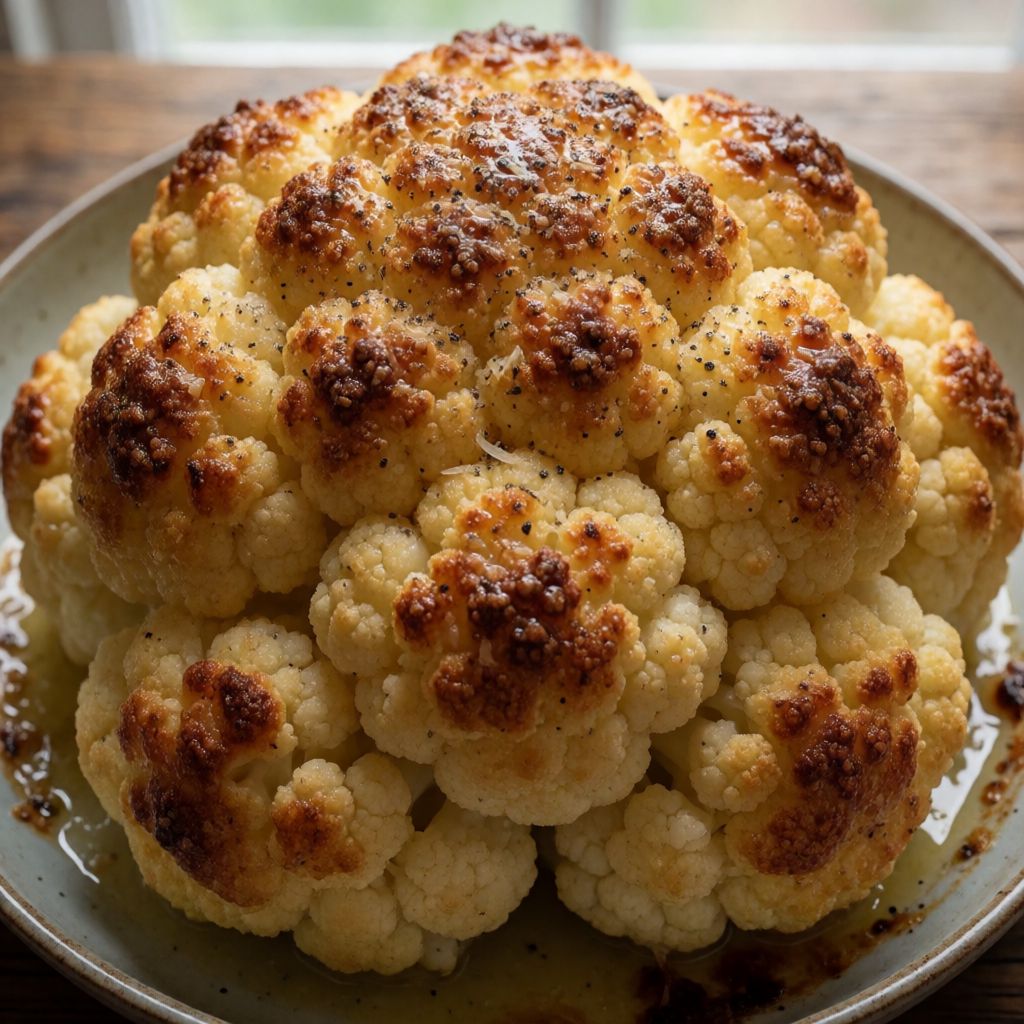
 AI photo
Roasted Whole Cauliflower
A whole cauliflower roasted with lemon butter, finished with parmesan and parsley.
Labels are worked out automatically from the ingredients and can be wrong. Check the packaging if it matters to you.
Ingredients
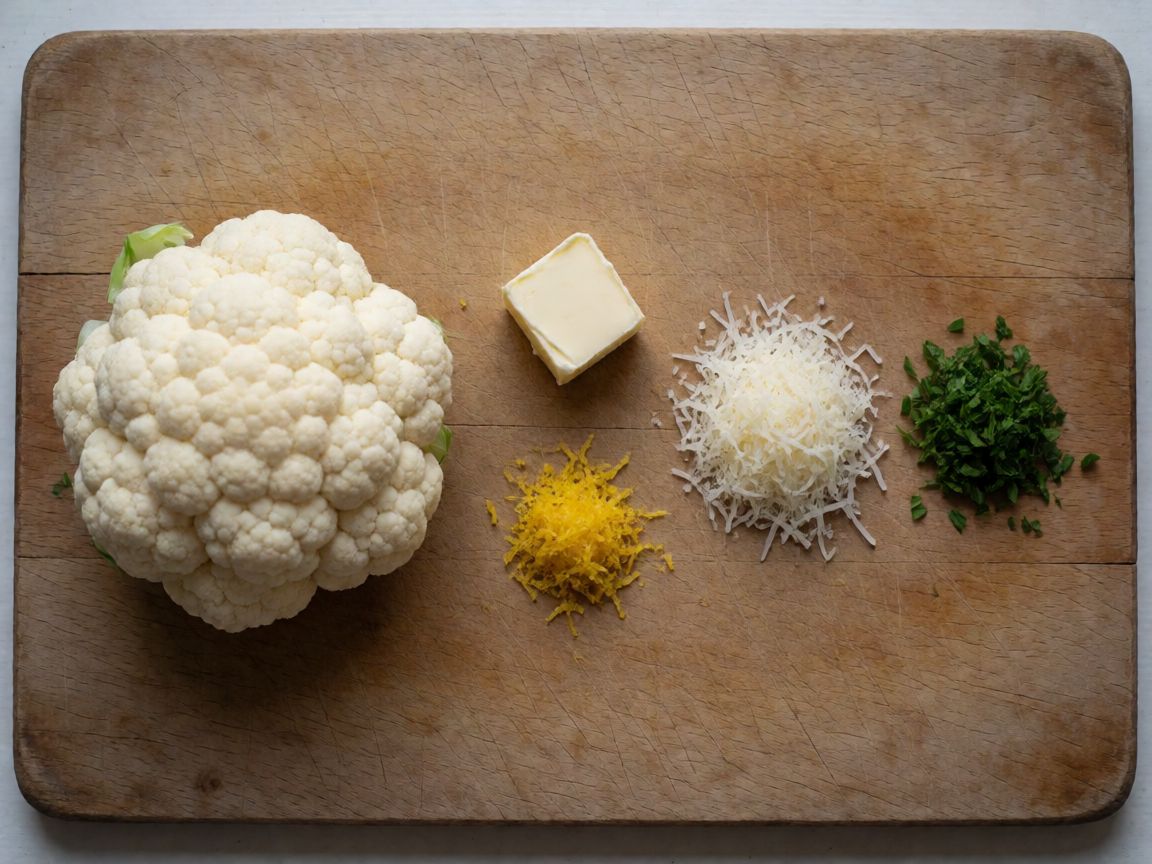
- 1 pcs Cauliflower
- 2 tbsp Butter room temperature
- 1 pcs Lemon finely grated zest
- Salt
- Black pepper freshly ground
- 30 g Parmesan freshly grated
- 1 bunch Parsley finely chopped







Steps
Rinse the cauliflower, remove the leaves and pat the head dry with a clean cloth.
Mix the butter with the lemon zest and a small pinch of salt.
Spread the lemon butter all over the cauliflower, adding a little extra lemon zest if you like.
Sprinkle with salt and freshly ground black pepper.
Roast the cauliflower in a preheated oven at 175°C with convection for 35–45 minutes, until the head is golden on top.
40 minBefore serving, sprinkle with parmesan and parsley.
A whole cauliflower roasted like a small, pale joint of meat — that's the trick to understanding it. You don't cut it into florets and scatter it about; you leave the head intact, dress it, and let the oven do to it what it does to a chicken: crisp the outside, soften the inside, and concentrate flavour instead of washing it away in steam.
What decides whether this works is moisture and fat, in that order. A cauliflower is mostly water trapped in tight little trees of cell walls. Roast it wet and those cells steam before they brown — you get a sad, soggy dome with pale patches. That's why you pat it dry after rinsing: not fussiness, just removing the one thing standing between you and colour. The butter does the opposite job — it's the fat that carries heat evenly across the curds and lets the Maillard browning actually happen on the surface, the same reason your Sunday roast potatoes crisp in dripping and never in water.
Some say you need to parboil a whole cauliflower first, or it'll never cook through in the middle. No — because this isn't a potato with a dense core; it's an open lattice of florets fused at a stalk, and hot air gets into the gaps a parboil would only make soggier. What you actually need is low, steady, dry heat for long enough, which is exactly what a fan oven gives you — convection here isn't decoration, it's the mechanism: moving air strips the surface moisture continuously so the whole head browns, not just the top nearest the element.
The cauliflower itself is the one ingredient with no real substitute — this recipe is built around its shape, a head that holds together and can stand on its own in a roasting dish like a little loaf. Pick one that's tight and pale, no grey patches, leaves still a bit perky if attached — that tells you it hasn't been sitting about losing moisture, which matters because you want *it* to lose moisture to the oven, not to your fridge drawer first. Romanesco works the same way if you want the pointed, almost architectural look instead; broccoli won't — the stalk's too dense and the head too loose, it'll dry out before the core cooks.
The butter and lemon zest paste is doing two jobs at once: fat for browning, and the zest's oils perfuming that fat rather than the florets directly, because zest rubbed straight onto wet vegetable just slides off. Any soft fat with no flavour agenda of its own works here — a neutral oil, even softened ghee — but butter earns its place because milk solids in it brown faster than the vegetable does, giving you colour slightly ahead of where plain oil would. If you're avoiding dairy, oil plus a very thin film of honey mimics that early browning reasonably well.
Salt and pepper go on after the fat, not before, for the same reason you salt a steak just before it hits the pan — salt pulls moisture to the surface, and here you want that moisture pulled out *into* the butter and air, not left sitting under it keeping the surface damp. A small pinch in the butter itself seasons from within; the sprinkle after seasons the surface you're about to eat first.
Parmesan and parsley go on at the very end, off the heat, because this is garnish, not cooking — melt parmesan in a hot oven for ten more minutes and you get a rubbery crust, not the salty, nutty dusting you actually want. Any firm, well-aged hard cheese substitutes here on the same logic — it needs to be dry enough to grate fine and sharp enough that a little goes a long way; a soft cheese will just slide off the butter and pool. Parsley's job is purely freshness against all that roasted richness — a bitter note like watercress does a similar job if that's what's in the fridge.
One honest note about the domestic oven: a wide pan or baking dish stands in fine for a tray, but don't crowd the cauliflower against the sides — air needs to move all round it the way it would round a Sunday joint, or one face stays pale while the rest colours. And patience is the real ingredient missing from the ingredient list. A whole head takes its own time to give up its water and take on colour; poke at it too soon, in a rush to serve, and you'll carve into a cauliflower that's golden outside and still raw at the heart.