
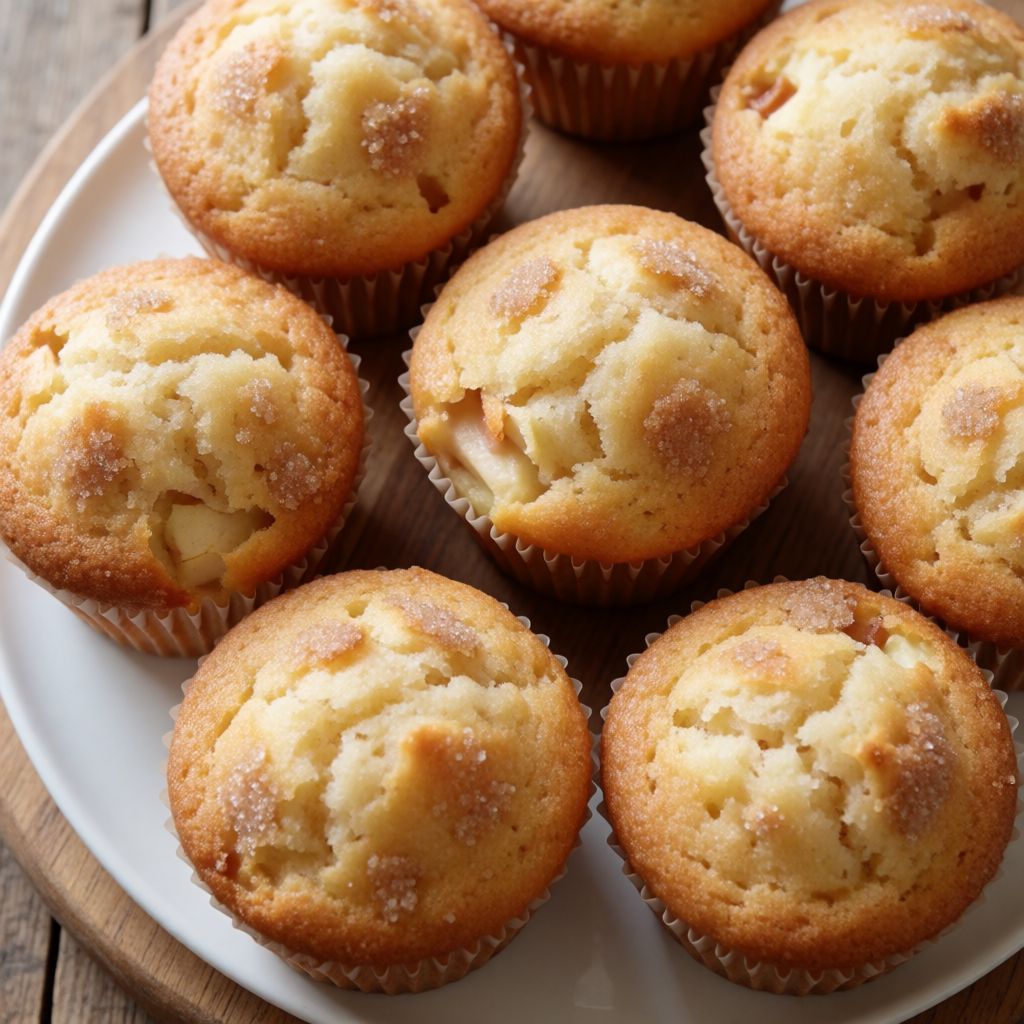
 AI photo
Apple Muffins
Soft spiced apple muffins with hazelnuts, finished with a light sugar crust on top.
Labels are worked out automatically from the ingredients and can be wrong. Check the packaging if it matters to you.
Ingredients
- 150 g Butter soft, room temperature
- 175 g Caster sugar
- 2 pcs Eggs
- 100 ml Yogurt
- 30 g Wholemeal flour
- 100 g Plain flour
- 1 tsp Cardamom ground
- 1 tsp Cinnamon ground
- 1.5 tsp Baking powder
- 1 pinch Salt
- 40 g Hazelnuts finely chopped
- 200 g Apple cut into small cubes
- 1 tbsp Caster sugar for sprinkling











Steps
Beat the butter with the sugar until light, fluffy and smooth.
Add the eggs one at a time, beating well after each addition.
Mix in the yogurt and wholemeal flour.
Combine the plain flour, cardamom, cinnamon, baking powder and salt, then sift into the batter.
Gently fold the batter, then stir in the hazelnuts.
Add the diced apple and fold gently into the batter.
Divide the batter among the muffin tins.
Sprinkle with a little sugar and bake in a fan oven preheated to 175°C for about 20 minutes, until cooked through in the middle.
20 minLet the freshly baked warm apple muffins cool slightly on a wire rack before serving.
A muffin is a cake pretending to be humble — same creamed-butter logic as a Victoria sponge, just dressed down into a paper case so it feels like breakfast instead of pudding. What decides whether these work is air: how much of it you beat into the butter and sugar at the start, and how little you knock out once the flour goes in. Beat first, handle later as if it owes you nothing.
The apple is the other half of the equation, and it's doing a job, not just sitting there for flavour. Cubed, not grated — grated apple weeps into the batter and you get a soggy crumb with no bite left; cubed, it holds its shape and gives you a pocket of warm, barely-cooked fruit in each one. Some say apple makes muffins heavy. No — too much liquid makes them heavy, and 200g of diced fruit against this much flour and raising agent is well within what the structure can carry.
Cardamom and cinnamon aren't decoration either — cardamom has a sharp, almost citrus lift that cuts through the butter and sugar so the whole thing doesn't just taste sweet and flat. Leave it out if you must, but know you're losing the one note that stops this being a plain apple cake in miniature.
This isn't a kazan dish, it's a tin-and-oven dish, so your oven is the variable you actually control. A fan oven at 175°C is a convection promise — hot air moving fast enough to set the outside before the inside collapses. If your oven runs its own way (most do, by 10-15 degrees in either direction), that's the first thing to know about it, not guess at while the muffins are already in.
Butter has to be properly soft — not melted, not fridge-cold and resistant, but soft enough that a sugar crystal can tear into it and drag in a bubble of air as it goes. That's the entire mechanism of "beat until light and fluffy": you are not mixing fat and sugar, you are manufacturing thousands of tiny air pockets that the raising agent will later inflate. Skip this stage or rush it cold, and no amount of baking powder fixes a dense muffin, because baking powder expands bubbles — it doesn't create them from nothing.
Eggs one at a time is not fussiness for its own sake. Butter is fat, egg is mostly water, and fat and water don't want to mix in one go — add all the egg at once to cold-ish butter and it splits, curdles, looks like scrambled eggs floating in grease. Adding it slowly lets the egg's own proteins hold the mixture together as an emulsion while it comes together. If it does split anyway, a spoonful of your measured flour beaten in will pull it back — that's the flour's structural job starting early, not a failure on your part.
Two flours here, wholemeal and plain, and that's a texture decision, not a health one. Wholemeal brings bran and a slight nuttiness that plain flour, stripped of the husk, can't give you; plain flour brings the lightness wholemeal alone can't, because its lower bran content means less interference with gluten strands forming cleanly. Use all plain if that's what's in the cupboard — you'll lose a bit of chew, not the muffin itself.
Yogurt is acid plus moisture. The acid reacts with the baking powder for a touch of extra lift, and the moisture keeps a butter-heavy batter from eating all your rise as dryness instead. No yogurt — buttermilk does the same job, or a spoon of lemon juice stirred into ordinary milk. Don't swap in cream; it's fat where you need acid.
Hazelnuts, finely chopped, add bite and a toasted note once the oven's heat hits their oil — they're not filler. Any nut that isn't oily enough to turn rancid quickly works the same way: almonds, walnuts, pecans. Skip them for a nut allergy and you lose texture, not structure — the muffin still rises fine without them.
The apple itself: pick one that holds its shape under heat rather than collapsing to mush — a Bramley will fall apart, a Granny Smith or a firm eating apple like Braeburn stays as cubes. In England that's an easy swap to make at any greengrocer, and it's worth asking rather than grabbing whatever's nearest, because a mushy apple gives you wet pockets instead of fruit pockets.
Folding, at steps 5 and 6, is the one word in this whole recipe that's doing quiet, serious work. Stirring vigorously after the flour goes in develops gluten the way bread wants it developed — strong, stretchy, chewy. A muffin doesn't want that; it wants tender crumb, so you fold, meaning you turn the batter over on itself gently until just combined, lumps and all, rather than beating it smooth. Overmix here and you get what every baking book calls "tunnelling" — long holes running up through the muffin, and a rubbery, tough top. That defect traces straight back to this step, not to the oven.
The sugar sprinkled on top before baking isn't a finishing flourish either — it melts and recrystallises slightly as it bakes, giving you a faint crack and crunch on top against the soft crumb underneath. It's a small thing and it's the difference between a muffin that looks homemade in a good way and one that looks like it needed icing to hide something.
As for doneness: "about 20 minutes" is your floor, not your answer. A skewer or a thin knife into the middle of the biggest one — if it comes out with wet batter clinging, it needs more time; if it comes out clean or with just a few moist crumbs, it's done. The middle rising into a slight dome and springing back when pressed lightly is the other tell. Trust what you see and feel over the clock, because your oven, your tin, even how full each paper case is will all shift that number a little. And once they're out — let them sit on the rack. They're still cooking internally from carried-over heat for a few minutes, and cutting in straight away just makes them look wetter than they are.