
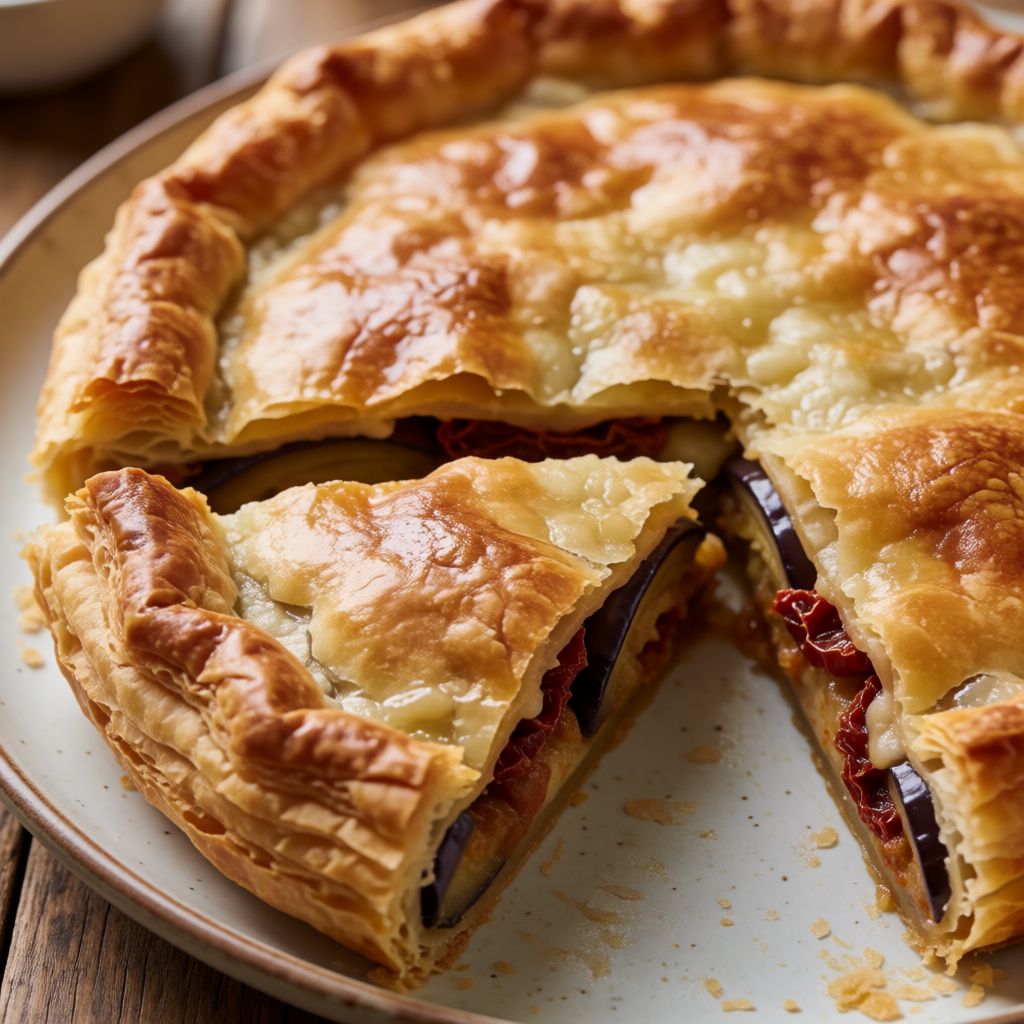
 AI photo
Aubergine Pie
A layered pie of aubergine, sun-dried tomatoes, olives and melting cheese in puff pastry.
Labels are worked out automatically from the ingredients and can be wrong. Check the packaging if it matters to you.
Ingredients
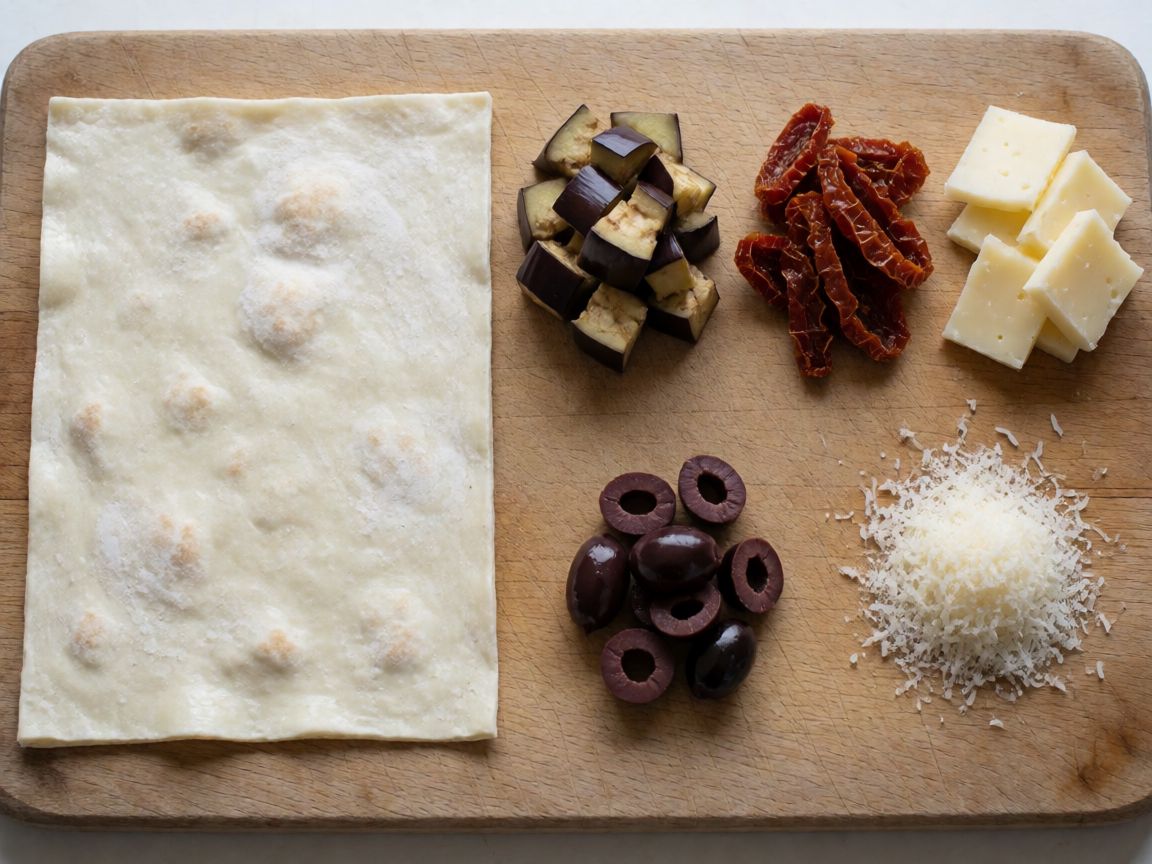
- 1 pcs Puff pastry
- 300 g Aubergine
- 100 g Sun-dried tomatoes
- 300 g Provolone
- 150 g Pitted black olives
- Salt to taste
- Black pepper to taste
- Parmesan to taste






Steps
Line a buttered 26 cm tin with the puff pastry and prick the base with a fork.
Wash the aubergines, peel and cut into very thin slices.
Layer the pie: half the aubergines, salt and pepper, half the sun-dried tomatoes and olives.
Add half the provolone, sliced.
Repeat all the layers with the remaining ingredients: aubergines, salt and pepper, sun-dried tomatoes, olives and provolone.
Finish with a layer of grated Parmesan, seal the edges of the pie and bake at 175°C for 35 minutes.
35 minServe the pie while warm.
This is a layered pie that works like a lasagne turned sideways: pastry as the vessel, aubergine as the thing that needs taming, and salty extras — olives, sun-dried tomato, provolone — doing the seasoning so you barely need to think about it. It's not a quiche, there's no egg custard holding it together. What holds it together is gravity, melted cheese, and the fact that aubergine, once cooked, collapses into something soft enough to bind to its neighbours.
The whole pie stands or falls on one thing: whether the aubergine gives up its water before it goes in, or does it in the oven instead, straight through your pastry base. Raw aubergine is mostly water locked into a spongy structure. Heat breaks that structure down and the water comes out — the only question is where. If it comes out in a bowl before baking, you get a pie that slices clean. If it comes out in the tin, you get a soggy bottom and a pastry that never had a chance, no matter how long you bake it.
Some say raw aubergine slices straight into a pie is fine because "it'll cook in the oven anyway." No — it will cook, but it releases its water slowly over 35 minutes, right into pastry that's already sealed in on all sides with cheese and tomatoes sitting on top. The pastry can't breathe, can't crisp, and ends up pale and wet underneath. Thirty-five minutes at 175°C is enough to melt cheese and brown a top — it is not enough to also evaporate a kilo of vegetable water through a lid of provolone.
So before any of this goes near the pastry: salt your aubergine slices, very thin as the recipe says, and let them sit — fifteen, twenty minutes, until you see beads of water sitting on the surface like sweat. That's not decoration, that's the water leaving under its own power, pulled out by osmosis because salt outside means water wants to go outside too. Pat them dry. Now they go into the pie already lighter, and whatever moisture is left will just baste the layers instead of flooding them. This is the one step not written down that decides the whole dish — patience here is the actual ingredient, not the pastry, not the cheese.
The aubergine itself: pick one that feels heavy for its size and has tight, glossy skin — that's dense flesh, few air pockets, less bitterness from old seeds. Slice it thin enough to fold, not thick enough to stay firm — you're building layers, not stacking planks. No courgette substitute here pretending to be the same thing; courgette has less structure and will turn to mush rather than soften into a layer, because its flesh is more water and less of the spongy cell wall aubergine has that collapses rather than disintegrates.
Provolone is doing two jobs: salt and glue. Any cheese that melts smoothly and isn't shy on flavour will do the same work — the criterion is "melts without turning oily or stringy-tough," which rules out things like a dry cheddar that separates into grease and solids under heat. A young, mild provolone melts because its proteins are still loosely structured; an aged one behaves more like parmesan, melting less and crisping more, which is actually closer to what you want in the top layer, not the middle. If you can't get provolone, a mozzarella that's been patted dry, or a mild gouda, does the middle-layer job fine.
Sun-dried tomatoes and olives are the seasoning layer, not a vegetable course — treat them as salt-and-acid delivery, not bulk. That's also why the recipe asks for pitted olives and not a careless handful with stones in — this is a domestic kitchen, not a kazan with someone watching every bite, and a stone in a slice at a Sunday table is the kind of thing people remember for the wrong reasons.
On the tin: a 26 cm tin feeding six is a generous but not huge slice each — this is a starter-sized pie unless you're serving it with a salad as the main event, in which case six becomes four. If your tin is glass or ceramic rather than metal, know that it carries heat more slowly and releases it more slowly too — the base may need a few extra minutes, which you judge not by the clock but by lifting an edge with a palette knife and looking for pastry that's gone from pale and waxy to properly golden and dry-looking, not just coloured on top.
Don't skip pricking the base — that's not fussiness, that's venting steam that would otherwise puff the pastry up into a dome and crack your neat layers apart from underneath. An ordinary fork, a few seconds, and the base stays flat enough to hold everything on top of it instead of fighting it.