
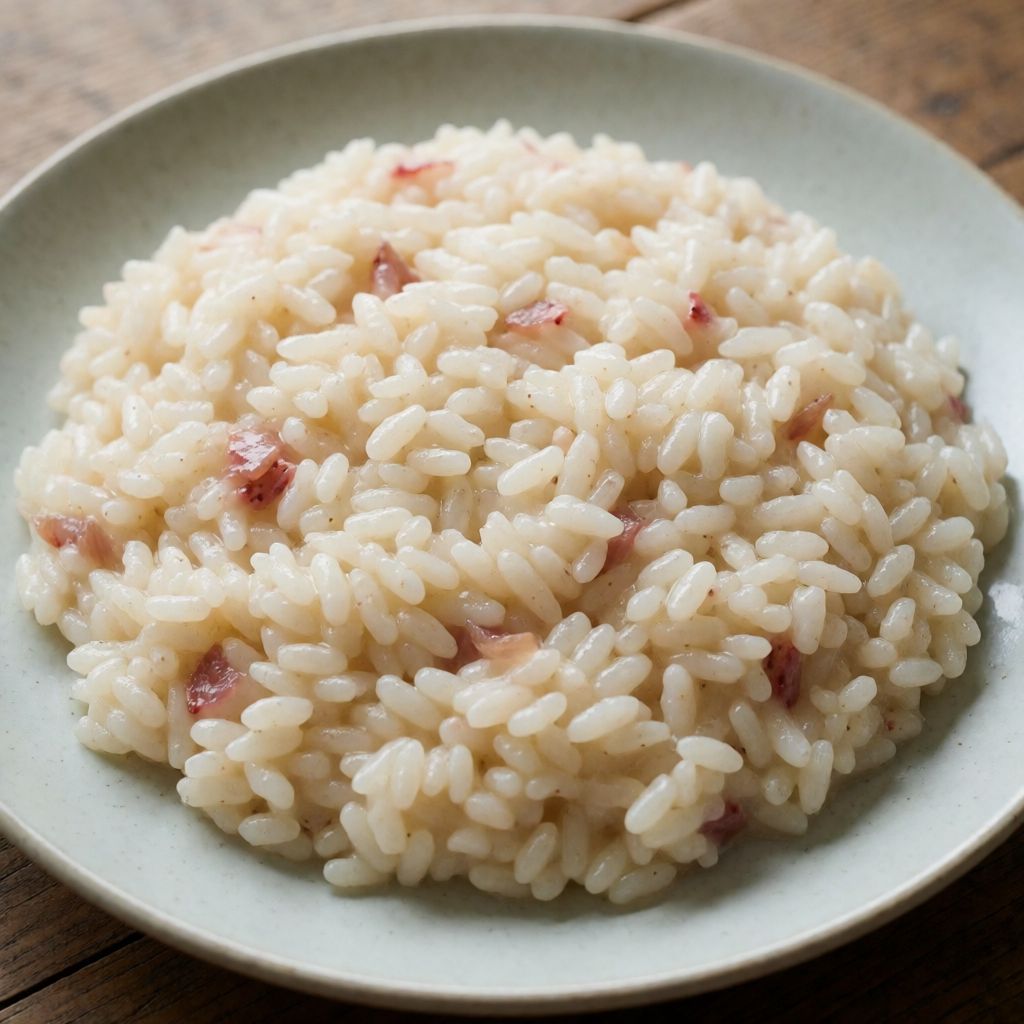
 AI photo
Strawberry Risotto
A creamy risotto with sweet strawberries and a splash of wine, finished with soft cheese.
Labels are worked out automatically from the ingredients and can be wrong. Check the packaging if it matters to you.
Ingredients
- 350 g Risotto rice
- 1 pcs Shallot
- Olive oil
- Salt to taste
- Black pepper to taste
- 80 g Cream cheese or robiola
- 120 ml Wine Brachetto d'Acqui or Moscato d'Asti
- 5 pcs Strawberries large
- Strawberries for serving
- 1 l Stock









Steps
In a saucepan, sauté the shallot in two tablespoons of olive oil.
Add the rice and toast it briefly.
Pour in the wine and let it evaporate completely.
Cook the risotto to doneness, gradually adding the stock.
5 minutes before it's done, add salt, black pepper to taste and the strawberries, cut into pieces.
5 minAt the end of cooking, stir in the cream cheese until creamy.
Serve, garnished with a few strawberries.
What was changed
Risotto rice Rice has been specified as risotto rice, since a proper risotto needs a starchy short-grain variety.
Risotto is not a rice dish. It's a starch-management exercise, and strawberries are just the latest thing people have decided to manage it with. The rice releases a sugar called amylose into the liquid around it, slowly, grain by grain, and that's what gives risotto its body — not cream, not stock reduced to a syrup. Everything in this recipe exists to control that release: how fast, how much, with what it mixes.
What decides whether this works is the same thing that decides any risotto: whether you let the rice tell you when to add the next ladle of stock, rather than following a clock. Pour on a schedule and you'll either flood the pan — rice sitting in a puddle, releasing nothing because it's not working for its liquid — or starve it, and it catches on the bottom and tastes of scorch underneath sweetness, which is worse than either flaw alone.
The strawberries are added late, in the last five minutes, and that's not decoration-timing, that's physics: cook fruit twenty minutes in hot stock and you get strawberry jam with rice in it — all the water boiled out, the sugars concentrated and turned savoury-sour in a way nobody wants. Five minutes gives you warmed fruit that still remembers being fruit: some bite, some brightness, the perfume still there. Some say this dish is a novelty, rice shouldn't meet berries — no, because risotto has taken onto itself pumpkin, saffron, nettles, whatever was in the larder of whoever was poor and had rice; sweetness is just the latest regional accident, in this case a nod to the sweet Piedmontese wines it's cooked with.
Start with the rice itself, because the whole method depends on which rice you use. You need a short, fat grain with a core of harder starch surrounded by a softer one — Arborio, Carnaroli, Vialone Nano are the names you'll find in any UK supermarket now, usually bagged as "risotto rice." Basmati or long-grain will not do this; they're bred to stay separate and dry, the opposite of what you want. If all you have is paella rice, it's close enough in family to get you through, though it holds its shape more stubbornly.
The shallot goes in first and gently, in oil with no fight in its flavour — olive oil here, nothing more assertive, because the dish is meant to taste of rice, wine and fruit, not of itself. Toasting the rice afterward — a minute or two until the grains go slightly glassy at the edges — seals that outer starch layer just enough that the grain releases it in a controlled trickle rather than all at once. Skip this and the rice dumps its starch into the first splash of stock, and you end up with porridge far sooner than you meant to.
The wine matters more than it looks like it should. Brachetto d'Acqui or Moscato d'Asti are both low-alcohol, sweet, lightly sparkling wines from Piedmont — they bring acidity to balance the sweetness that's coming from the strawberries later, and a faint rose or muscat perfume that plain dry white wine won't give you. If you can't find either, a sweet rosé or even a splash of elderflower cordial loosened with dry white wine will get you closer than a bone-dry Pinot Grigio, which will just fight the fruit instead of flattering it.
Stock should be warm when it goes in — cold stock shocks the rice and stalls the cooking, so you're fighting the clock rather than the grain. A litre is generous, and you won't necessarily use all of it; stop pouring when the rice bends to a slight bite rather than snapping, with a little resistance left in the centre. That's doneness by feel, not by minutes — the 25 minutes on the box is a floor, not a target, because stove heat, pan width and even the day's humidity shift it.
A kazan-sized pan is of no use to anyone making dinner in a London flat, and you don't need one: a wide, heavy-based pan that lets the rice sit in a thin-ish layer is actually closer to how risotto wants to be cooked than a deep pot, because heat and evaporation reach every grain evenly. Keep the heat low enough that the stock simmers rather than boils when you add it — a hard boil knocks the grains against each other and breaks them before they're done, giving you starch cloud instead of a creamy sauce holding whole grains.
Strawberries, finally: go for ones that are ripe but still a bit firm, not the soft, weeping kind that have already turned to mush in the punnet — those will disintegrate entirely in five minutes of heat and leave you with pink rice rather than rice with strawberry in it. Cut them in pieces rather than slices, so each spoonful carries a bit rather than a slick. And patience is doing real work in step four here — the whole dish stands or falls on whether you let each ladle of stock absorb before adding the next, not on any ingredient at all.