
 AI photo
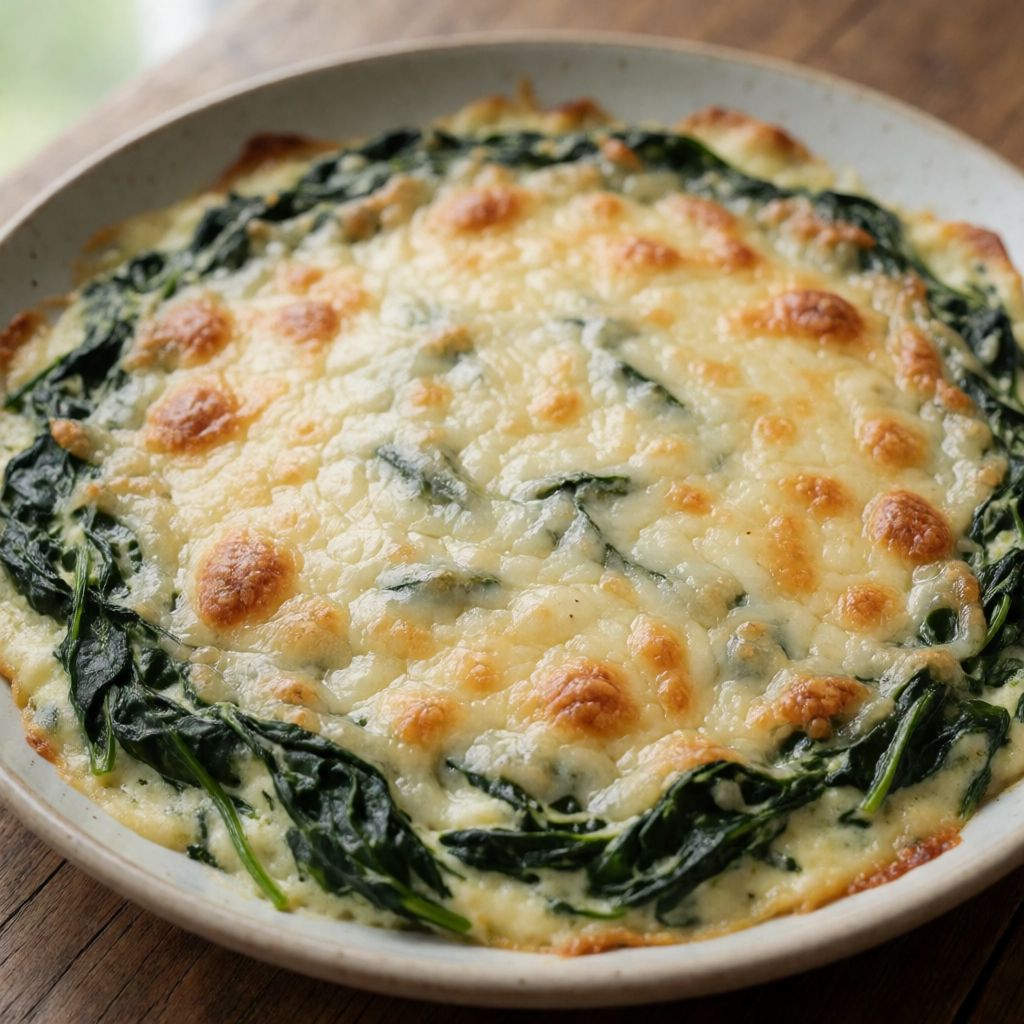
Spinach Baked Under a Cheese Crust
A comforting side of spinach layered with béchamel and baked under a golden cheese crust.
Labels are worked out automatically from the ingredients and can be wrong. Check the packaging if it matters to you.
Ingredients







Steps
Boil the frozen spinach in salted boiling water.
15 minTrim the roots, stems and tough ribs from the fresh spinach, then soak it in water with a little bicarbonate of soda.
Simmer the cleaned fresh spinach in a covered pan with a little water.
Squeeze out the spinach and sauté it in a pan with butter.
Preheat the oven to 180°C.
Line the bottom of a baking dish with a layer of béchamel, add the spinach, cover with more béchamel and sprinkle with Parmesan.
Bake in the oven until a golden crust forms.
15 minTransfer the baked spinach to plates and serve hot.
This is spinach doing something unusual for an English table: it's not a soggy side boiled to grey submission, it's held in a béchamel, armoured under Parmesan, and pushed into the oven until the top sets into a crust. The whole dish is really a conversation between two kinds of wet — the water sitting inside the spinach, and the milk sauce holding it together — and whether you solve that water problem decides if you get a dish that holds its shape on the fork or a dish that turns into green soup the second you cut into it.
Spinach is almost entirely water. Cook it any way you like — boiled, simmered, sautéed — and it collapses down to a fraction of its raw bulk, and all that volume it lost had to go somewhere: into the pan, into the béchamel, into your gratin dish turning the whole thing watery. So every step before the oven is really one long argument with moisture. Boil it, drain it, then squeeze it — hard, with your fists, like wringing a cloth — because a dish that bakes wet never gets a crust, it gets a wet lid with scorched spots.
The béchamel is doing a second, separate job: it's not there for flavour so much as for structure. It's a sauce built to hold fat and liquid together without splitting, which is exactly the skill spinach needs borrowed, since spinach on its own has no binding power at all. Sandwich it — sauce, spinach, sauce — and what bakes isn't naked leaves drying out under heat, it's leaves suspended in something that can take a gratin crust on top without collapsing underneath.
Start with the spinach itself, because fresh and frozen ask for different handling and that's not fussiness, it's biology. Fresh spinach carries grit in every crease of its leaf and a faint metallic edge some people are sensitive to; the soak in water with a pinch of bicarbonate of soda loosens the dirt and softens that edge a touch — it's not alchemy, bicarbonate is mildly alkaline and spinach's sourness is partly acid, so it knocks the sharpest note down. Frozen spinach skips all that: it's pre-washed, pre-trimmed, already blanched, which is why it goes straight into boiling water with no soaking at all. Either way you end up at the same place — a sodden mass that must be squeezed dry before it touches anything else, because any water left in the leaf is water that dilutes your béchamel in the oven and stops the top from ever crisping.
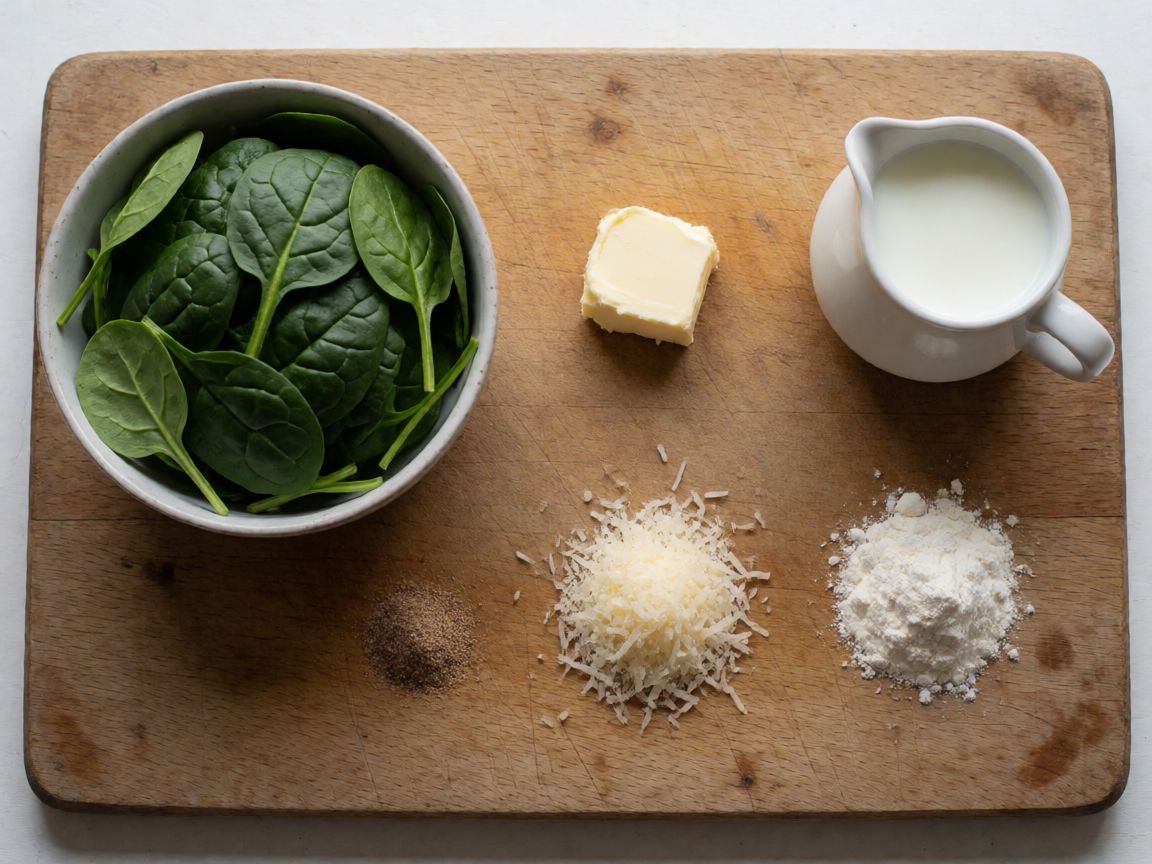
Butter appears twice for two different reasons. The first 100g is for sautéing the squeezed spinach — this isn't about richness, it's about driving off the last of the moisture over direct heat while coating the leaf in fat, which is what gives baked spinach body instead of stringiness. The second 25g goes into the roux, the base of the béchamel, where it's cooked with flour before the milk goes in — this is just French sauce-making logic (the roux), and you don't need a kazan or a copper pan for it, a small saucepan on your ordinary hob does the job; the only thing that matters is cooking the flour in the butter for a minute or so before the milk arrives, so you lose the raw, pasty taste of uncooked flour. If you're out of butter for the roux specifically, any neutral fat with no flavour of its own — a flavourless oil, even — will thicken milk the same way, though you lose a little of butter's own roundness.
Parmesan here is doing a job no other cheese quite does as well: it's old, hard, very low in moisture, and that matters because a wetter cheese — mozzarella, say — would melt into a slick instead of a crust. Under the oven's heat the Parmesan's proteins and fats brown and tighten rather than ooze, which is exactly the texture you want on top: shattering, not stretching. A strong hard grana-style cheese is the real criterion; Parmesan is simply the easiest to buy in Britain.
Nutmeg is traditional in béchamel not by superstition but by habit that stuck because it works: a few scrapes cut through the flatness of warm milk and butter without announcing themselves as "nutmeg" — you should taste roundness, not spice. Salt goes in at more than one stage — the boiling water, the sauté, the sauce — because spinach loses so much volume that under-salting any one stage leaves the whole dish bland once it's reduced down to a quarter its raw size.
On the oven: 180°C is a heat for setting and colouring a sauce that's already cooked, not for cooking raw ingredients through — everything underneath the Parmesan is already done before it goes in. What you're watching for isn't a clock, it's the surface turning from pale and shiny to freckled gold, Parmesan's fat rendering at the edges first. Fifteen minutes is where to start checking, not where to stop. A proper gratin or baking dish helps here more than a deep casserole would, because you want surface area — more cheese exposed to heat means more crust, and in a flat without a grill you're relying on the oven's top heat alone to do that browning, so don't crowd it into a tall, narrow dish where the top barely reaches the hot air.
This whole method — sauce as scaffolding, cheese as crust — only really makes sense once you think about what a gratin was built to solve in the first place: leftover or humble vegetables, stretched and dressed up with dairy and heat until they held together as something worth putting in front of people, long before anyone worried about whether it was "authentic". Four people, one dish, and the patience to squeeze the spinach properly — that's the whole secret, and there isn't a shortcut round it.
·