
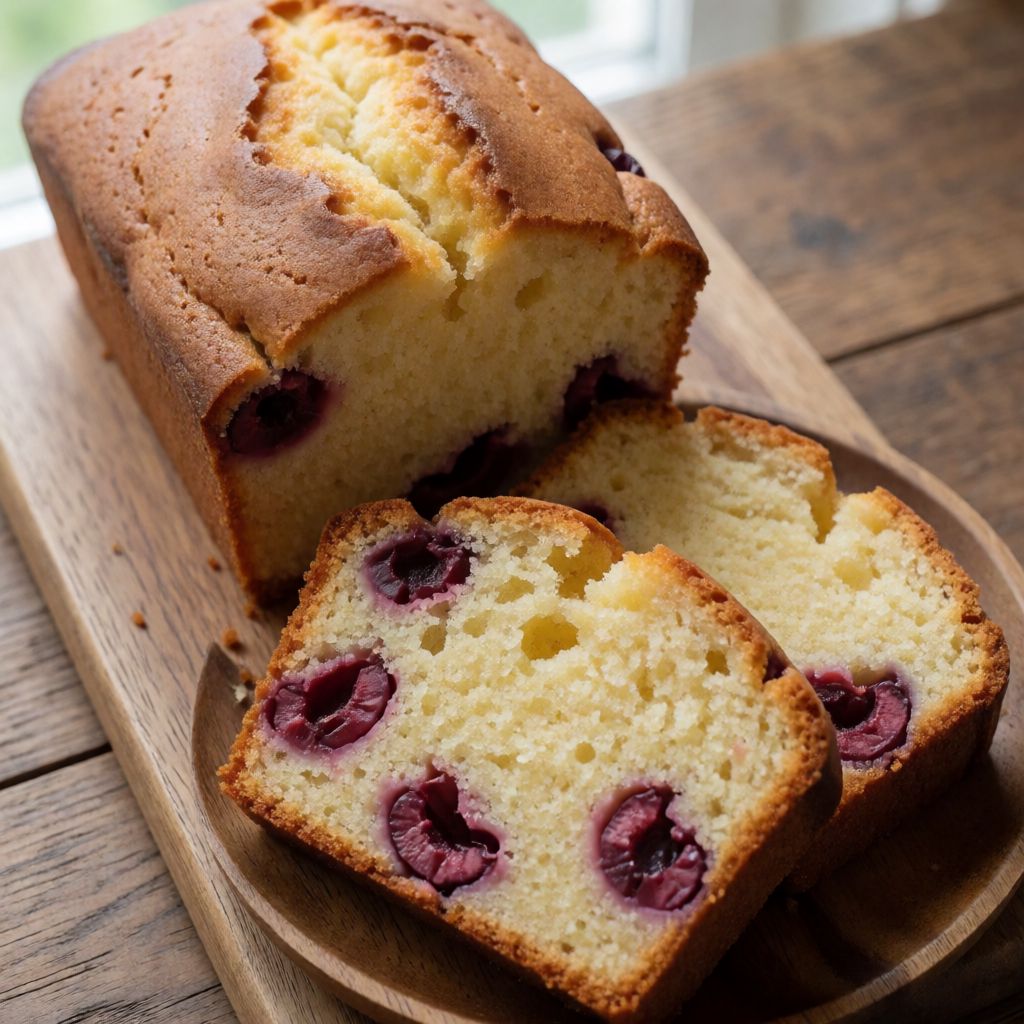
 AI photo
Cherry Loaf Cake
A buttery loaf cake studded with fresh cherries, baked until golden and dusted with icing sugar.
Labels are worked out automatically from the ingredients and can be wrong. Check the packaging if it matters to you.
Ingredients
- 350 g Cherries pitted
- 200 g Plain flour
- 180 g Butter softened
- 50 g Potato starch
- 1 pcs Baking powder
- 1 tsp Vanilla extract
- 3 pcs Eggs
- 180 g Caster sugar
- Salt to taste
- Icing sugar to taste, for dusting









Steps
Beat the softened butter with the caster sugar using a whisk.
Add the eggs one at a time, along with the salt and vanilla extract, mixing until smooth and creamy.
In a separate bowl, mix the plain flour, baking powder and potato starch, then gradually fold into the creamed mixture.
Wash the cherries and remove the stones, carefully cutting a slit on the side.
Put the cherries in a bag, add a little flour and shake until the fruit is coated.
Grease a loaf tin with butter and line it with baking parchment.
Pour in half the batter, level it, then arrange half the cherries on top, pressing them in lightly.
Add the remaining batter and scatter the rest of the cherries on top.
Bake in a preheated fan oven at 160°C for 1 hour.
60 minCheck with a wooden skewer; if needed, bake for a further 5–10 minutes.
Remove from the oven and let cool to room temperature before turning out of the tin.
Turn the cake out carefully so it doesn't crack.
Before serving, dust with icing sugar through a sieve.
What was changed
Vanillin was swapped for Vanilla extract, which is what shoppers normally buy here.
A loaf cake is really a creamed sponge wearing a different hat — same logic as a Victoria sandwich, just baked tall and narrow instead of flat and split. Butter and sugar get beaten together not for sweetness but for air: sugar crystals tear tiny pockets into the fat as you whisk, and those pockets are what lift the cake later, before the raising agent does a stroke of work. Skip that stage or rush it, and no amount of baking powder will save you — it can only expand air that's already there, it can't invent it.
What decides whether this cake works is restraint in two places: how gently you fold in the flour, and whether the cherries sink. Overmix once the flour's in and you develop gluten, which is exactly what you want in bread and exactly what you don't want here — it turns a soft crumb into something closer to chewy. And cherries, being wet and heavy, want to plummet straight to the bottom of the tin while the batter is still loose; coating them in flour first is the only real defence, giving the surface enough grip to stay where you put them.
The middle is the part people distrust — a few minutes of underbaked-looking cake under a skirt of ready set edges — but that's not a fault, it's structure finishing its work from the outside in. Pull it the moment the top looks done and you'll get a gluey seam running through the slice.
Six people, one standard loaf tin, roughly an hour's bake plus however long your oven actually takes to prove that middle is set — the skewer test exists precisely because every oven lies a little about its own number.
Butter: soft, not melted — melted butter can't hold air, it just coats the sugar and goes flat. Soft means it gives gently under a finger, not that it's gone glossy or started separating. If your kitchen's cold and the butter's stubborn, cut it into pieces rather than microwaving it; a short rest does what heat can't.
Caster sugar specifically, not granulated: the finer grain dissolves into the butter and shears it into smaller fat droplets as you beat, which is where the aeration actually happens. Granulated works in a pinch but you'll beat longer and get a coarser crumb for the effort.
Potato starch alongside the flour is doing a real job, not padding the ingredient list — starch has no gluten-forming proteins at all, so swapping part of the flour for it is a direct way to soften the crumb without fiddling with mixing technique. Cornflour does the same thing if that's what's in your cupboard; they're interchangeable here.
Eggs added one at a time, not all at once — each egg brings water, and butter doesn't want to take on water fast. Dump them in together and the mixture can split, curdling into something that looks like scrambled egg floating in fat. It'll still bake, roughly, but the texture suffers: a split batter traps air less evenly. A spoonful of your flour mixed in with a stubborn egg brings it back together if you feel it start to go.
Baking powder: this is your actual lift, working alongside the air you beat in, not instead of it. It's a mix of an acid and a base that only react once wet and warm — which is why nothing visibly happens to raw cake batter sitting on the counter. Use it fresh; it loses potency sitting open in a cupboard for months, and a flat loaf with a dense streak through the middle is often just old baking powder, not a mixing fault at all.
Cherries fresh, pitted, with that slit cut in the side — the slit isn't decorative, it lets juice escape as the fruit heats rather than building pressure and splitting the fruit open messily inside the crumb. Frozen cherries work too, but thaw and pat them properly dry first; extra water in the batter is extra steam fighting your structure as it sets, and a soggier seam around each fruit.
Icing sugar at the very end, through a sieve, once the cake's fully cool — dust it hot and it just melts into the surface and vanishes. Patience here costs you nothing but a few minutes, and it's the difference between a cake that looks finished and one that looks like you forgot a step.
·