
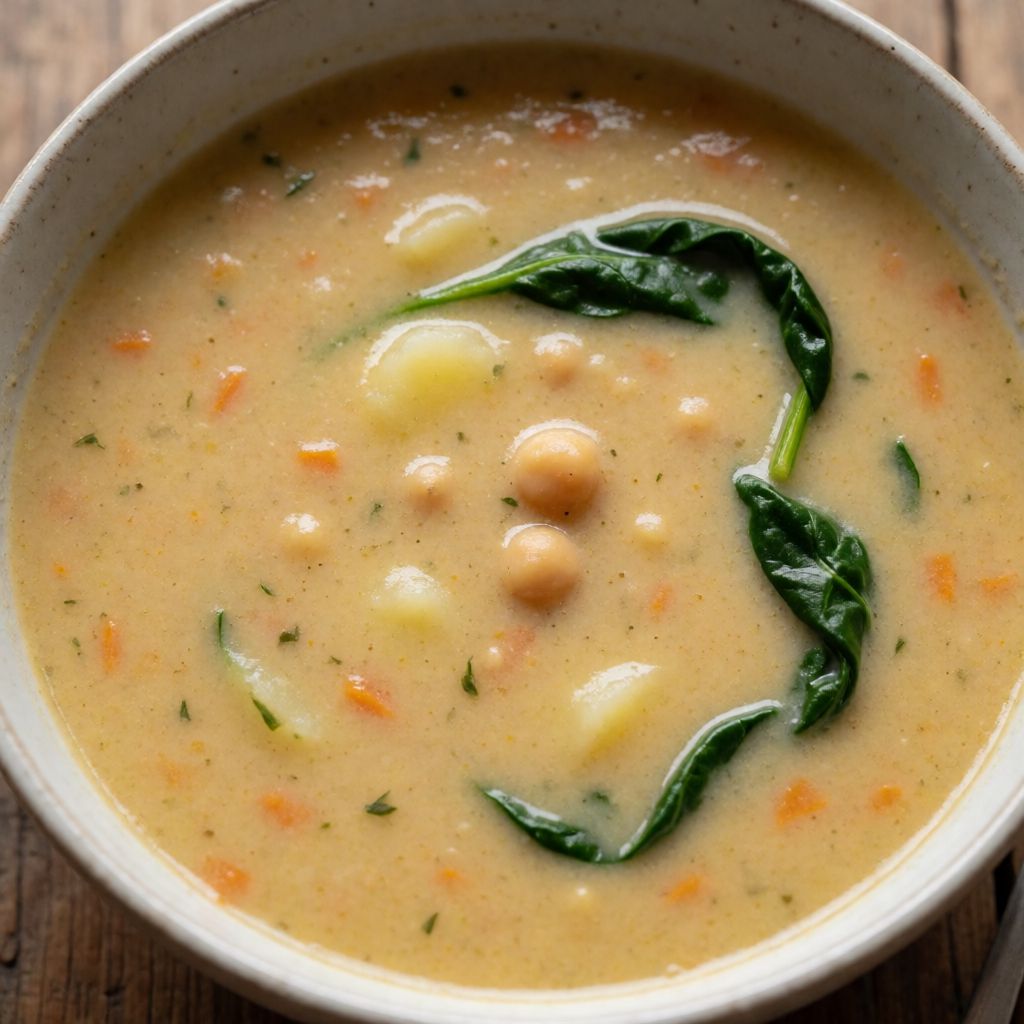
 AI photo
Provençal-Style Creamy Chickpea Soup
A warming creamy chickpea soup with spinach and fresh herbs, inspired by Provençal cooking.
Labels are worked out automatically from the ingredients and can be wrong. Check the packaging if it matters to you.
Ingredients
- 500 g Chickpeas
- 150 g Spinach
- 1 pcs Carrot
- 1 pcs Potato
- 2 pcs Spring onion
- 2 tbsp Fresh herbs chopped
- 2 tbsp Olive oil
- Salt to taste
- Black pepper to taste









Steps
Soak the chickpeas overnight with a bay leaf and a strip of kombu seaweed.
Boil the chickpeas in plenty of water for about 2 hours, adding salt near the end.
120 minChop and fry the spring onion in a pot with olive oil.
3 minAdd diced carrot and potato, and fry for a few minutes.
5 minAdd the cooked chickpeas, season with salt, black pepper and fresh herbs.
Cover with a lid and cook for 35 minutes.
35 minAdd the rinsed spinach.
Stir, wait a few minutes, then remove the pot from the heat.
Let the soup cool slightly, then blend until smooth.
Serve the creamy soup warm with croutons and a drizzle of olive oil.
What was changed
We swapped borage for Spinach, as it's easier to find in UK shops.
This is a peasant soup dressed up as something from a Provençal farmhouse table, and the dressing-up is honest — the French did feed themselves on chickpeas, olive oil, and whatever vegetable was still standing in the garden, because meat was for Sunday and this was for the rest of the week. What decides whether it works isn't the spinach or the herbs, it's the chickpea. Everything else is noise around a well-cooked bean.
A chickpea that hasn't softened all the way through stays faintly gritty even after the blender has pulverised it — the blade can shred a hard centre into fine grit, but it can't turn grit into cream. So the real work of this recipe happens the night before, in a bowl of water, long before anything touches heat. Soaking isn't about saving cooking time (it barely does) — it's about letting the dry seed take up water evenly, so that two hours later in the pot, the whole bean has had the same journey. Skip it and you get a soup with a soft outside and a sandy core, no matter how long you boil.
The carrot and potato aren't flavour here so much as texture insurance and bulk. Potato especially — once blended, its starch is what gives the soup body without you needing cream or flour, which is the Provençal economy again: dairy and butter cost money, a potato from the same garden as everything else costs nothing. Choose a potato that breaks down willingly rather than one bred to hold its shape in a salad — a floury one, the kind that goes fluffy when boiled for mash, not a waxy salad potato that stays stubbornly separate even under the blade.
The spring onion at the start is doing the job a regular onion does in most soups, just gentler and faster — it's there to lay down a base note before anything else goes in the pot, cooked only until it turns from sharp white to soft and faintly sweet, never until it browns, because browning here would mean bitterness fighting with the chickpea's delicacy later. Watch the colour, not the clock — "3 minutes" is a floor, not a verdict.
Spinach goes in last and leaves the heat almost immediately, and that's deliberate: spinach loses its green and turns to khaki sludge within minutes of real boiling, and worse, overcooked spinach brings a metallic, slightly bitter note that no amount of herbs will cover. It needs only enough heat to wilt and release into the broth, which is why the pot comes off the stove right after — the residual heat in the liquid finishes the job without punishing it.
Fresh herbs — parsley, a bit of thyme if you have it growing on a windowsill, whatever's soft-leaved and not woody — are added chopped and late-ish, because like spinach they fade under sustained heat; add them raw at the end if you want the smell as well as the taste. Olive oil here isn't just a cooking fat, it's a finishing one too, which is why the recipe asks for a drizzle at serving — any oil with no character of its own would do for the frying stage, sunflower or a neutral vegetable oil, but for the final drizzle you want something that actually tastes of something, because that last spoonful sitting on top is the one your spoon meets first.
On a domestic British hob, the two-hour simmer for the chickpeas is the stage people most often cheat, because two hours sounds like a lot for "just beans." It isn't a lot — it's the difference between a soup you can mash with a fork and one you need a blender's full strength to rescue. If your hob runs hot and the water's gone from a gentle shiver to a hard rolling boil, pull it back; a violent boil breaks the chickpeas' skins loose before the insides are done, giving you floating husks and a still-firm centre, which is the opposite of what two hours was meant to buy you.
Croutons at the end aren't decoration, they're the one bit of texture contrast in a dish that's otherwise entirely smooth — day-old bread, torn or cut, dried in a dry pan or the oven until it resists the spoon. Any stale, close-crumbed loaf will do; the croutons just need backbone, not a particular bread.