
 AI photo
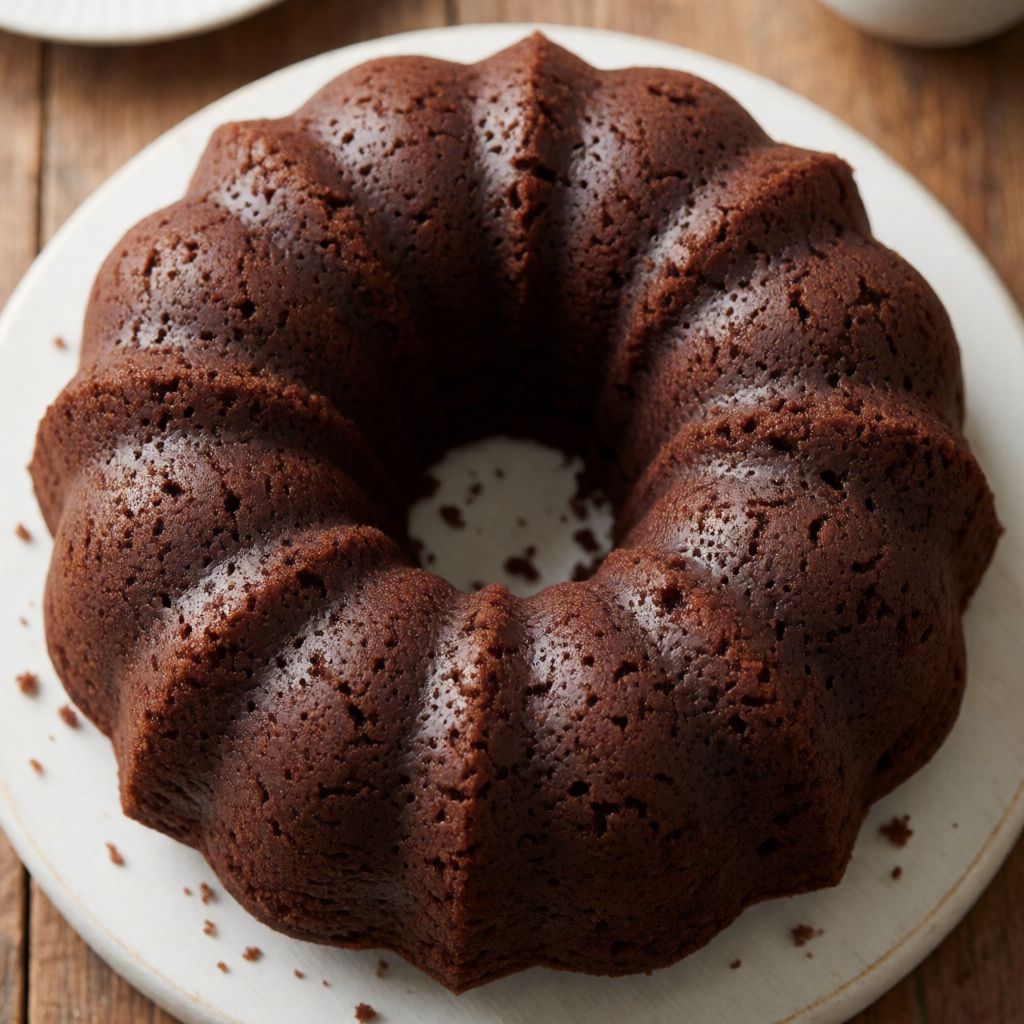
Chocolate Bundt Cake with Egg Whites
A light chocolate bundt cake made with whipped egg whites and chunks of white chocolate.
Labels are worked out automatically from the ingredients and can be wrong. Check the packaging if it matters to you.
Ingredients
- 4 pcs Egg whites
- 170 g Caster sugar
- 110 ml Vegetable oil
- 150 ml Water
- 50 g Cocoa powder
- 180 g Plain flour
- 16 g Baking powder
- 70 g White chocolate roughly chopped







Steps
Pour the sugar into a bowl, add the water and oil, and whisk with a mixer until smooth.
Sift in the flour, baking powder and cocoa powder, folding them into the mixture in small portions.
Separately whisk the egg whites into stiff, firm peaks, then gently fold them into the batter.
Add the roughly chopped white chocolate and carefully fold it into the batter.
Pour the batter into a 22-24 cm bundt tin, greased with butter and dusted with flour.
Bake in a fan oven preheated to 170°C.
42 minLet the cake cool slightly before serving.
This is a chocolate bundt that gets its lift and its lightness from egg whites and oil, not from butter and whole eggs — so it behaves differently in the bowl and differently in the oven than the Victoria sponge you're used to. Oil instead of butter means no creaming stage at all: there's no air to beat into fat, because there's barely any solid fat here. The air in this cake comes almost entirely from the whisked whites, so whether the sponge stands up tall or sits flat and dense depends on one thing — how well you whip those four whites and how gently you fold them in afterwards.
What decides success is the order of operations and the handling of the whites. Fold too roughly, or too long, and you knock the air straight back out — the bubbles you worked for collapse, and the oil-heavy batter, which has no structure to hold itself up without that air, bakes into something closer to a damp brownie than a risen bundt. That's not a disaster exactly, but it's not what you're making.
Some say egg-white cakes are finicky and only work with a stand mixer and a trained hand. No — a hand mixer and patience do the job; the whites just need to actually reach stiff peaks (they hold a point, don't slump when you tip the bowl) before they go anywhere near the chocolate batter, and you need to resist stirring once they're in, using a folding motion instead.
The cocoa and the white chocolate are doing two separate, almost opposite jobs — one bitter and dry, one sweet and fatty — and that contrast is most of the cake's character, not a decoration on top of it.
Sugar first, with the water and oil, whisked until it's smooth rather than grainy — this isn't creaming, there's no air being trapped here, it's simply dissolving the sugar enough that it won't leave a gritty texture later, and making sure the oil doesn't sit separate from the liquid as a slick on top. Any neutral vegetable oil works — the test is simple: it should have no smell of its own, so sunflower, rapeseed, a bland groundnut oil, all fine; extra virgin olive oil is the wrong choice here, its flavour fights the cocoa instead of staying out of the way.
The dry ingredients go in sifted and in small portions for a reason beyond tradition: cocoa powder in particular clumps stubbornly in a wet batter, and a big dump of it in one go leaves you working hard pockets of dry cocoa into a thick, oily liquid — which means overmixing one spot while another stays lumpy. Little by little, folding as you go, keeps the gluten in the flour from being worked too hard too — this is not a bread, you don't want elasticity, you want tenderness, so handle it only as much as it takes to disappear the lumps.
Four egg whites whipped to stiff peaks is the engine of the whole cake. This batter, being oil-based and quite wet, has almost no structure of its own to trap gas from the baking powder alone — the whites are what carry most of the volume. Stiff means stiff: pull the beater out and the peak should stand up and hold its shape, not flop over. Underwhipped whites give you a sponge that's merely okay; whipped past the point of stiff, they go grainy and start to weep liquid, and folding those in deflates the batter just as badly as not whipping them enough. Folding in — not stirring, not mixing — matters because stirring motion shears the bubbles apart; folding (cutting down through the centre, turning the bowl, lifting from the bottom) keeps most of the air intact while still combining the two mixtures.
The white chocolate, roughly chopped and folded in last, isn't there to make the cake sweeter in a general sense — cocoa powder is bitter and dry on its own, and without some pocket of fat and sugar running through the crumb, the whole cake reads as slightly austere. Chopped roughly rather than melted means you get soft, half-melted pools through the baked crumb rather than it blending invisibly into the batter — that's the point, you want to find it. If you don't have white chocolate, milk chocolate chips do a similar softening job, though the flavour balance shifts slightly sweeter and milkier; dark chocolate chunks go the other way entirely and intensify the bitterness rather than offsetting it, so it's a genuinely different cake, not an equivalent swap.
Greasing the tin with butter and dusting with flour, rather than trusting a nonstick coating alone, is what prevents the cake tearing when you turn it out — a bundt tin has ridges and a central tube, more surface for batter to grip onto than a simple loaf tin, and a sponge with no butter in the crumb to self-lubricate against the metal needs that help. In a British kitchen without a dedicated bundt tin, a plain round or loaf tin, similarly greased and floured, will bake the same cake — you lose the shape, not the texture.
At 170°C fan, 42 minutes is your lower bound, not your answer — ovens vary enough, especially fan ovens with their own quirks of hot spots, that you want a skewer or thin knife in the centre coming out clean, with maybe a few damp crumbs but no wet batter, as your real signal. A cake this moist from oil will look slightly underdone at the edges even when it's cooked through, so don't chase visual browning here — that instinct, trained on butter cakes, will make you overbake this one.
Letting it cool slightly before turning out and serving isn't a nicety — a bundt straight from the oven is fragile, the crumb hasn't set, and the structure the whites gave you will slump if you demould it too soon. Patience here is simply an ingredient: five, ten minutes resting in the tin costs you nothing and saves you a broken cake.