
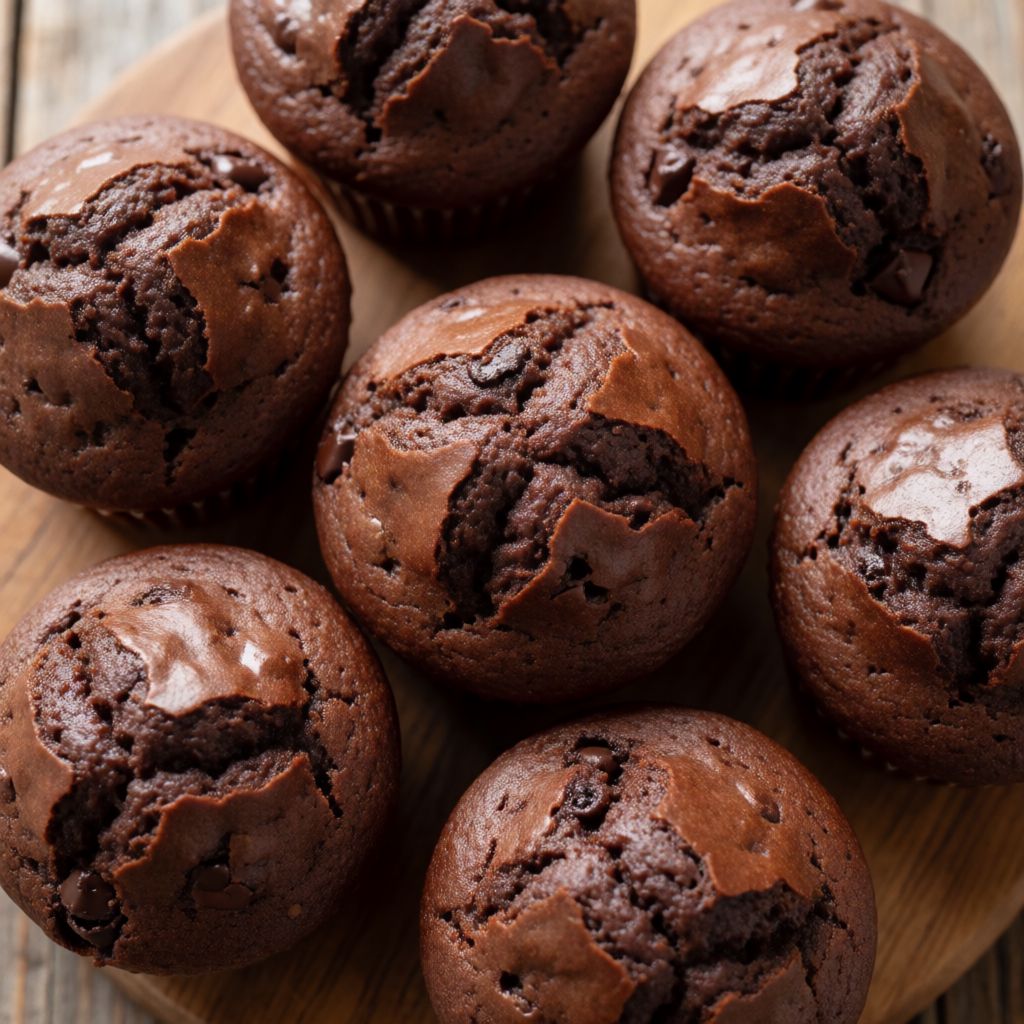
 AI photo
Chocolate Muffins
Rich chocolate muffins with a soft, fudgy centre, topped with extra dark chocolate chunks.
Labels are worked out automatically from the ingredients and can be wrong. Check the packaging if it matters to you.
Ingredients
- 1 pcs Eggs
- 1 tsp Vanilla sugar
- 170 g Caster sugar
- 125 g Butter
- 140 g Dark chocolate finely chopped
- 100 ml Milk
- 100 ml Crème fraîche
- 50 g Dark chocolate roughly chopped
- 165 g Plain flour
- 10 g Cocoa powder
- 1.5 tsp Baking powder
- 1 pinch Salt










Steps
Beat the eggs, vanilla sugar and caster sugar until pale and fluffy.
3 minMelt the butter in a saucepan over low heat, then remove the pan from the heat straight away.
Add the finely chopped dark chocolate to the pan and stir until the chocolate has melted.
2 minAdd the chocolate-butter mixture to the bowl with the eggs and sugar and whisk together.
Add the milk, crème fraîche and half of the roughly chopped dark chocolate, and stir.
2 minMix the flour, cocoa powder, baking powder and salt, sift into the batter and stir well.
2 minDivide the batter among the muffin cases and sprinkle the remaining chocolate on top.
2 minBake in a preheated fan oven at 170°C for 20 minutes, until cooked through in the centre.
20 minLeave to cool on a wire rack.
15 min
A chocolate muffin is not a small chocolate cake, whatever the tin shape suggests. A cake wants to be built slowly — fat and sugar creamed into a stable emulsion, flour folded in at the last second so the crumb stays fine. A muffin wants the opposite: it wants to be a bit rough. The whole point of this method — melt the butter with chocolate, then stir it through wet, then cut the dry mixture in fast — is to leave pockets of imperfect mixing. That's what gives you the domed top with the slightly craggy crust and the open, almost coarse crumb inside. Mix it like a cake and you'll get a muffin that's dense and rubbery, because you've developed the gluten in the flour instead of just dampening it.
So step 6 — "stir well" — is the one place where "well" has a ceiling. You want the flour wetted through, no dry streaks, and then stop. Every extra stir after that builds gluten strands, and gluten strands in a quick bread are what make it chewy instead of tender. Some say overmixing just makes muffins "a bit tougher" — no, it's the same mechanism that makes bread bread: water plus flour plus agitation equals elastic protein network. You don't want elastic in a muffin, you want crumbly.
Go through the ingredients with the method in mind and most of them explain themselves.
Two kinds of chocolate, two jobs. The 140g finely chopped goes into the batter itself, melted with the butter — this is what makes the muffin actually taste of chocolate rather than just looking like it, because it's distributed through every bite rather than sitting in pockets. The 50g roughly chopped is split: half stirred through the batter for texture (a chip you actually bite into), half scattered on top before baking, where it half-melts into a shiny, slightly bitter crust. If you only have one chocolate in the cupboard, use it for both — the difference is nice, not essential. What matters more is the percentage: something in the 60-70% cocoa solids range. Go much sweeter and the sugar in the recipe stacks on top of it and you lose the contrast that makes "chocolate muffin" taste like chocolate and not like fudge.
Butter, melted rather than creamed — this is the tell that you're making a quick bread, not a cake. No air is being whipped into fat here; the rise comes entirely from the baking powder and from steam, which is why the method can afford to be quick and a bit careless. Any butter works; unsalted is conventional only because you're adding a pinch of salt separately and want to control it yourself, not because salted butter ruins anything.
Crème fraîche plus milk together give you acidity and fat without the muffin becoming heavy — the acid in crème fraîche also gives the baking powder something to react against a touch faster, which helps the rise set before the batter has time to sink. No crème fraîche in the house? Soured cream does the same job; plain yoghurt a notch thinner but close enough. Don't reach for double cream instead — it has the fat but none of the acidity, and the muffin will taste flat.
Cocoa powder alongside melted chocolate is there to deepen colour and bitterness without adding more fat — chocolate already brings plenty of cocoa butter, and loading in more chocolate instead of cocoa powder would make the crumb greasy rather than dark. Use a cocoa that says "cocoa powder" and nothing else on the tin — not drinking chocolate, which carries its own sugar and milk powder and will throw off the whole balance of the recipe.
Vanilla sugar is doing a small, specific job: rounding off the bitterness of the dark chocolate, the way a pinch of salt does in a savoury dish. If you don't have it, a few drops of vanilla extract stirred in with the eggs does the same work — it's flavour, not structure, so there's no mechanism to break by substituting.
One real myth worth naming here: people think you must use a mixer to get a good muffin, because that's what cake recipes have trained them to expect. No — step 1 asks for pale and fluffy eggs and sugar because that traps air you'll need later, but everything after that is deliberately hand-stirred and quick. A mixer run too long on the final flour addition is the single fastest way to ruin this recipe, because it does exactly the gluten-building job you're trying to avoid. Patience here isn't about waiting — it's about resisting the urge to keep stirring once it looks mixed enough.