
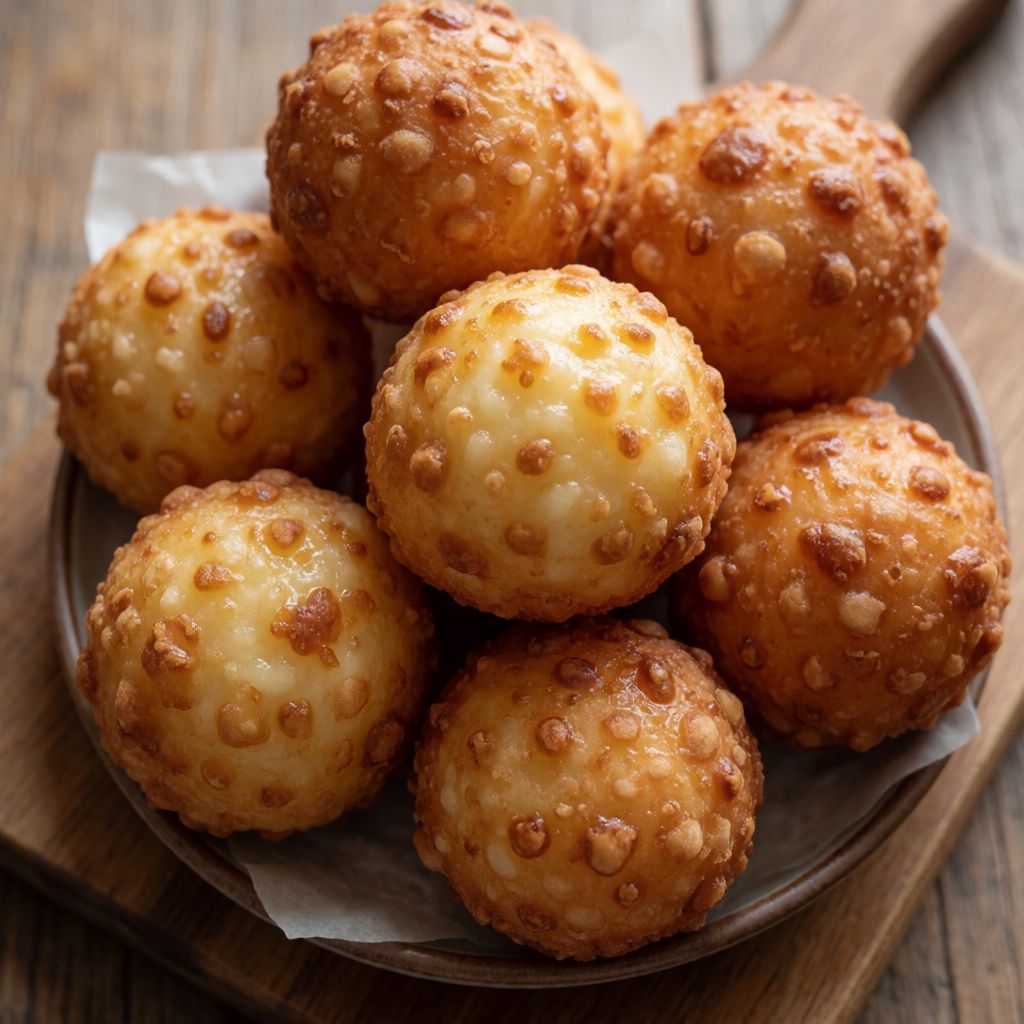
 AI photo
Savoury Fried Cheese Balls with Parmesan and Scamorza
A savoury snack of golden fried dough balls with parmesan and smoked scamorza cheese inside.
Labels are worked out automatically from the ingredients and can be wrong. Check the packaging if it matters to you.
Ingredients
- 200 g Plain flour
- 1 pcs Egg
- 40 g Butter
- 50 g Parmesan
- 3 tbsp White wine
- 2 pinch Salt
- 6 g Baking powder
- 30 g Smoked scamorza cheese
- Vegetable oil to taste, for frying
- 1 pinch Black pepper to taste




Steps
In a large bowl combine the sifted plain flour and the baking powder, add the parmesan and a pinch of salt and pepper, mix and make a well in the centre.
Into the well crack the egg, add the butter and pour in the white wine, then knead the dough by hand.
Shape the dough into a ball, cover with cling film and let it rest for at least 30 minutes.
30 minTear off small pieces of dough, place a piece of scamorza inside and shape into neat balls.
Heat the oil for frying in a saucepan.
When the oil is hot, add the balls and fry until golden on all sides.
Remove the cooked balls with a slotted spoon, place on kitchen paper, then transfer to a bowl.
Sprinkle with a pinch of salt and serve warm or cold.
This is a dough, not a batter — that's the whole trick. Flour, parmesan, egg, butter and wine get kneaded into something closer to pasta dough than fritter mix, which is why it can hold a cube of melting cheese inside without collapsing into the oil. Think of it as a savoury doughnut hole with a cheese centre: crisp, short crust outside, a pull of molten smoked scamorza when you bite in.
What decides whether it works is the resting and the sealing. Skip the 30 minutes under cling film and the gluten hasn't relaxed — you'll fight the dough every time you try to wrap it round the cheese, and it'll spring back, thin at the seams, and split open in the oil. Rest it, and it goes obedient: soft enough to mould, firm enough to hold its shape. The other decider is how well you pinch the dough shut. Any gap, any thin patch, and the scamorza finds it the moment it starts to melt — it'll leak into the oil, scorch, and leave you with an empty, slightly sad shell.
Some say you need a thermometer and a deep-fat fryer to get this right. You don't — a saucepan with oil two or three fingers deep does the job, because these balls are small enough to float and turn on their own. What you're watching for isn't a number, it's colour and sound: the oil should shimmer and a dropped crumb of dough should fizz up instantly, not sit there sulking. Gold — proper gold, not pale and not browning fast — is the cue, not a clock.
Serve them warm, cheese still soft, or at room temperature as a snack — they don't sulk once cool, which is rare for anything fried.
Flour is the structure, obviously, but what it's really doing here is giving the parmesan something to cling to. Plain flour, not strong bread flour — you don't want gluten fighting you, you want a short, biscuit-like crumb that still holds a seal. Sift it with the baking powder so the lift is even; baking powder here isn't for rise in the showy sense, it's for a faint crack and lightness in what would otherwise be a dense little dumpling.
Parmesan goes in the dough itself, grated fine, because its job is flavour and a bit of salt-and-savour backbone throughout — not the melt. That's the scamorza's job. Smoked scamorza is chosen because it melts cleanly without weeping too much water or fat, and the smoke gives you something to notice against the plain dough. If you can't get it, use a semi-firm melting cheese that doesn't turn to oily soup — a mild smoked cheddar, provolone, even a firm mozzarella will do, provided it's not so wet it floods the dough from inside. The criterion is: holds shape as it softens, doesn't drown in its own liquid.
The egg and butter bind and shorten the dough — butter especially stops it going tough and bready. Melt or soften it first, don't throw it in cold and hard, or you'll be kneading lumps instead of dough. The wine is there for acidity and a little steam-lift in the fryer, and because it loosens the dough just enough to bring it together without adding much extra liquid the way milk or water would. Any dry-ish white you'd actually drink works; if you've none open, a splash of water with a few drops of vinegar gets you the acidity without the alcohol, though you lose a whisper of flavour.
Salt and pepper are seasoning for the dough, not garnish — don't skip the pinch at the end thinking the parmesan already salted it enough; parmesan salts from inside, the finishing pinch salts the crust your tongue meets first.
For the oil: anything with no smell of its own and a high smoke tolerance — sunflower, groundnut, a light vegetable oil. Not olive oil; its flavour fights the smoked scamorza, and good extra virgin is wasted as a deep-fry medium anyway. In a British kitchen without a dedicated fryer, a wide, heavy-based saucepan — the kind you'd use for a Sunday gravy — holds heat steadily and is the honest substitute; thin-walled pans lose temperature the second you drop balls in, and that's when the dough drinks oil instead of crisping.
Last thing, and it's not optional: patience. The dough needs its rest, the oil needs to come up properly before anything goes in, and you need to let the balls turn gold rather than hauling them out brown-on-one-side because you're hungry. None of this is fussy — it's just the order the chemistry asks for.
·