
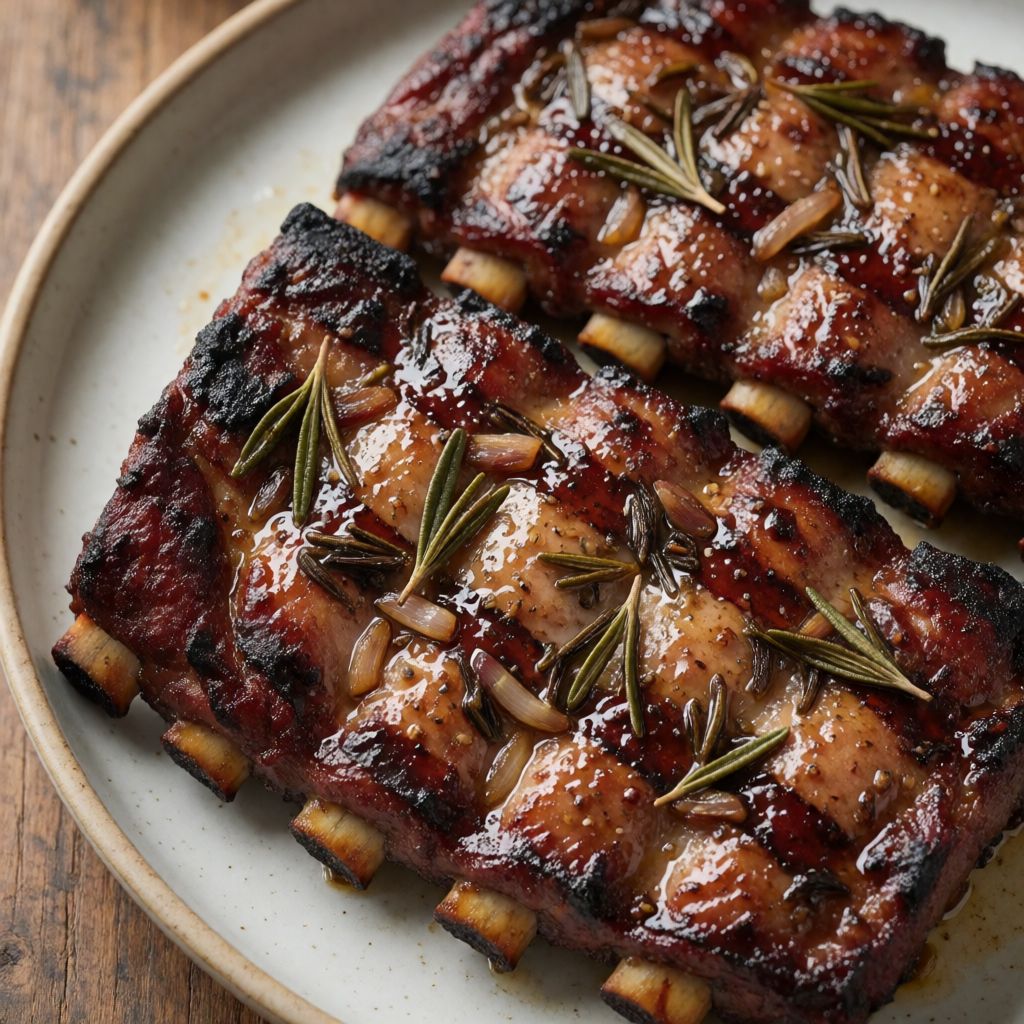
 AI photo
Grilled Pork Ribs
Pork ribs marinated in red wine and herbs, then grilled and served with a tangy homemade barbecue sauce.
Labels are worked out automatically from the ingredients and can be wrong. Check the packaging if it matters to you.
Ingredients
- 1.5 kg Pork ribs
- 800 ml Red wine
- 100 g Shallot
- 8 pcs Rosemary
- 270 g Tomato passata
- 20 g Tomato paste
- 80 g Onion
- 1 clove Garlic
- 60 ml White wine vinegar
- 50 g Brown sugar
- 50 g Mustard
- 15 g Fresh chilli pepper
- 60 ml Olive oil
- 15 g Tabasco sauce
- 15 g Worcestershire sauce
- Salt to taste
- Black pepper to taste













for the marinade
- 80 ml Olive oil
- Salt to taste
- Black pepper to taste
Steps
Pour the red wine into a bowl, add finely chopped shallot and rosemary for the marinade.
Cut the pork ribs, place them in the marinade, add the oil, salt and pepper, cover with plastic wrap.
Put in the fridge to marinate.
120 minAfter 1 hour, turn the meat over for even marinating.
Chop the onion, heat the olive oil in a saucepan.
Add the garlic and fry for a few minutes until golden.
Remove the garlic, add the chopped onion.
Cook the onion gently for a few minutes.
Pour in the white wine vinegar, letting it evaporate.
Add the tomato passata, tomato paste, mustard, chilli pepper and brown sugar.
Cook the sauce over a low heat.
Add the Tabasco and Worcestershire sauce, season with salt and pepper.
Strain the sauce through a sieve and pour it into a bowl.
Prepare the grill and heat it up.
Place the pork ribs on the grill and cook, turning occasionally. Doneness: 70°C inside.
Serve the hot ribs with the prepared sauce.
This is a two-part dish pretending to be one: ribs that spend most of their life in red wine, and a barbecue sauce built the way proper barbecue sauce is built — from a fried base, not from a bottle poured over meat at the last minute. What decides whether it works is not the grill, it's the marinade time and the sauce's own cooking time, both of which you cannot rush by turning up the heat.
The marinade is wine, shallot, rosemary and oil, and it is doing a specific job: wine's acid and alcohol loosen the connective tissue at the rib's surface and let fat-soluble rosemary oils actually get into the meat instead of sitting on it. Two hours is the lower bound here, not a target — some say marinating ribs overnight makes them better still, and that's true only up to a point, because past a day the acid starts breaking down texture rather than seasoning it, and you get something closer to mush than rib. Turning the meat halfway through is not fussiness — without it, the half sitting above the liquid never marinates at all, it just sits there dry while the submerged half does all the work.
On your hob, "grill" means a wide pan or a ridged griddle, honestly — most UK kitchens don't have an outdoor kazan or coals going on a Tuesday, and that's fine. What a pan can't give you is live-fire smoke, but it can give you the sear and the fat rendering, which is most of what's actually happening to the ribs anyway. The one thing you cannot fudge is the internal temperature: 70°C is the number because below it the collagen in rib connective tissue hasn't had enough heat-time to turn to gelatine — the meat will be cooked through but tough, chewy at the bone, no matter how good it looks outside. A meat thermometer earns its keep here; poking and guessing doesn't.
Pork ribs: buy them with a decent amount of meat between the bones, not the thin, almost-bare racks sometimes sold as "spare ribs" — those dry out before the inside ever reaches temperature. Red wine for the marinade should be something you'd actually drink a glass of, not necessarily expensive — its tannin and acid are doing real structural work, and a thin, watery wine does that work thinly too. Shallot rather than onion in the marinade because it's milder and sweeter raw, which matters when it's sitting uncooked in liquid for two hours; if you only have onion, use less of it and chop it finer so it doesn't dominate.
Olive oil appears twice and for different reasons: in the marinade it carries the rosemary's aromatic compounds, which are oil-soluble, into the meat; in the sauce it's the medium for frying garlic and onion without them catching. Any neutral oil with no smell of its own will do the sauce job — sunflower, rapeseed, whatever's in the cupboard — but for the marinade, stick with something that has flavour to give, since that's the point of it being there.
Tomato passata plus tomato paste is a thickness trick as much as a flavour one: passata gives body and moisture, paste gives concentrated tomato depth without adding more liquid you'd then have to cook off. Brown sugar against the vinegar's sharpness is the whole sweet-sour backbone of barbecue sauce — some say you can skip the sugar for a "healthier" sauce, but then the vinegar has nothing to push against and the sauce just tastes sour, not balanced; use honey if that's what you have, it does the same job with a different accent. Mustard, Tabasco and Worcestershire sauce are the sauce's seasoning trio rather than its base — they're there for heat, tang and that savoury depth Worcestershire brings from its anchovy and tamarind, and none of them need to be exact; add by taste, not by the gram, once the base is cooked.
The straining through a sieve at the end is not decoration — it's what turns a chunky cooked tomato mixture into a sauce you'd actually pour, smooth enough to coat a rib rather than sit on it in lumps. Skip it if you genuinely don't mind texture, but know you're choosing a relish, not quite the sauce this recipe means.
This feeds four, and the patience is front-loaded: two hours marinating, then a sauce that wants low heat and time to reduce properly, not a hard boil to rush it. Everything after that — the actual grilling — is comparatively quick. Treat the waiting as part of the cooking, not time lost before the real cooking starts.