
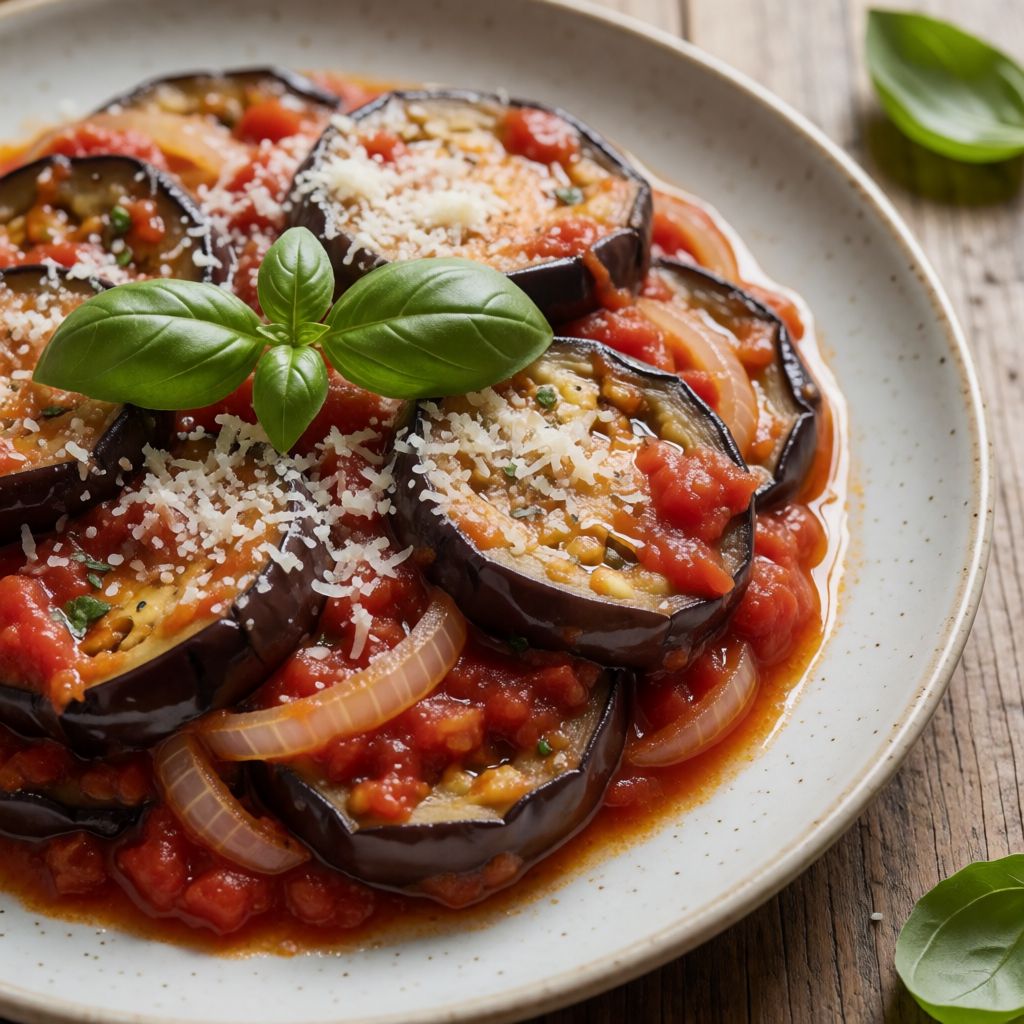
 AI photo
Palermo-Style Aubergine Parmigiana
A layered Sicilian dish of fried aubergine, tomato sauce, basil and hard cheese, left to rest before serving.
Labels are worked out automatically from the ingredients and can be wrong. Check the packaging if it matters to you.
Ingredients
- 5 pcs Aubergine
- 1 l Tomato passata
- 1 pcs Onion
- Basil a few leaves
- Parmesan grated, to taste
- Salt to taste
- Chilli powder to taste
- Vegetable oil for frying
- Olive oil







Steps
Wash the aubergines thoroughly, trim the ends and slice lengthways into thin, even slices.
Heat plenty of vegetable oil in a frying pan and fry the aubergine slices on both sides until cooked through.
Transfer to a plate lined with kitchen paper to drain off excess oil, and let cool.
Heat the olive oil in a saucepan, add the chopped onion and fry until golden.
Pour in the tomato passata and add salt and chilli powder to taste.
Simmer the sauce over a low heat for at least 30 minutes.
30 minTake a large baking dish and spread a layer of sauce on the bottom, then a layer of fried aubergine, sprinkle with Parmesan and scatter over a few basil leaves.
Repeat the layers in the same order, forming at least three layers.
Let the parmigiana rest for a few hours before serving for the best flavour.
What was changed
The hard cheese has been specified as Parmesan, widely available and fitting for this dish.
Parmigiana di melanzane is not a bake-off between you and the oven — it's three separate decisions, each already made before the dish goes anywhere near heat for a third time. You fry the aubergine. You cook a sauce. You layer them cold-ish and hot-ish together, and then — this is the part people skip — you leave it alone. What decides whether it works isn't the oven at all; it's whether the aubergine gave up its water before it met the oil, and whether you had the nerve to let the finished dish sit for a few hours before anyone touches it.
Some say this is a southern-Italian lasagne with vegetables instead of pasta. No — because the logic runs backwards. Lasagne needs the oven to cook raw layers into one object. Parmigiana's layers are all already cooked — the aubergine fried, the sauce simmered — before they ever go in the dish. The "baking" at the end, if you even do it, is just marrying flavours and melting cheese. The dish is built, not cooked, in that final stage. That's also why it's better the day after: a lasagne degrades overnight, a parmigiana improves, because it was never relying on heat to hold it together — only on time.
Start with the aubergine itself, because for five of them you're choosing at the shop, not just at the chopping board. Look for ones that feel heavy for their size and have taut, shiny skin — a light, dull aubergine has gone spongy inside, lost moisture, and will behave unpredictably in hot oil. Firmness under light finger pressure is your test, not colour. If you can't get good ones, courgette sliced the same way will take a parmigiana-shaped sauce reasonably, though it won't have that same soft, almost meaty collapse aubergine gives you — it's a stand-in, not a swap people should pretend is identical.
The onion in the sauce is doing a quiet job: it's sweetness and body, not flavour you're meant to notice as "onion." Chop it fine and fry it in olive oil until it turns from white to pale gold — past that, into brown, and it turns bitter, which then simmers for half an hour concentrating that bitterness into the whole sauce. If you've got a stick blender, you can blitz the sauce smooth after simmering and never notice whether the onion was diced neatly — most home versions do exactly this, because recovery from a mistake is easier than precision.
Tomato passata is already strained and smooth, which is the whole reason to buy it rather than tinned whole tomatoes for this — you want a sauce with no seeds or skin fighting the Parmesan and basil for texture. A litre for five aubergines and four people sounds like a lot until you remember it's reducing for thirty-plus minutes and then being spread in thin layers across a wide dish — you're not making soup, you're making a sauce that clings and doesn't run when sliced. Chilli powder here isn't about heat for its own sake — a pinch sharpens the sweetness of the tomato the way salt does, so taste before you decide you need more.
Two oils, two jobs. The vegetable oil for frying needs to be neutral and able to take real heat without smoking or arguing with the aubergine's own taste — any flavourless oil with a high smoke point does this: sunflower, groundnut, rapeseed if that's what's in the cupboard. The olive oil is for the sauce, where its own flavour is actually welcome, mixing into the tomato rather than being fried off and wasted — don't swap them. Frying aubergine in good olive oil is just an expensive way to burn olive oil's flavour away; save it for the sauce, where it survives.
On a British hob you won't have a wide, shallow kazan-style pan built for this kind of frying — use the widest frying pan you own, and fry in batches rather than crowding the pan. Crowd it and the oil temperature drops the second the slices go in; instead of frying, the aubergine stews in lukewarm oil, soaking it up without ever crisping even slightly at the edges — that's the actual mechanism behind "oily parmigiana," not a vague curse about aubergine being thirsty. Kitchen paper on a plate is your drain, and a second sheet over the top does the job of a lid if your dish doesn't have one — keeps splatter down while the next batch fries.
Three layers minimum, but it's the resting after that actually makes the dish. Hot, straight out of assembly, the layers are still distinct — sauce here, aubergine there, cheese not yet one with anything. Given a few hours, even just sitting at room temperature covered, the layers merge by capillary action — sauce soaks sideways into aubergine, cheese softens into both — and what you get sliced the next day holds its shape and tastes like one dish, not three stacked ones. This is patience as an ingredient, not an afterthought: don't serve it straight away expecting the full thing, because it genuinely isn't there yet. Feeds four generously as a side, or two if treated as a main with bread, in which case stretch to six people by widening the dish rather than the layers.