
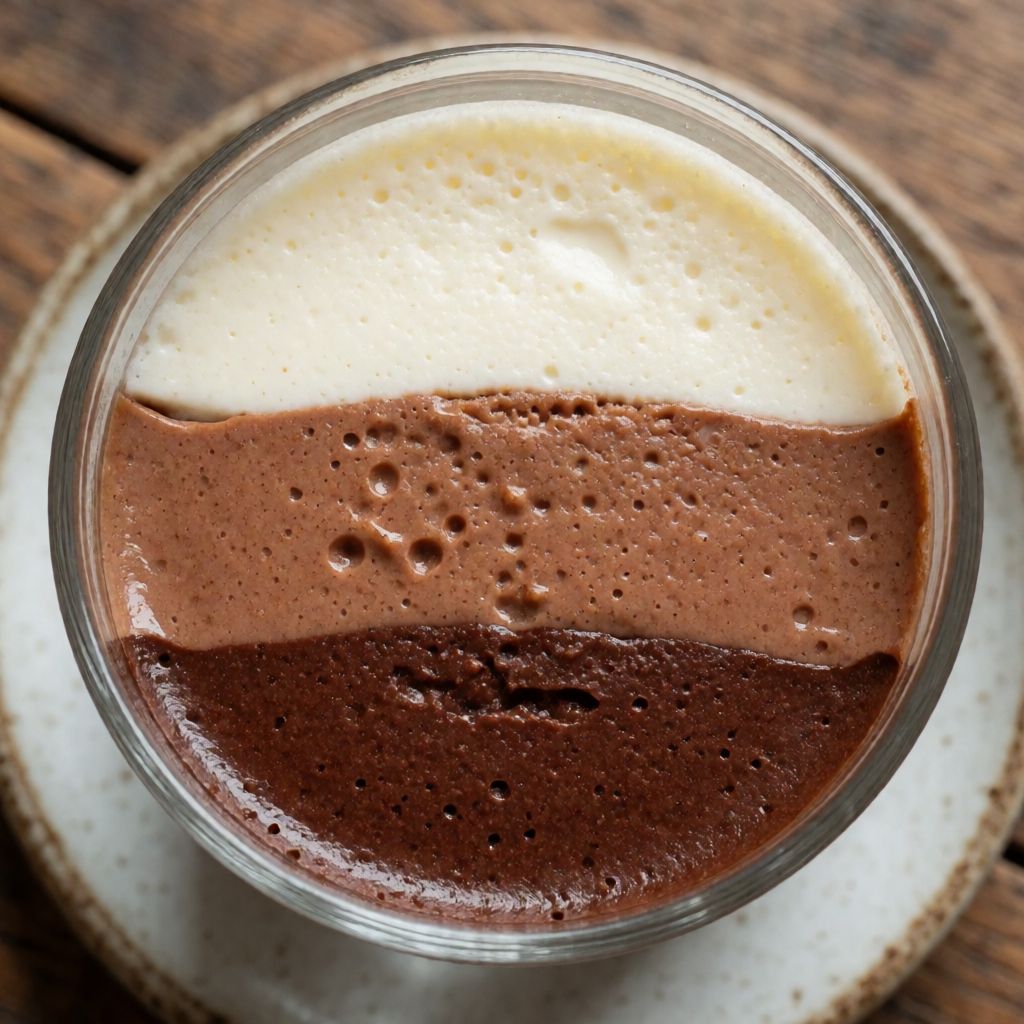
 AI photo
Three Chocolate Mousse
A rich layered mousse made with three kinds of chocolate, set in chilled layers for an elegant finish.
Labels are worked out automatically from the ingredients and can be wrong. Check the packaging if it matters to you.
Ingredients
- 100 g Dark chocolate
- 100 g Gianduja chocolate
- 100 g White chocolate
- 500 g Milk
- 230 g Caster sugar
- 15-20 g Gelatine
- 8 pcs Egg yolks
- 500 g Double cream
- 1/2 pcs Vanilla pod



Steps
Warm the milk in a saucepan.
Whisk the egg yolks with 200g of the caster sugar until smooth.
Pour the whisked mixture into the hot milk and cook, stirring constantly, until it becomes a smooth custard.
Squeeze out the gelatine (softened in cold water), add it to the custard and mix well.
Divide the three types of chocolate into separate bowls and split the hot custard between them.
Stir each mixture until smooth.
Leave to cool until the custard thickens.
Whip the double cream with 30g of caster sugar and divide into three portions.
Gently fold the cream into each chocolate custard.
Spoon the first layer of dark chocolate mousse into a dish.
Chill in the fridge for 5 minutes.
5 minSpoon in a layer of gianduja chocolate mousse.
Allow to set in the fridge.
Finish with a layer of white chocolate mousse.
Keep refrigerated until serving.
Three mousses, one base. You make a single custard — crème anglaise, really, egg yolks and sugar cooked into hot milk — and split it three ways while it's still warm, one bowl for dark chocolate, one for gianduja, one for white. Same cream, same technique, three different melting points and sugar levels, which is why you layer them in the order you do and why each layer needs its own sulk in the fridge before the next goes on top.
What decides whether this works isn't the chocolate, it's the custard. Cook the yolks and sugar into the milk too hot and you get sweet scrambled eggs with cocoa in them — the yolk proteins seize somewhere around 80°C, so you're cooking by sight and feel, not a number: it thickens, coats the back of a spoon, stops looking like milk. Some say you need a thermometer for this. No — your eyes are the thermometer; a thermometer just tells you what your eyes already told you, a beat too late.
The gelatine is doing the structural work the chocolate alone can't. White chocolate barely sets on its own; dark chocolate sets hard and can turn grainy under cream. Gelatine gives you one consistent wobble across all three, so the layers hold their edges when you spoon one on top of another instead of bleeding into each other. That's also why each layer gets its own chill before the next goes on — not tradition, just physics: a soft layer under a wet layer collapses into stripes, not a dessert.
On the chocolate itself: dark, gianduja, white are chosen for contrast, not flavour alone. Dark carries cocoa solids and almost no sugar of its own, so it needs the custard's sweetness. Gianduja — chocolate blended with hazelnut paste, an Italian wartime stretch of cocoa with cheaper nuts when cocoa was rationed and expensive — is already sweeter and softer, closer in body to the custard, which is why it sits as the middle layer and behaves itself best under pressure from both sides. White chocolate has no cocoa solids at all, just cocoa butter, sugar and milk solids, so it's the softest-setting and most fragile — it goes on top, where nothing presses down on it. If you can't get gianduja, milk chocolate with a spoonful of smooth hazelnut spread stirred in gets you close enough; the point is sweetness and softness between dark and white, not a brand name.
The milk and egg yolks together are the custard, and the custard is what turns raw chocolate into mousse rather than ganache. Whole milk, not skimmed — you need the fat to carry flavour and to keep the texture silky once it's cold. Eight yolks for 500g of milk is a rich ratio; it's what gives the set body before the gelatine even gets involved, so if you're short a yolk or two, lean a little harder on the gelatine to compensate, within reason.
Gelatine, softened in cold water first and squeezed out before going in warm, not boiling — boil it and you knock out its setting power, which is the real reason behind "add it off the heat," not some rule for its own sake. 15-20g across 1.5kg of base mixture is a light hand; this is meant to wobble on a spoon, not stand up like a jelly at a children's party. If you only have leaf gelatine sheets rather than powder, weight for weight it's roughly the same, soak until floppy, squeeze hard.
Double cream, whipped soft rather than to stiff peaks, folded in gently — this is where most home versions go wrong. Over-whip it and folding it into warm-ish custard knocks the air straight back out, and you lose the lightness that makes this a mousse rather than a cold custard with chocolate in it. Any cream with enough fat to hold air works; in the UK that's double cream by default, and whipping cream at a push, though it won't hold quite as long in the fridge.
The vanilla pod is background, not a flavour you should taste directly — split it, scrape the seeds into the milk while it warms, and it rounds off the sweetness of three different sugars without announcing itself. A teaspoon of vanilla extract covers you if you don't have a pod, though a real pod against a British Sunday-roast kitchen's usual store cupboard is worth the extra spend here — it's doing more work than you'd think in a dish with this much sugar and three types of cocoa fighting for your attention.
Caster sugar specifically, not granulated, because it dissolves into the yolks and into the whipped cream without a grainy wait — granulated will work but you'll feel the grit longer before it disappears. Split as the recipe asks, 200g into the custard and 30g into the cream, because the cream only needs a whisper of sweetness; the custard is carrying almost all of it.
·