
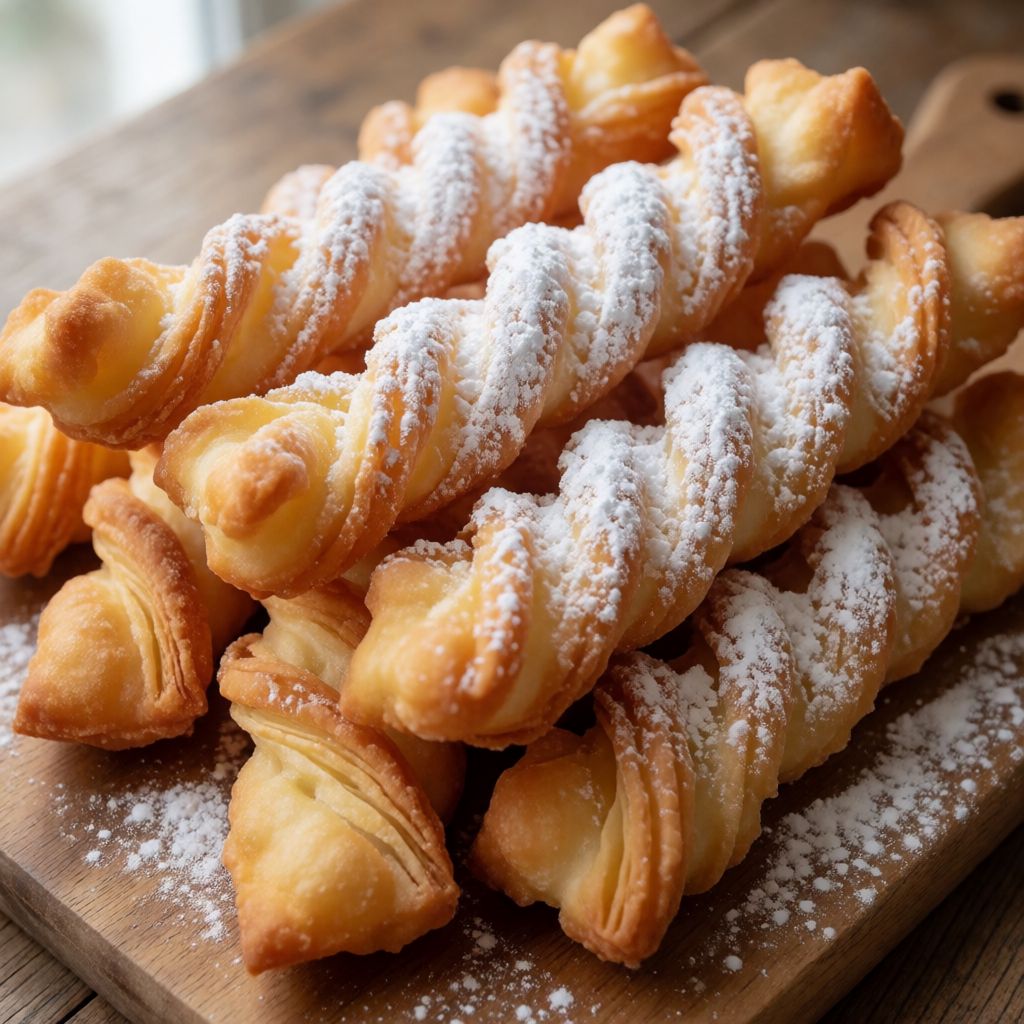
 AI photo
Crispy Ricotta Pastries
A crisp fried pastry made with ricotta, lightly sweetened and dusted with icing sugar.
Labels are worked out automatically from the ingredients and can be wrong. Check the packaging if it matters to you.
Ingredients
- 450 g Plain flour
- 400 g Ricotta
- 100 g Caster sugar
- 1 pcs Lemon or orange zest
- 1 tsp Baking powder
- Icing sugar to taste
- Vegetable oil to taste, for frying





Steps
Pour the flour into a bowl, add the baking powder, sugar and lemon or orange zest, and mix with a wooden spoon.
Add the ricotta and knead the dough by hand until it becomes elastic and smooth.
Wrap the dough in cling film and let it rest.
Place the dough on a lightly floured surface and roll it out very thinly with a rolling pin.
Cut the sheet into rectangles with a knife or a fluted ravioli cutter. Make a slit down the centre of each.
Pour enough vegetable oil into a pan and heat it to 170°C.
Fry the pastries 2-3 at a time until golden.
Lift the cooked pastries out with tongs onto a plate lined with paper towel.
Before serving, dust the pastries generously with icing sugar.
If you prefer to bake them, arrange on a baking tray lined with parchment paper and bake at 180°C for about 20 minutes.
20 min
What was changed
Peanut oil was replaced with Vegetable oil, a frying oil more commonly used in UK kitchens.
This is a dough that has no business being this crisp. Ricotta goes into a pastry with no egg, no butter, no water — just flour, sugar, a scrape of zest and baking powder — and the fat and moisture from the cheese does all the work. That's the whole trick, and it's why the dough feels strange in your hands the first time: elastic, slightly damp, nothing like shortcrust. You're not building layers like puff pastry, you're building a dough that puffs on its own, in blisters, because of what's trapped inside it.
What decides whether these work isn't the frying, it's the rolling. Thin is not a style choice here — it's the mechanism. Roll it thick and you get a biscuit that's dense in the middle and never crisps through; roll it down to where light comes through it slightly, and the oil can drive the moisture out fast enough that the whole thing shatters when you bite it. The slit down the centre isn't decoration either — it's a vent, so the steam escapes in one place instead of blistering the surface into blowouts or, worse, into a bubble that explodes and spits oil at you.
Some say ricotta pastry needs egg to hold together — no, because the protein in the ricotta itself, worked by hand, is what gives you the elasticity. Add egg and you get something closer to a biscuit dough, and you lose the particular shatter these have. The kneading is also not a formality: you're developing just enough gluten to let the sheet hold a thin roll without tearing, not so much that it turns tough and chewy once fried.
Flour is just flour here — plain, nothing stronger — because you don't want a bread-strength gluten network fighting the ricotta. 450g is a generous amount against 400g of ricotta; that ratio is what keeps the dough rollable rather than sticky. If your ricotta is on the wetter end — some tubs are closer to a loose curd than others — hold back a spoonful of flour at first and add it gradually. Ricotta itself is the one ingredient you shouldn't substitute freely: you need something curdy and relatively dry, drained, not creamed. A good UK supermarket ricotta works fine; cottage cheese pushed through a sieve is the honest stand-in if ricotta isn't in the fridge, though it'll taste a touch more savoury, so don't skimp on the zest to balance it.
The sugar — 100g caster — isn't there to make these sweet on its own; icing sugar at the end does that job. It's there to feed the browning in the oil and to round off the ricotta's slight tang. Caster dissolves into the dough evenly where granulated would leave gritty pockets, so don't swap one for the other without expecting a slightly different crumb.
Zest — lemon or orange, your call, whichever's in the bowl — is doing the job that vanilla does in other doughs: it's there so the fried oil doesn't dominate the smell of the thing. Use a fine grater and take only the coloured skin; the white pith underneath is bitter and will sour the whole batch faster than any amount of icing sugar can fix.
Baking powder at a teaspoon is modest on purpose. This isn't meant to rise like a cake — it's meant to lift in small blisters as it fries, giving you that craggy, not-quite-flat surface. Too much and the dough puffs into something bready instead of crisp.
For the oil: anything with no smell of its own and a high smoke point — sunflower, groundnut, a flavourless vegetable oil — so you taste ricotta and zest, not the fryer. Olive oil is the wrong call here; its own flavour fights the lemon. 170°C is the number that matters most in the whole recipe, and it's worth getting a thermometer for it, or the old trick of dropping in a cube of bread and watching it colour in under a minute. Go in cooler and the dough drinks oil and sits heavy in the pan instead of sealing and puffing. Go hotter and the outside colours before the inside's cooked through — you'll bite into gold crust and raw dough.
A wide, deep-ish pan does this job well enough in an ordinary flat — you don't need a deep fat fryer, just enough oil to let the pastries float rather than sit on the base of the pan, and a splash guard or loose lid nearby, because hot oil and a slit pastry will spit. Frying two or three at a time isn't fussiness — crowd the pan and the oil temperature drops the moment the dough hits it, and you're back to the "cooler oil" problem.
If you'd rather not fry at all, the oven version at 180°C for about 20 minutes gives you something closer to a biscuit — drier, less shattering, but no spitting oil and no standing over a pan. It's a fair trade if that's the kitchen you've got that day, just don't expect the same bite.
Icing sugar goes on at the very end, after they've cooled a touch, not before — put it on hot pastries straight from the oil and it melts into a wet glaze instead of sitting as a soft white dust. Six people, a plate each with two or three — have the tea with milk ready, because these want something plain and hot alongside them, not another sweet thing competing for attention.