
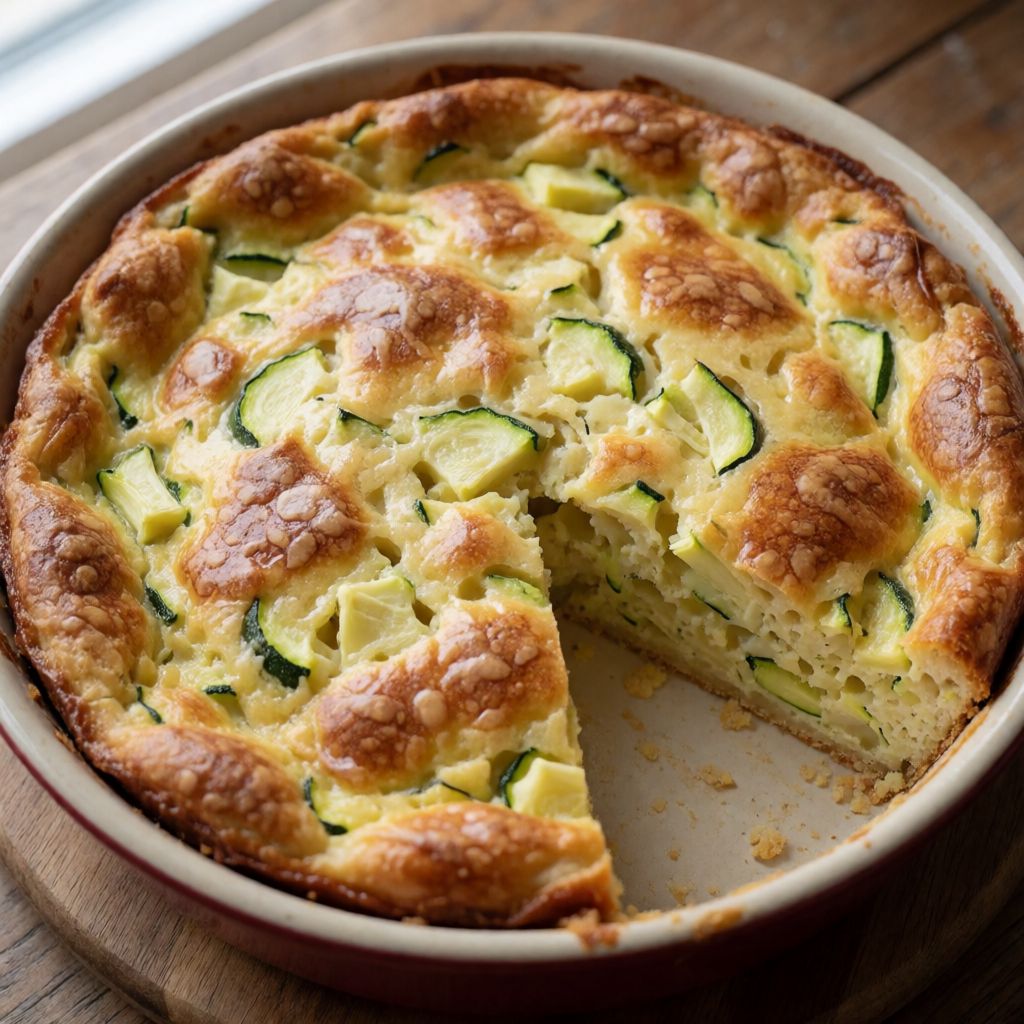
 AI photo
Stale Bread and Courgette Bake
A frugal bake that turns stale bread and courgette into a savoury pie layered with ham and cheese.
Labels are worked out automatically from the ingredients and can be wrong. Check the packaging if it matters to you.
Ingredients
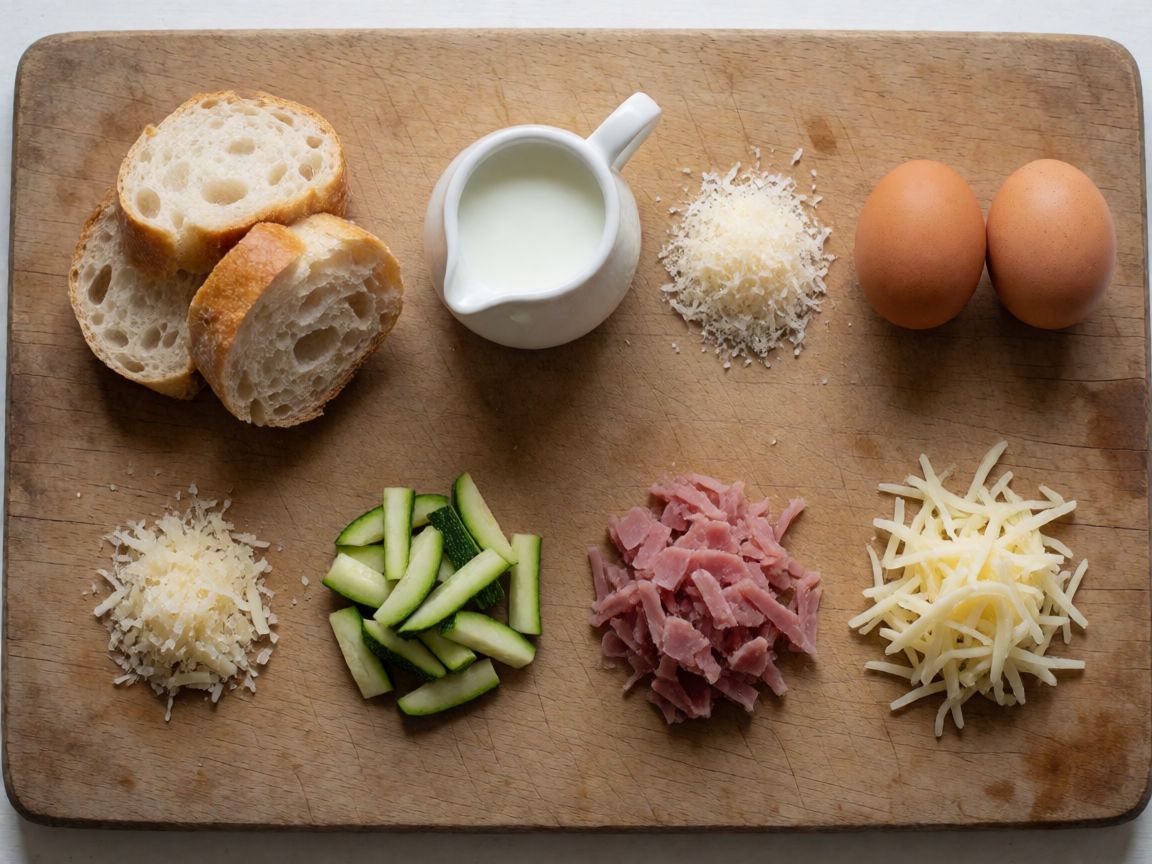
- 300 g Stale bread
- 200 ml Milk
- Salt to taste
- Black pepper to taste
- 90 g Parmesan
- 2 pcs Eggs
- 200 g Courgette
- Olive oil to taste
- 60 g Ham
- 80 g Provolone







Steps
Grate the courgette, salt it and leave in a colander for 30-60 minutes to drain off excess moisture.
45 minBreak the stale bread into pieces and soak in the milk. Knead the bread with your hands until soft.
Add salt, black pepper, Parmesan and eggs, mix until smooth, then stir in the courgette.
Line a 24 cm tin with baking paper. Spread half the mixture in an even layer, shaping a rim at the edges.
Fill with the provolone and ham.
Cover with the rest of the bread mixture, sprinkle with Parmesan and drizzle with olive oil.
Bake in a fan oven preheated to 170°C for about 30 minutes.
30 min
This is a pie built on a trick bakers have used for centuries: stale bread is not waste, it is a structure waiting for liquid. Dry bread has lost its moisture but kept its crumb's ability to drink it back in — soak it in milk and it turns into something closer to a soft dough than to breadcrumbs. Add egg and cheese and you have a case that holds its shape without flour, without a pastry crust, without any of the fuss people associate with a "proper" bake.
What decides whether it works is the courgette, and specifically what you do to it before it ever meets the bread. Courgette is mostly water held in a loose vegetable structure — salt it, and that water is pulled out by osmosis and drips away in the colander. Skip this and the water has nowhere to go but into your bake, where it turns a firm, sliceable pie into a wet, sagging one that collapses when you cut it. Some say courgette doesn't need salting if you're baking it anyway, since the oven will dry it out — no, because the oven dries the surface while the centre stays wet, and by the time the middle catches up the top has already turned to leather.
The middle layer of ham and provolone is not filling for its own sake — it is there to stay soft while everything around it firms up. Provolone melts into strings rather than fat; ham, being already cooked and salted, just needs warming through. Think of it as the middle of a toastie, except the "bread" either side is this courgette-bread mixture, and the whole thing is baked rather than fried.
Stale bread is the whole point, not a compromise. Fresh bread has too much air and too little surface damage — it won't take up milk evenly, it'll just go gummy on the outside while the centre stays dry. Bread a day or two old, properly dried out, has a crumb riddled with tiny open pockets, and milk gets drawn into those pockets the way a sponge takes up water. If your bread is fresh, don't skip the soak — instead, slice it and leave it out, or give it a few minutes in a low oven, so it actually behaves like stale bread before you start. Any crusty white or sourdough-type loaf works; soft sandwich bread falls apart into paste rather than holding a crumb structure, so it's the wrong tool here.
The milk is doing a specific job, and it's not "moisture" in a vague sense — it's rehydrating the starch in the bread so it becomes pliable enough to knead by hand, the way you'd work a dough. If you're out of milk, water will rehydrate the bread but won't give you the same softness or the faint savoury backing milk gives the whole mixture; a milk you already have in for tea with milk is exactly the right kind, nothing special required.
Parmesan and eggs are the binder, and they're doing two different things. Egg sets with heat and locks the crumb and courgette into one mass — without it, the bake would stay a loose, crumbly heap even after thirty minutes in the oven. Parmesan, once it melts and then cools slightly, adds a second kind of glue, plus the salt and savoury depth that stale bread and courgette on their own don't have. If you haven't got Parmesan, any hard, dry grating cheese with a strong character will do — pecorino, an aged cheddar — the criterion is a cheese that grates fine and tastes of something on its own, not a soft cheese that just melts into puddles.
Courgette itself: choose one that feels dense and heavy for its size, with no soft give under the skin — a soft courgette has already started losing water and flavour on its own, before you've even salted it. If courgette is out of season or looking tired, a firm cucumber salted the same way, or grated carrot, will give you the bulk and the bite, though the flavour shifts, obviously.
Ham and provolone are the middle layer, and the logic is the same as any stuffed bake: a filling that's already cooked, so the short time in the oven only needs to melt and warm it, not cook it through. Any dense, not-too-wet melting cheese stands in for provolone — mozzarella works but is wetter and can leak; a firm cooked ham, the kind you'd put in a sandwich, stands in fine for the specified ham. Skip pre-cooked bacon or anything raw here — it won't cook through in thirty minutes at this temperature, and that's a real risk, not a texture quibble.
The tin size and the paper lining matter for the same reason: a 24 cm tin gives you a layer thick enough to hold the filling without the middle drying out before the edges set, and the paper is there because this is not a batter that releases cleanly from bare metal — without it you're chiselling at a tin rather than lifting out a pie. On an ordinary domestic hob and oven, 170°C in a fan oven means real circulating heat, not the gentler, patchier heat of a non-fan setting — if your oven doesn't have a fan, add a few minutes and trust the look of it over the clock: golden on top, firm rather than wobbling when you nudge the tin.