
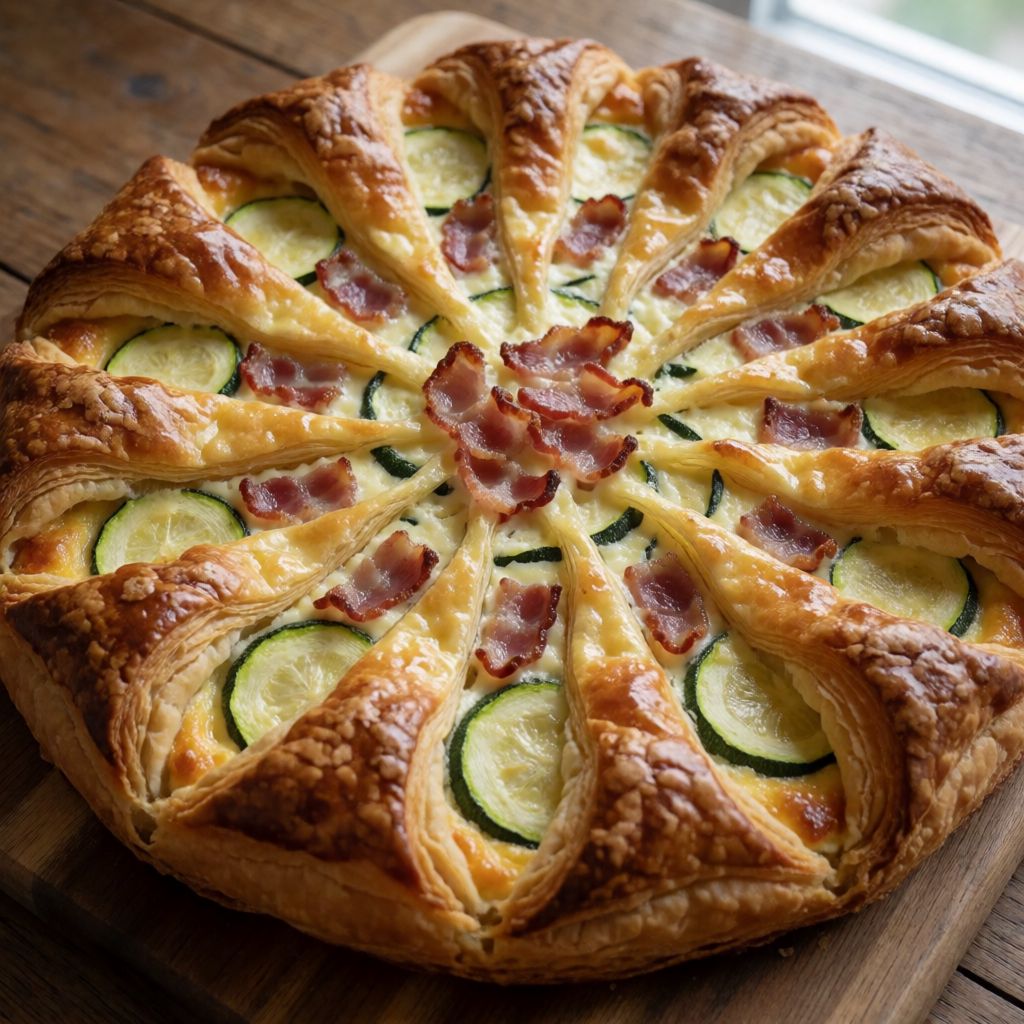
 AI photo
Sunshine Pie with Courgette and Bacon
A sunshine-shaped puff pastry pie filled with courgette, ricotta and bacon.
Labels are worked out automatically from the ingredients and can be wrong. Check the packaging if it matters to you.
Ingredients
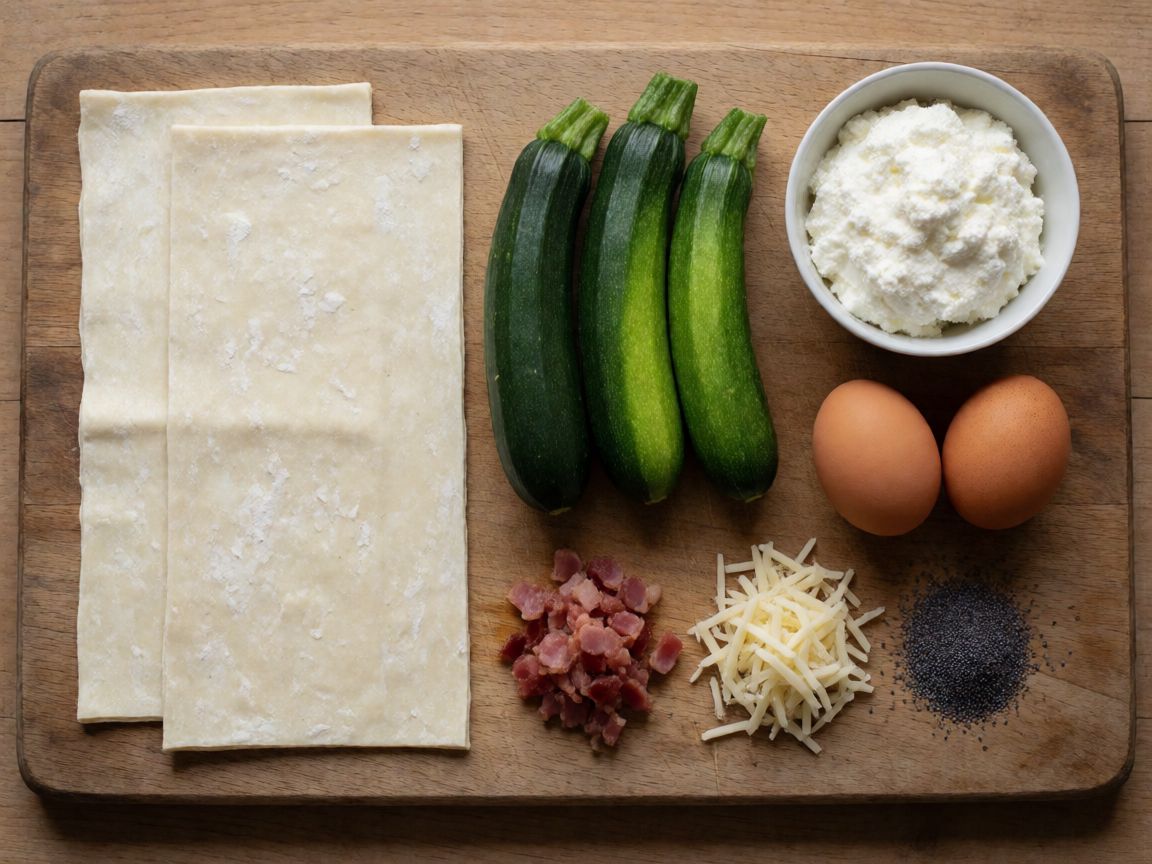
- 2 pcs Ready-rolled puff pastry sheets
- 3 pcs Courgette
- 250 g Ricotta
- 2 pcs Eggs
- 100 g Bacon
- 100 g Provolone
- Salt to taste
- Black pepper to taste
- Nutmeg to taste
- Poppy seeds for sprinkling



Steps
Wash the courgettes, trim the ends and grate them.
Add the ricotta and bacon to the courgettes and mix thoroughly.
Beat in one egg, add salt, black pepper and nutmeg to taste, and mix again.
Cut the provolone into small cubes and add to the filling.
Lay one sheet of ready-rolled puff pastry on a baking tray and use a bowl about 12 cm across to mark a circle in the centre.
Spread the courgette and ricotta filling in the centre and around it, leaving 1–2 cm from the centre and 1–2 cm from the outer edge.
Cover with the second sheet of pastry and press down firmly to outline the filled centre and seal the outer edge.
With a knife, cut 16 wedges without separating them from the centre 'sun': first cut the pastry into 4 parts, then each into 4 more.
Twist each wedge 45° upward so the filling shows.
Beat the second egg and brush it over the whole surface of the pastry, then sprinkle poppy seeds in the centre.
Bake in a preheated fan oven at 180°C for about 20–25 minutes, until golden brown.
23 min
This pie works on a trick that's older than puff pastry itself — the braided or twisted-petal shape you see on every "sun" or "wreath" pastry from here to the Balkans. It's not decoration. It's engineering: cutting the pastry into wedges and twisting them up turns a flat disc into something with surface area, so the heat gets at more pastry, and the filling gets a window to breathe steam out of instead of trapping it and going soggy underneath. A sealed pie with this much wet filling — grated courgette, ricotta, egg — would sweat itself into a puddle. This one can't, because you've built the escape route in before it goes in the oven.
What decides whether it works is water, mostly. Courgette is close to 95% water, and if you grate it straight into the ricotta you'll get a filling that pours rather than spreads, and a centre that never sets. Some say you must salt the grated courgette and squeeze it dry before using it — and for once that instinct isn't wrong, it's just not written into this recipe, so you compensate by trusting the open twist to let steam go instead of condensing back into the filling. If your courgettes are the watery supermarket kind (ends cut, skin shiny, obviously picked a week ago), give them ten minutes in a sieve with a pinch of salt before you mix — nobody will dock you marks for it, and the base will actually be a base and not a swamp.
Puff pastry here is doing a job, not just holding things together, so buy the best ready-rolled sheets you can — the ones listing butter, not "vegetable fat," because fat with a high melting point is what gives you those separate, shatter-crisp layers instead of a dense biscuit. If all you've got is one large sheet, cut it into two matching rectangles yourself rather than hunting shops for the two-sheet pack — the pie doesn't care how the pastry arrived, only that top and bottom match.
Courgette is the bulk and the problem, both. Choose small to medium ones — the giant marrows some allotments produce by August are mostly seed and water once you hollow them for grating, and you'll end up fighting the same sogginess twice. Any firm summer squash does the same job if courgette isn't to hand; the test is the same — flesh that holds its shape when you press a thumbnail in, not one that gives like a sponge.
Ricotta is there for two reasons: it carries less water than cottage cheese, so it won't fight the courgette, and it has almost no salt of its own, so you're in control of seasoning rather than guessing someone else's brine. If you can't get ricotta, drained cottage cheese works, but drain it properly through a sieve for a good half hour first, or you're back to the water problem. Full-fat is not optional here — low-fat ricotta is mostly water with ambition, and it won't set in a 20-minute bake.
Bacon and provolone are the savoury backbone, and neither is precious about its form. Bacon lardons, cut thick and fried until the fat's rendered but before they crisp hard, give you both meat and a little extra fat that the lean ricotta filling is missing — that's not an accident, puff pastry fillings always want some fat in reserve because the pastry itself is giving off very little moisture to the filling, it's not basting anything. Provolone melts long and stringy rather than oily, which is what you want in small cubes scattered through rather than grated — grated cheese disappears into the mix, cubed cheese gives you pockets of pull when you cut in. A mild cheddar or a young gouda will do the same structural job if provolone's not stocked locally; you're after meltability and a mild flavour that doesn't fight the nutmeg, not a specific name.
Nutmeg is not a flourish — it's there because courgette and ricotta together are quite flat on their own, all water and mild fat, and nutmeg is the one spice that reads as "savoury custard" rather than "sweet" even in tiny amounts, which is why it turns up in every ricotta-and-greens filling from spanakopita to lasagne. Grate it fresh if you can; the tins of ready-ground nutmeg lose their punch within months of opening and you'll end up adding three times as much to taste the same thing.
The egg wash and poppy seeds are cosmetic but not pointless — egg wash is what gives puff pastry that lacquered, Sunday-best shine, because the proteins set and catch light under heat in a way raw pastry never will. Poppy seeds in the centre mark where the filling is, a visual cue more than a flavour one, so don't skip it thinking it's decoration for its own sake — it's telling your guests which part is which before anyone's cut in. If you've none in the cupboard, sesame does the same signalling job and toasts to the same dark fleck.
Patience shows up twice here and both times it's invisible in the ingredient list. Once, in letting any squeezed courgette actually sit and drain rather than rushing it into the bowl. And once, in trusting the twist-and-bake to do its slow work rather than opening the oven door to check — every time you open a fan oven, you drop the temperature ten degrees and let the pastry layers relax before they've fully set, which is exactly how you get a flat, dense ring instead of the flaky sunburst you're aiming for.