
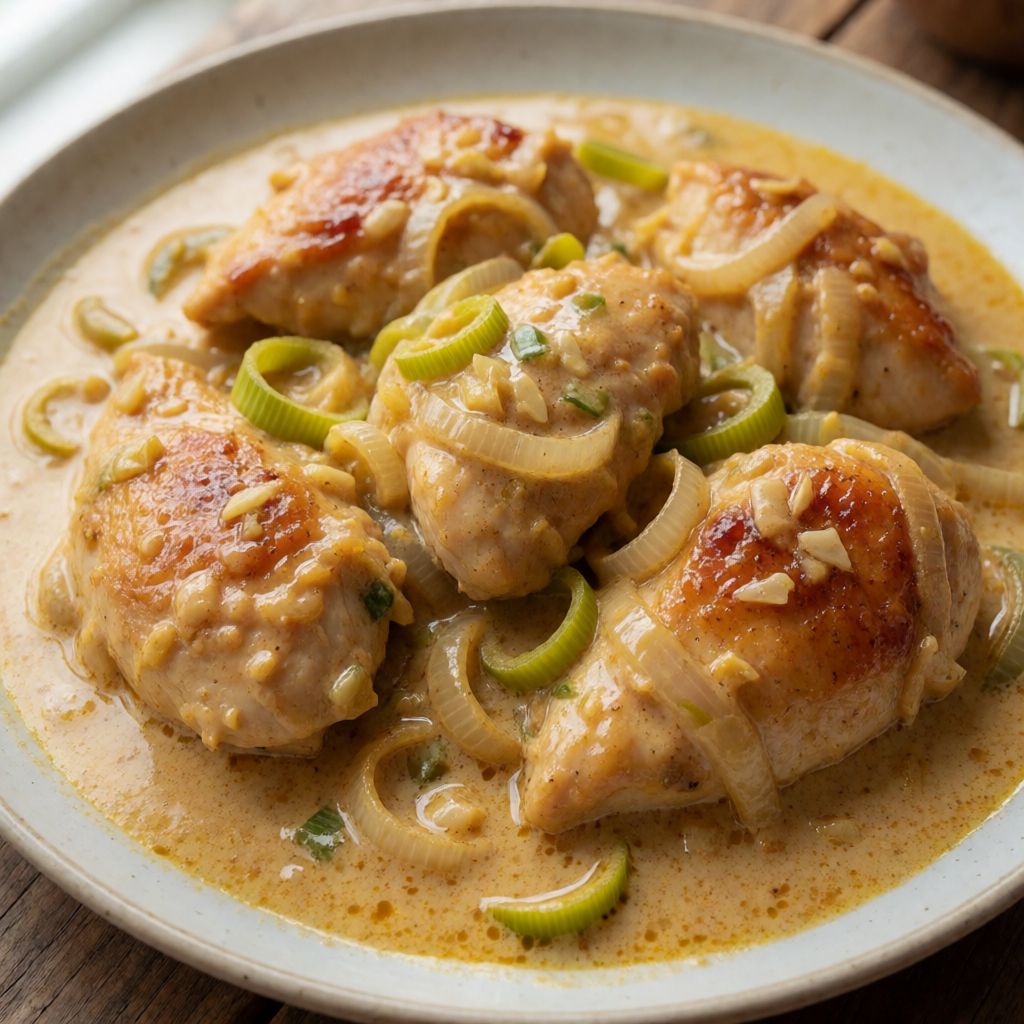
 AI photo
Baked Chicken with Coconut Milk and Curry
A quick baked chicken dish in a creamy coconut curry sauce with vegetables and pineapple, served with basmati rice.
Labels are worked out automatically from the ingredients and can be wrong. Check the packaging if it matters to you.
Ingredients
- 400 g Chicken breast
- 25 g Plain flour
- 3 clove Garlic crushed
- 1 pcs Onion finely chopped
- 2 pcs Leek sliced into rings
- 2 tbsp Curry powder
- 1 tsp Ground coriander
- 1 tsp Cumin
- 400 ml Coconut milk
- 100 ml Double cream
- 100 ml Stock
- 100 g Spinach
- 1 pcs Broccoli cut into florets
- 400 g Pineapple fruit and syrup, canned
- 1 tsp Olive oil
- 1 tsp Butter
- Salt
- Black pepper freshly ground
- 300 ml Basmati rice
- 50 g Peanuts salted
- 1 bunch Parsley finely chopped





















Steps
Cut the chicken breast into strips and coat in flour, salt and pepper.
Quickly fry the chicken in a hot pan with oil.
4 minRemove the chicken from the pan and in the same pan fry the onion, garlic and leek (adding a little more oil if needed) until soft.
5 minAdd the curry powder, coriander and cumin, and mix well.
1 minAdd the coconut milk, cream, stock and spinach. Bring to the boil.
5 minSeason with pineapple juice, salt and pepper to taste.
Transfer to a greased ovenproof dish together with the chicken, broccoli and pineapple.
Bake in a preheated fan oven at 190°C for about 20-25 minutes.
22 minMeanwhile, cook the basmati rice according to the packet instructions.
17 minServe with the rice, peanuts and a sprinkling of parsley.
What was changed
The whipping cream was replaced with Double cream, the usual choice in a British kitchen.
This is a curry only in the loosest sense — no one in Chennai or Lahore is simmering chicken in coconut cream and tinned pineapple and calling it done. It's a British invention wearing a curry's spices, which isn't an insult. It's a whole genre: the Sunday roast swapped for something with more smell and less washing-up, built around a jar of curry powder because that's what's in the cupboard, not because anyone is chasing a specific regional dish. Know that going in and you stop fighting the recipe for not being "authentic" — it was never trying to be.
What decides whether it works is two separate cooking events pretending to be one dish: a quick sear that has to stay quick, and a sauce that has to reduce before it ever sees the oven. The chicken gets dredged in flour and pushed into a hot pan for a few minutes — that's not to cook it through, it's to seal the surface so the meat doesn't dump its juices straight into the sauce and turn into boiled chicken wearing a curry disguise. Flour plus hot fat equals a crust; crust equals the meat staying meat.
Then the same pan — don't wash it, that's fond, that's flavour stuck to metal, free seasoning — takes the onion, garlic and leek. These go in gently, no sear here, because the job is softening and sweetening, not browning. Burnt garlic is bitter garlic, permanently, no amount of coconut milk fixes it later.
The oven stage is where people get it wrong by assuming "bake" means "simmer under a lid." It isn't covered. A fan oven at 190°C — hot enough that the surface of the sauce actively reduces, not just warms through — is thickening the coconut-cream-stock mixture by evaporation while the broccoli steams in its own moisture and the chicken finishes gently, no longer searing, just arriving at done. If your dish is covered with foil, you get a thin, wet sauce and crunchy broccoli with no colour; if it's open and your oven runs cool, you get a watery sauce and overdone chicken, because the two things aren't converging at the same rate. Doneness here isn't a clock number — it's the sauce visibly tightening around the broccoli and the broccoli going from squeaky-raw to tender-with-a-bit-of-bite. The 20–25 minutes is a lower bound; a domestic oven that doesn't hold its stated temperature evenly (most don't, especially near the door) will drift either side of it.
The rice cooking "meanwhile" is not a throwaway line — it's the one bit of real time management in the whole thing. Basmati wants a rinse before it goes in the water, not for ritual but because the starch coating it is what makes rice gluey; rinse it off and the grains stay separate. Some say you must soak it for thirty minutes first — you don't, not for a weeknight dish like this, a good rinse and attentive timing does the same job with less planning.
On the chicken: breast, not thigh, which is the actual compromise of this dish — breast dries out faster than thigh, so the sear-then-bake method exists specifically to protect a cut that punishes overcooking. If you've got thigh fillets lying around, use them instead and worry less about timing; they forgive you.
Coconut milk — buy it in the tin, not the drinks-aisle "coconut milk" meant for smoothies, which is thinned to nothing. You want the kind that separates into a thick cap and thin liquid when it sits; shake the tin or stir once it's open. If you only have coconut cream, loosen it with a splash of the stock. Double cream on top of that isn't tradition, it's just British kitchens reaching for the dairy they always have, to round out acidity from the pineapple and give the sauce a cling that stock and coconut milk alone don't give you.
Curry powder is the one ingredient where "any curry powder" is honestly fine — this isn't a dish built around a single spice blend's identity, it's built around the idea of curry powder, warm and a bit sweet and a bit hot depending what's in your jar. Coriander and cumin on top of that aren't correcting a bad curry powder, they're pushing the warm, earthy register further because tinned blends go stale in cupboards and lose their top notes first.
The pineapple, syrup included, is doing acid-and-sugar work that in a more traditional curry would come from tamarind or tomato — it's the sharp counter to all that cream and coconut fat. Any oil with no smell of its own works for the initial fry: sunflower, vegetable, a neutral rapeseed — not your good olive oil, which has a flavour worth protecting for something that'll actually taste it. The peanuts and parsley at the end aren't garnish for the photo — salted peanuts give you the crunch that a soft, creamy dish is otherwise missing entirely, and parsley is doing nothing more mystical than cutting through the richness with something green and a bit bitter. Patience is the real ingredient missing from most home versions — rushing the onion and leek stage, skipping the spice-toasting minute, covering the dish in the oven out of habit from other recipes — each shortcut shows up later as a flat, wet, under-seasoned sauce, and none of it is fixable once it's in front of you.